
Choosing a partner for eCommerce project development is a much more complex challenge than simply finding the cheapest one with the right expertise. It's also about finding the team that will ensure long-term scalability, compliance with industry standards, rapid market entry, regular updates, maximum profitability, and much more. So how can you find the perfect partner? Let's find out!
What to Look for in an Ecommerce Development Company
Finding a technology partner first and foremost requires a deep dive into their competencies. They should have an understanding of the eСommerce market in your industry and region. Here's how to identify them:
- Relevant ecommerce experience. Your future contractor should understand the specifics of online sales in your niche, including conversion funnels, checkout logic, catalog management principles, the specifics of online marketplaces, etc.
- Experience with projects of a similar scale. Make sure the team has already implemented projects of your scale (experience building small online clothing stores does not guarantee the contractor's ability to launch a high-load marketplace with tens of thousands of SKUs).
- Technical expertise. It's important to assess the partner's thorough knowledge of modern programming languages and patterns (such as microservices or headless approaches). Experience with м providers and tech stacks that match your project's needs must also be present.
- Domain knowledge. Your partner should also understand the specifics of your niche (for example, B2B sales or food products). This way, you won't have to spend a lot of time explaining your business processes, and the contractor will be able to immediately propose the right architectural solutions without numerous rounds of revisions.
- Custom development experience. This requirement implies the contractor's ability to create unique business logic for the non-standard requirements of your business.
- Experience with integration with complex and legacy software. Your partner should have experience seamlessly integrating online stores with complex corporate systems and payment gateways through custom connectors or middleware without sacrificing performance.
- Expertise in scaling and performance. The ideal partner knows how to ensure your website doesn't crash during seasonal sales or an increase in advertising traffic.
- Clear post-launch support. Your partner should have clear service level agreements, guarantee regular security updates and uptime monitoring, and specify deadlines for bug fixes after release.
- Transparent project management. It's important that your partner follows well-known methodologies like Agile or Scrum and provides you with a dedicated Project Manager with whom you can plan sprints and conduct progress reviews.
- Security and performance expertise. Your vendor must ensure compliance with generally accepted data protection standards and be able to optimize page load speed to prepare your project for high search rankings.
Evaluate the Company’s Ecommerce Experience
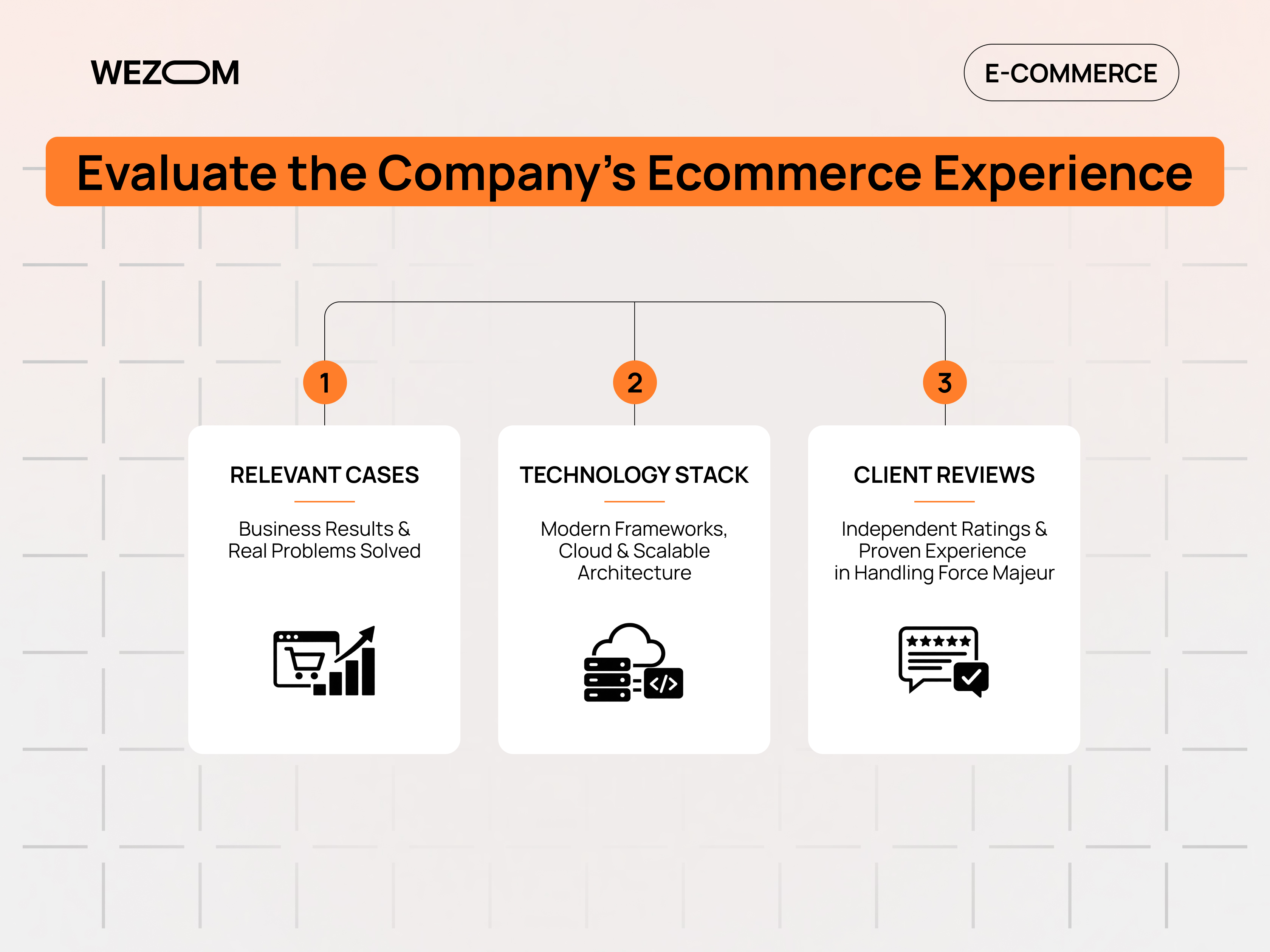
Don't limit yourself to a cursory assessment of the portfolio – a reliable eCommerce development agency review is usually built on three pillars:
- Analysis of relevant case studies, taking into account business results (i.e., what problems the client faced, what architecture the developers chose to solve them, and how much conversion/loading speed improved after the release);
- Technology stack review, that is, the team should be masters in utilizing modern frameworks and have experience working with cloud vendors (instead of building monolithic-only solutions);
- Evaluation of real client reviews (this can be done by checking reviews on independent platforms like Clutch) and how the contractor handled force majeure in past projects.
Custom Ecommerce Development vs. Platform-Based Development
The first challenge businesses face is choosing between a ready-made engine like Shopify or WooCommerce and custom development, so it's important to understand when it makes sense to choose the former and when the latter. Specifically, if you have a standard product catalog and typical purchasing scenarios (i.e., no unique features), it’s better to choose a ready-made engine. As for collaborating with a custom eCommerce development company, this solution is optimal if your project requires complex business logic, sophisticated product configurators, deep customization of the dashboard, or, for example, integration with legacy corporate systems. Let's analyze these two approaches in more detail in the table below:
| Criteria | Ready-made SaaS or CMS | Custom ecommerce development |
|---|---|---|
| Speed of launch | High, up to several weeks | Low, up to several months |
| Scalability | Is limited by the vendor’s restrictions | Unlimited |
| Initial costs | Low (for the subscription and mockups) | Higher (for UX, architecture design, backend and frontend code) |
| Code ownership | You’re tied to the vendor’s limitations | You obtain full control over the code and data |
| Integration capabilities | Complex integration often require custom APIs and middleware | Native API integration with any corporate system |
| Security | Is the vendor’s responsibility | Requires a dedicated team from your contractor |
Questions to Ask an Ecommerce Development Agency Before Hiring
To avoid playing Russian roulette with your money, use this list of questions.
Technical questions (or "Show me your code, and I'll tell you who you are")
At this stage, it's a good idea to ask the following:
- "What architecture would you recommend and why?" (If you're offered a monolith on an outdated engine for a project with a million-strong catalog, eliminate that eCommerce development firm immediately – a good contractor will first ask about your workload and then talk about microservices or headless approaches.)
- "What technologies will you use?" (If you're offered to build an online spare parts store using a landing page builder because it's easier for the designer, don't rush to sign the contract – you're likely dealing with a "lazy team" that's unwilling to learn new things.)
- "How will the system scale?" (This will help you understand what will happen to your online store if, for example, a marketer sends out a mailing to 500,000 people, and they all decide to buy the same product – will the server crash or can it handle the influx?)
- "How will integrations be implemented?" (Ask how exactly the new website will communicate with your WMS, PIM, ERP, and CRM. If the answer is "our programmers will conjure something up using CSV files," expect trouble – you need APIs and webhooks, not tedious life hacks with flash drives.)
- "How will performance be monitored?" (Will you only find out about the website's downtime when an angry client texts you in a messenger, or will the system automatically send an alarm to engineers several minutes before the crash?)
Process questions (or "Who are all these people and what are they doing")
Here, you can figure out whether development will turn into a 24/7 grind:
- "Who will be on the project team?" (You should know their names and roles – otherwise, it will be a team of three freelance students juggling your project with their studies in a different time zone.)
- "How will the requirements be documented?" (Will there be a technical specification to measure the result against, or will all communication be voice-based?)
- "How often will we receive updates?" (Ideally, the contractor has regular demos to avoid being shown a green page with an Error 404 the day before the release.)
- "How is scope creep handled?" (What happens if you decide to add a new product category mid-project – will you be asked to move the feature to the second release stage?)
- "What does the testing process look like?" (If a developer is the same person who performs QA, your site will crash every time a user accidentally clicks the "Buy" button.)
Business questions (or "Where's my money?")
The business portion of your interview should include questions like:
- "Have you worked with similar clients?" (If the e-commerce development company only previously built one-page websites for beauty salons, your complex online store with an omnichannel sales funnel will be a testing ground for them, paid for by you.)
- "Can you provide relevant case studies?" (Ask to see projects with real numbers: how conversion rates increased, how much the website sped up, etc.)
- "What KPIs can the project improve?" (Professionals speak in the language of metrics, not abstract "brand image improvements.")
- "What risks do you see in our project?" (If the contractor agrees with everything you've said, you're dealing with amateurs – a complex project always has pitfalls with integrations, regulatory requirements, or database migrations.)
Post-launch questions (or "What to do when everyone completes their work")
To ensure your contractor’s reliability, be sure to use the final section of questions – they will help you understand what will happen after your website’s deployment:
- "What support is included?" (What is included in support for the first month after release – is it estimated within the overall budget, or is each edit assessed separately?)
- "How are bugs handled after launch?" (If a website payment fails during a sale, how many hours will it take for a specialist to start working?)
- "Will your team be able to continue developing the platform?" (Sometimes, after a website is built and then parted ways, a new contractor can't look at this "original code" without tears and demands a rewrite.)
- "What happens if we need additional functionality?" (How easy is it to develop the system with new features in the future?)
Red Flags When Choosing an Ecommerce Development Firm
If you notice even one of these signs during the negotiation stage, you know you're dealing with a disastrous agency:
- Unrealistically low budget estimates (for example, if they promise to build an Amazon-level marketplace in two weeks for three hundred dollars);
- Guaranteed results without fully understanding the requirements (something akin to statements like "We guarantee a 300% sales increase," which you hear without even showing your catalog or describing your target audience);
- Lack of relevant eCommerce case studies (every niche is different);
- Vague technical proposal (when the specifications look like a high school essay);
- Lack of a dedicated team (meaning that when a multitasker gets sick, your online store will be halfway through implementation for an unknown amount of time);
- Poor communication (for example, if a manager responds to messages once every three days);
- Lack of testing and security processes (meaning lawsuits for personal data leaks are inevitable);
- The entire team's dependence on a single developer (if they disappear, your project will stall);
- Refusal to explain the project architecture (meaning they don't understand what they're doing);
- Lack of clarity about who owns the source code (as a result, after the work is completed, the repository will remain on their server, and they may require you to pay a separate fee for the right to retrieve your files);
- Dependence on dubious modules (especially when there are hundreds of them and almost all of them are of unknown origin).
How to Choose the Right Ecommerce Development Company
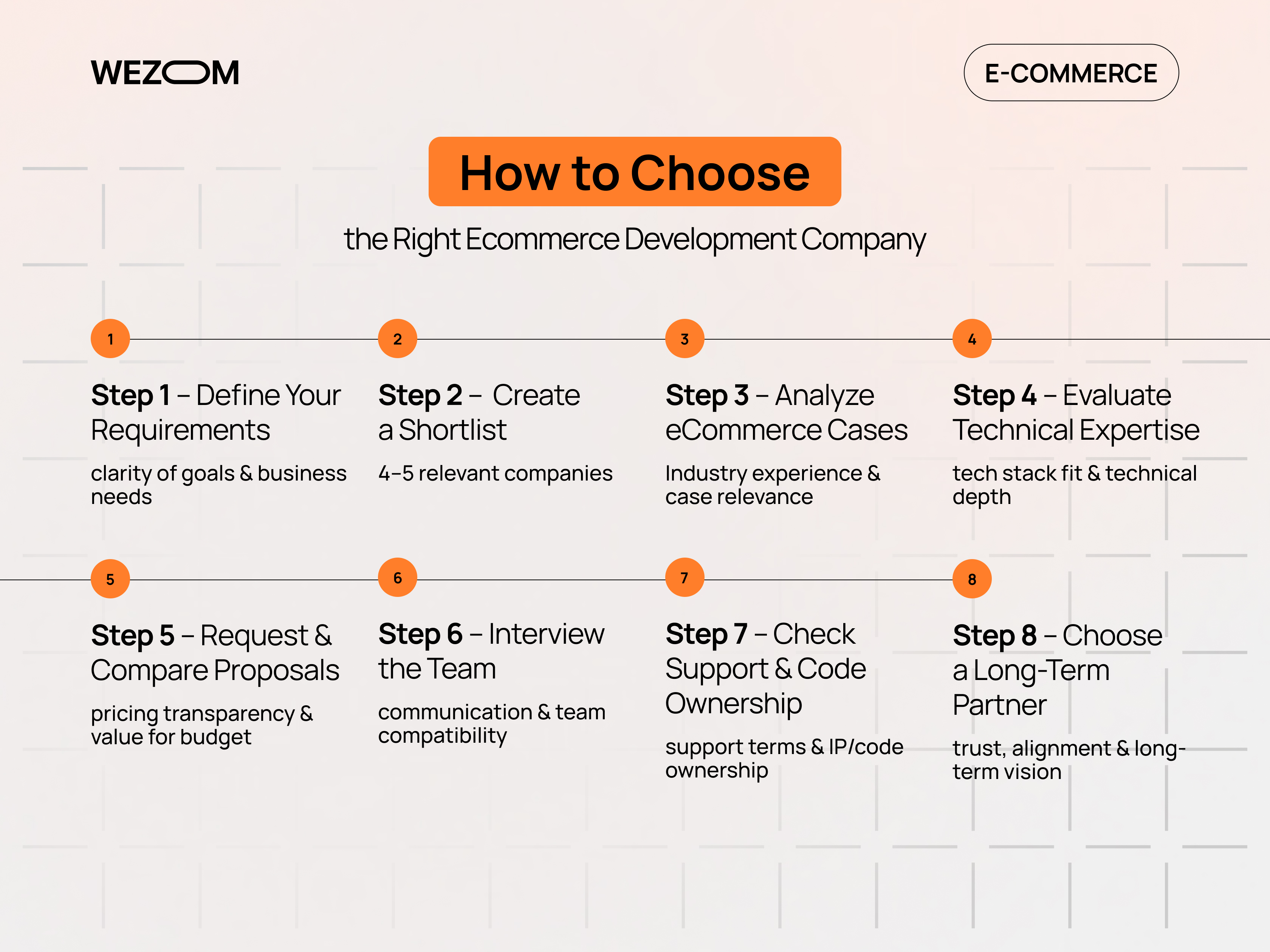
Choosing a reliable custom e Commerce development company is a decision that will determine the fate of your online business for years to come. Here's a rough algorithm that will protect you from unreliable cooperation:
- Communicate business and technical requirements from the outset (i.e., before sending a brief, you should describe the main functionality, expected workloads and integrations, as well as the budget);
- Create a shortlist of 4-5 companies with the most relevant experience for your domain;
- Analyze their ecommerce case studies and the deliverables they've brought to businesses;
- Evaluate their technical expertise (tech stacks, experience with cloud infrastructure and architectural patterns, etc.);
- Request detailed commercial proposals, evaluating estimates by timeline and roadmap stages;
- Compare the scope and pricing (the problem is that too low a price often doesn't take into account the full scope of work, leading to unexpected additional expenses);
- Interview the team to assess the level of communication, particularly those who will be writing code and managing the project (this is also a great opportunity to find out how quickly the agency responds and whether they use workflow tracking tools);
- Clarify all aspects of support and code ownership (it's important to clarify warranty obligations, rules for transferring rights to the code repository, and post-launch maintenance in the contract);
- Choose a partner for long-term value, meaning one who offers and understands how to bring your business to stable growth.
Conclusion
The success of an online store certainly depends largely on the chosen tech stack, but those who will use it are no less important. Specifically, your e-commerce development agency must be able to think in terms of your business metrics and anticipate bottlenecks during the design phase, taking into account the cost of ownership over several years. Only this way, you will obtain an online store that won't require a huge investment in redesigning it from scratch.

FAQ
Чи варто створювати власний маркетплейс замість продажу через Prom або Rozetka?
Це залежить від зрілості бізнесу та ніші. Якщо потрібен швидкий старт продажів в мережі із мінімальними ризиками — готова платформа буде оптимальним рішенням. Якщо ж ніша вже сформована, а бізнес готовий інвестувати в довгостроковий розвиток, рішення створити маркетплейс під окрему нішу стає стратегічно виправданим кроком.
У яких нішах власний маркетплейс має найбільший потенціал?
Найбільший потенціал мають спеціалізовані ринки з широкою номенклатурою та складним вибором: автозапчастини, будматеріали, медичне та промислове обладнання, агротовари — будь-які напрямки, де покупцям потрібен експертний підхід, а не просте порівняння цін.
Скільки часу займає розробка маркетплейсу?
MVP з базовим функціоналом можна реалізувати за кілька місяців. Повноцінна платформа з розширеними можливостями, інтеграціями та масштабованою архітектурою потребує довшого циклу розробки — зазвичай від пів року і більше, залежно від складності проєкту.
Чим нішевий маркетплейс кращий за великий універсальний майданчик?
Нішевий майданчик пропонує кращий користувацький досвід для конкретної галузі: спеціалізовані технічні фільтри, пошук за артикулами чи кресленнями, перевірених постачальників та інструменти для B2B-закупівель (виставлення рахунків, закупівля за кошторисом).
Чи можна запустити маркетплейс без великої кількості продавців?
Так, якщо почати з MVP та фокусу на одній категорії товарів. Аби уникнути “проблеми курки та яйця”, варто братись за формування пулу зацікавлених продавців завчасно — вже на ранніх етапах розробки. Це дозволяє сформувати якісну вітрину й відпрацювати операційні процеси перед виходом на ринок.
