
A pallet of vaccines that sat at 12 °C for two hours on a loading dock, a reefer trailer that lost power overnight, a forklift that failed in the middle of a peak shift: most logistics losses start as events nobody saw in time. IoT in logistics closes that gap by attaching sensors, trackers, and telematics units to the physical assets that move goods and streaming their data into the systems that plan and execute operations. This guide covers how connected logistics infrastructure works, its main use cases and architecture, the role of AI, and what it takes to budget and scale a deployment.
What Is IoT in Logistics and How Does It Work?
The internet of things in logistics refers to networks of connected devices that capture the location, condition, and status of shipments, vehicles, containers, and warehouse equipment, then transmit that data to software that can act on it. The value comes from linking a physical event, such as a door opening or a temperature excursion, to a business record such as a purchase order, a delivery stop, or a maintenance work order.
Core components of an IoT logistics ecosystem
A working ecosystem has five layers. Field devices (GPS trackers, temperature and humidity sensors, RFID tags, door and shock sensors, telematics units connected to the vehicle CAN bus) generate raw readings. A connectivity layer moves the readings over cellular, LPWAN, Bluetooth, or satellite links. Gateways and edge nodes aggregate and filter data close to the source. A cloud or on-premises IoT platform handles device management, ingestion, storage, and rules. Finally, business applications such as a TMS, WMS, ERP, or customer portal consume processed events.
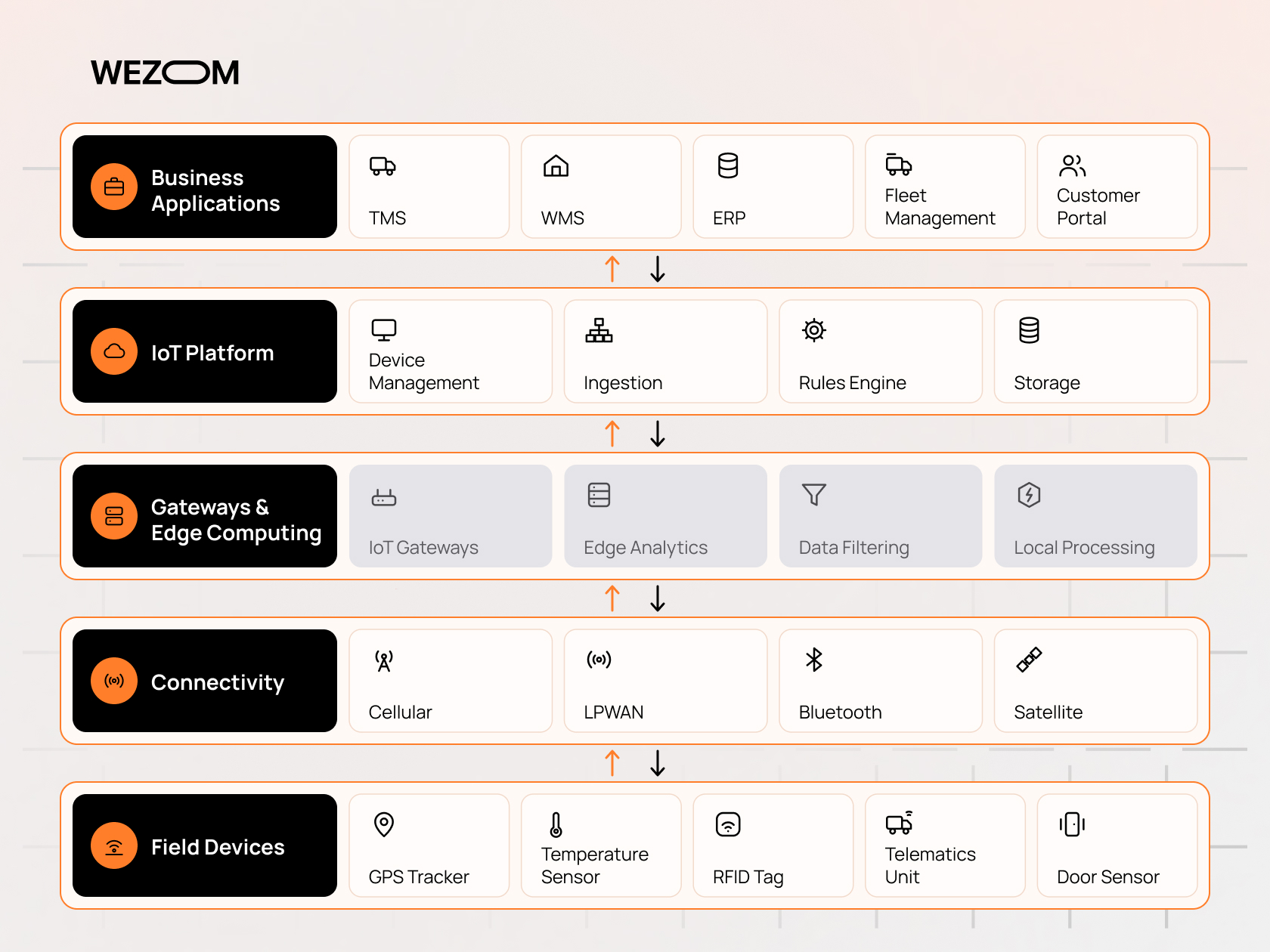
How IoT devices collect and transmit supply chain data
Devices sample physical conditions at a configured interval or on a trigger. A battery tracker might report every few hours while parked and more often once it detects movement. A telematics unit reads engine hours, fuel consumption, and fault codes directly from the vehicle bus. Each reading is timestamped and sent in a compact payload, often over MQTT or CoAP, directly to the cloud or through a gateway. When coverage drops, devices buffer readings and upload them later. The platform then decodes each message, links it to the right asset and shipment, and evaluates it against alert rules.
IoT in transportation vs. IoT in supply chain management
IoT in transportation focuses on moving assets: vehicle location, driver behavior, engine diagnostics, fuel use, hours of service, and route execution. IoT in supply chain management also covers inventory, warehouse equipment, container dwell times, and the condition of goods across several companies and handoffs. In practice the two overlap. A trailer's GPS position is a transportation data point, while the temperature log of the pallets inside that trailer becomes evidence in a supplier quality record. Treating both as one data model keeps fleet data from staying locked in a telematics portal the supply chain team never sees.
Key IoT Applications in Logistics and Supply Chain Operations
The most mature iot supply chain applications share a pattern: they replace a periodic manual check with continuous measurement and route exceptions to someone who can respond.
Real-time shipment tracking and supply chain visibility
Real-time shipment tracking attaches a tracker to a pallet, parcel, container, or trailer and reports location and status throughout the journey. IoT logistics tracking becomes far more useful when location events are matched to milestones in the order lifecycle: departure from origin, port arrival, customs release, and delivery. That mapping produces end-to-end shipment traceability that customer service, planning, and finance teams can all use.
Fleet management and vehicle telematics
Fleet telematics combines GPS with data from the vehicle's onboard diagnostics. Connected fleet management platforms show where each truck is, how it is driven, how long it idles, and whether any fault codes are active. Many fleets add AI dash cameras and driver apps for electronic logs, inspections, and proof of delivery. The payoff comes from acting on the data: coaching drivers on harsh braking, assigning the nearest vehicle to an urgent pickup, and generating compliance reports without paper logs.
Smart warehouse management and inventory tracking
Inside distribution centers, RFID inventory tracking lets readers at dock doors, portals, and shelves register tagged items without line-of-sight scanning. Combined with BLE beacons and location sensors on forklifts, this produces near real-time stock positions and equipment usage data. Warehouse automation systems such as conveyors and mobile robots add telemetry that reveals congestion and idle capacity. Because item-level tagging raises costs and read-accuracy issues, many operations start at pallet or case level.
Cold chain monitoring for temperature-sensitive goods
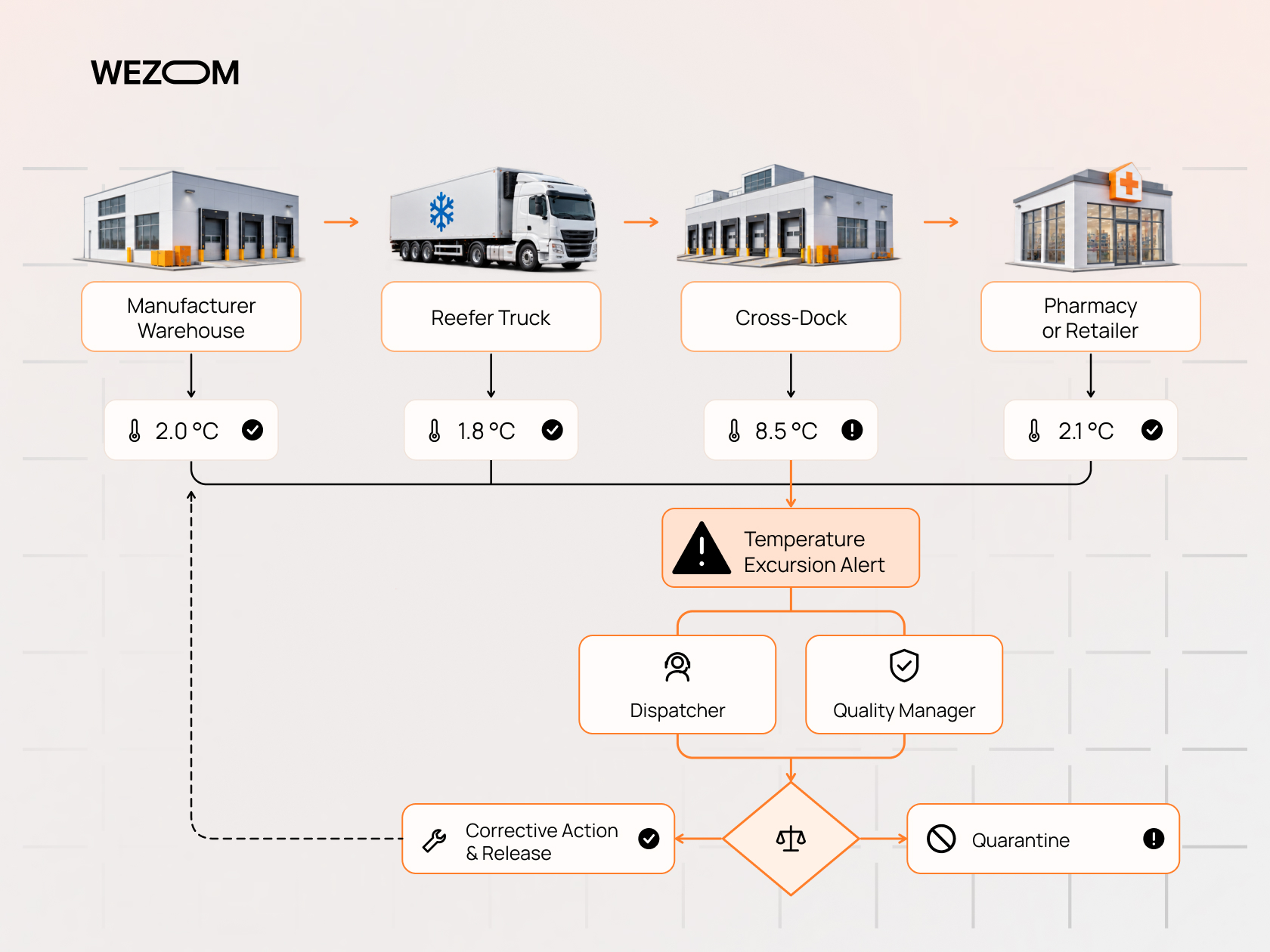
Cold chain monitoring tracks temperature, humidity, and sometimes light exposure and shock for pharmaceuticals, vaccines, fresh produce, seafood, and frozen food. Sensors inside reefers, containers, or individual packages log readings throughout transit and raise alerts when values leave a defined range. The alert must reach someone who can act, such as a driver who can check the reefer unit. The logs also document quality release decisions under rules such as pharmaceutical Good Distribution Practice.
Predictive maintenance for vehicles and logistics equipment
Predictive maintenance uses equipment data, such as engine fault codes, oil temperature, vibration on conveyor motors, or battery health on electric forklifts, to forecast failures before they occur. Maintenance is then scheduled by actual condition rather than fixed mileage. Models need enough real failure examples to learn from, so many programs start with rule-based thresholds and add machine learning later.
Yard management, container tracking, and asset utilization
Large yards often lose time searching for the right trailer or container. GPS asset tracking and smart container tracking devices record where each unit is parked, whether it is loaded or empty, and how long it has been waiting. Yard management systems use these events to sequence dock appointments and cut detention charges. The same data supports asset utilization optimization, for example rebalancing idle trailers between sites instead of leasing more.
Last-mile delivery monitoring and route optimization
Vehicle telematics and driver apps provide actual stop times, dwell at each address, and proof-of-delivery events such as photos, signatures, and geofence confirmations. Routing software uses this data to resequence stops when plans change and to send customers accurate time windows.
Benefits of IoT in Supply Chain and Transportation
The benefits of iot in supply chain operations come from specific mechanisms, not from connectivity itself.
Reducing operating costs and manual processes
Logistics process automation removes routine manual work: drivers no longer call in location updates, warehouse staff spend less time on cycle counts, and back-office teams stop transcribing paper delivery notes. Fuel costs fall when idling and inefficient routes become visible and measurable. Maintenance shifts from emergency repairs to planned work in low-demand periods.
Improving delivery accuracy and shipment traceability
Recorded events replace estimates. A timestamped geofence entry and photo proof settle delivery disputes quickly. Traceability also supports recalls: if a product batch is flagged, the business can identify which shipments carried it, where they went, and what conditions they experienced.
Minimizing cargo damage, spoilage, and theft
Cargo condition monitoring detects temperature excursions, shocks, tilt, and unexpected door openings while there is still time to intervene. Route-deviation and geofence alerts flag a trailer that leaves its corridor, supporting theft response and insurance claims.
Increasing fleet efficiency and asset utilization
Utilization data shows which vehicles, trailers, containers, and handling equipment are working and which are idle. Fleets cut empty miles by matching backhauls to vehicle positions, and warehouses right-size forklift fleets from recorded usage.
Supporting data-driven decisions and logistics sustainability
Logistics data analytics turns months of sensor data into planning inputs: real lane transit times, carrier performance, dock throughput, and seasonal demand patterns. The same data supports sustainability reporting, since fuel consumption, idling time, and distance traveled can be measured per shipment or customer instead of estimated from averages.
IoT Logistics Solutions: Technologies and System Architecture
Effective iot logistics solutions combine hardware, connectivity, software, and integration choices that fit the operating environment.
IoT sensors, RFID tags, GPS trackers, and connected devices
IoT sensors for logistics include temperature, humidity, light, shock, tilt, and door sensors, as well as fuel-level and tire-pressure monitors. RFID tags are passive (cheap, short range) or active (battery-powered, longer range). GPS trackers range from hardwired telematics units powered by the vehicle to battery-powered devices for unpowered trailers and containers. Devices on trucks and containers also need ruggedized enclosures rated for vibration, moisture, and temperature extremes.
Connectivity options: Cellular, LPWAN, Bluetooth, and satellite
LPWAN and cellular connectivity cover most logistics needs. LTE-M and NB-IoT, both cellular LPWAN standards, offer low power consumption and good building penetration for trackers that send small payloads. Standard 4G and 5G suit vehicle telematics and video. LoRaWAN suits private sites like yards and ports. Bluetooth Low Energy connects short-range sensors to a nearby gateway or a driver's phone. Satellite connectivity covers ocean routes and remote regions without terrestrial coverage, at higher cost per message.
IoT gateways, edge computing, and cloud platforms
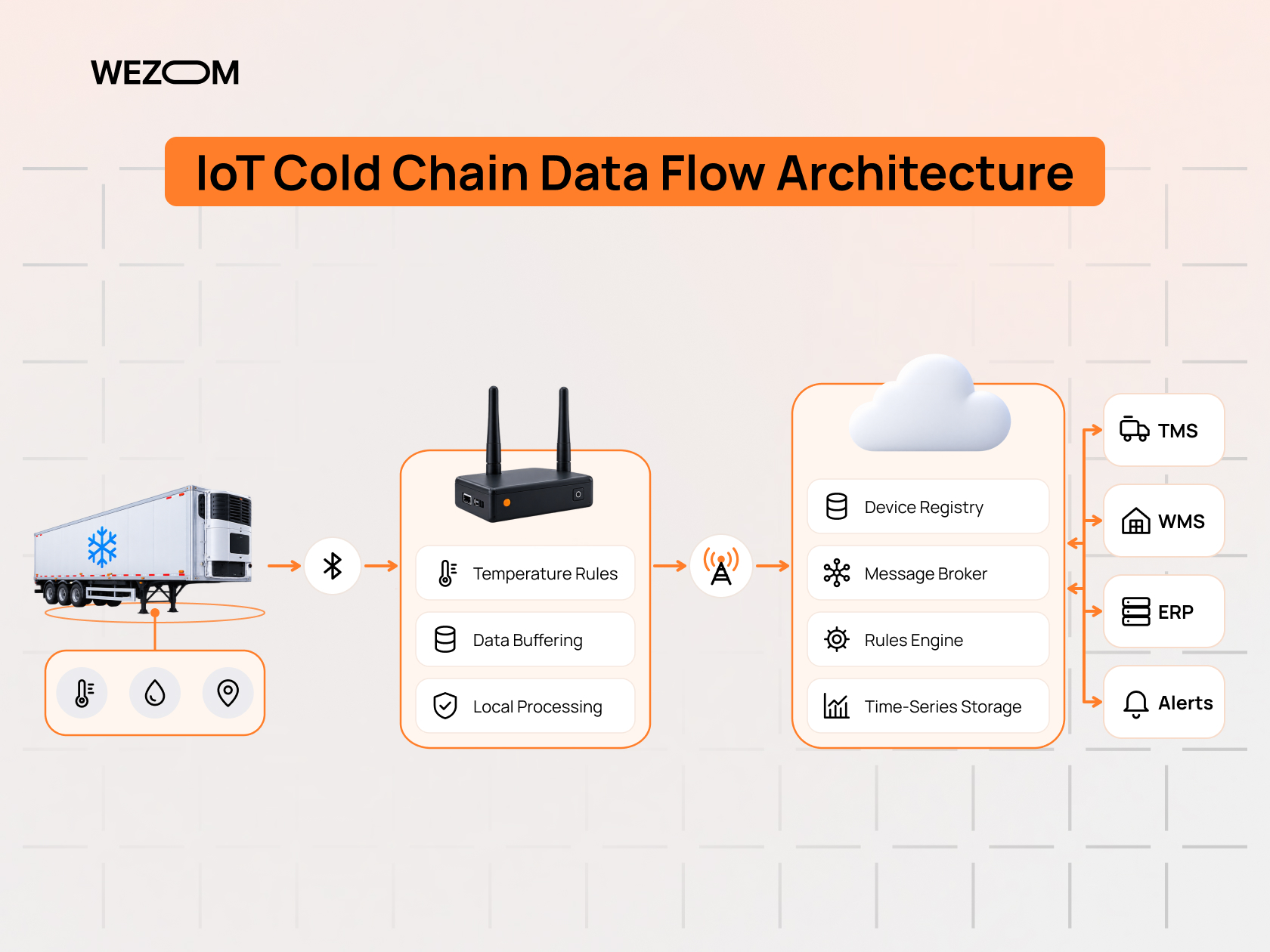
Gateways collect data from local sensors over Bluetooth, LoRaWAN, or wired connections and forward it upstream. Edge computing in logistics adds processing at that point: a gateway in a reefer can evaluate temperature rules locally and trigger an alarm even when the cellular link is down, or a camera can analyze video on the device and send only events instead of continuous footage. Cloud platforms provide scalable ingestion, storage, device management, and analytics. The edge–cloud split depends on latency needs, link reliability, and data volume.
Integrating IoT data with TMS, WMS, ERP, and fleet management software
Transportation management system integration lets live location and ETA updates adjust delivery appointments and carrier performance scores. Warehouse management system integration feeds RFID reads into receiving and inventory records and triggers putaway tasks. Sensor data integration usually runs through APIs, message queues, or middleware that maps device events to the target system's data model. A common pattern is an event bus that publishes normalized events, such as "shipment arrived at geofence" or "temperature excursion started", that each subscribing system processes in its own way.
Data security, device authentication, and remote management
Every connected device is a potential entry point. Strong logistics cybersecurity starts with unique device identities and certificate-based authentication, encrypted communication (TLS or DTLS), and secure boot to prevent tampered firmware. IoT device management platforms handle provisioning, configuration changes, over-the-air firmware updates, and decommissioning across thousands of units. Unpatched field devices accumulate vulnerabilities, so remote management is also a security control.
AI and IoT in Supply Chain Management
AI and IoT in supply chain operations work as a pair: IoT supplies continuous, granular data, and AI models find patterns that rules cannot easily capture.
Predictive analytics for demand forecasting and inventory planning
Traditional forecasting relies on historical orders. Adding IoT signals, such as real-time stock levels from RFID, in-transit inventory positions, and sell-through data from connected shelves, gives models a more current picture of supply and demand. Planners can also set safety stock from lead-time variability measured by trackers instead of supplier-stated lead times.
AI-powered route optimization and delivery ETA prediction
AI-powered route optimization uses historical and live telematics data, traffic, weather, and recorded service times to build and adjust routes. ETA prediction models learn from thousands of completed trips how long specific lanes, stops, and customers actually take, which produces more accurate arrival windows than distance-and-speed calculations.
Automated anomaly detection for cargo conditions and vehicle performance
Static thresholds generate either too many alerts or too few. Anomaly detection models learn normal behavior for a specific reefer unit, lane, or engine and flag deviations, such as a compressor cycling more often than usual or a temperature curve drifting slowly upward, before a hard limit is breached.
Digital twins and intelligent supply chain orchestration
Digital twins in logistics are virtual models of a warehouse, fleet, or network kept up to date by live IoT data. Operators use them to test scenarios: what happens to dock throughput if two inbound trucks arrive late, or how a port closure would affect deliveries next week. Orchestration layers then act by reallocating inventory or rebooking carriers. Building a useful twin requires clean master data and reliable event streams, so it typically comes after core tracking and integration are stable.
How to Implement IoT in Logistics: Step-by-Step Guide
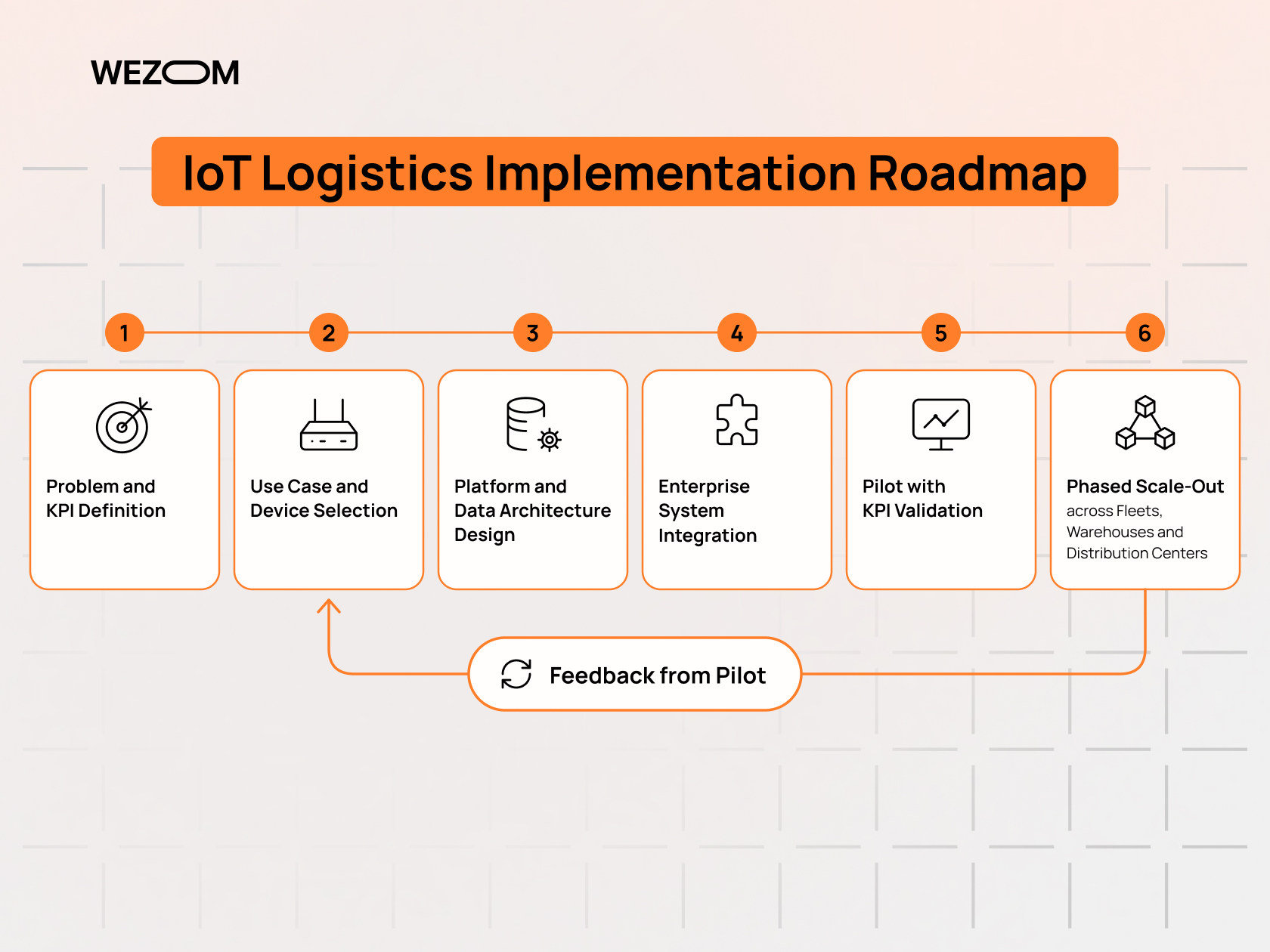
A structured rollout reduces the risk of buying hardware that never produces usable data.
Identify logistics bottlenecks and measurable business objectives
Start with operational problems, not devices. Examples include high spoilage on specific lanes, excessive detention charges, frequent unplanned vehicle downtime, or poor ETA accuracy. For each problem, define a baseline metric and a target, such as excursion rate per thousand shipments or average trailer dwell time.
Select IoT use cases, devices, and connectivity infrastructure
Prioritize use cases by value and feasibility. Then select hardware based on battery life requirements, reporting frequency, environmental conditions, form factor, and certification needs for the countries and carriers involved. Connectivity choices follow coverage maps and roaming agreements for the actual routes, including ocean or rural segments.
Design the IoT logistics platform and data architecture
IoT platform development covers device onboarding, ingestion pipelines, storage for time-series data, rules and alerting, user roles, and APIs. Key decisions include whether to build on a hyperscaler IoT service or a logistics-specific platform, how long to retain raw data, and which events need real-time processing.
Connect IoT solutions to existing enterprise systems
Integration is often the longest phase. The team maps device events to shipments, orders, assets, and locations in the TMS, WMS, and ERP, resolves identifier mismatches, and defines which system owns each record.
Launch a pilot project and validate operational KPIs
A pilot limited to one lane, site, or fleet segment tests hardware reliability, data quality, alert accuracy, and user adoption under real conditions. The team compares results with the baseline and adjusts thresholds and workflows before expanding.
Scale IoT deployment across fleets, warehouses, and distribution networks
Scaling introduces operational questions that pilots hide: device logistics (installing, retrieving, and recharging trackers), support processes, firmware update schedules, and connectivity cost management.
Challenges of IoT Adoption in Transportation and Logistics
IoT in transportation and logistics brings practical obstacles that should be planned for from the start.
Hardware deployment and connectivity limitations
Installing devices across hundreds of vehicles or thousands of returnable assets is labor-intensive, and devices on assets owned by subcontractors or customers may not be recoverable. Coverage gaps, metal containers that block signals, and roaming restrictions can create data blind spots on exactly the routes where visibility matters most.
Legacy system integration and data interoperability
Many logistics companies run older TMS or WMS platforms with limited APIs, and each device vendor may use its own data format. Without a normalization layer, teams end up with several portals that do not share identifiers.
Cybersecurity risks and protection of logistics data
Compromised devices can leak location data for high-value cargo, provide a path into enterprise networks, or produce falsified readings. Supply chain risk management should include vendor security reviews, network segmentation, and device-specific incident response.
Device maintenance, battery life, and sensor reliability
Battery-powered trackers need recharging or replacement, and frequent reporting drains batteries faster. Sensors can drift out of calibration or be damaged in handling. Without maintenance, data quality erodes and users stop trusting alerts.
Scalability and long-term infrastructure costs
Costs that look minor in a pilot, such as per-device connectivity fees, cloud storage, and support staff, grow linearly or faster with scale. Data retention policies, edge filtering, and careful selection of reporting intervals keep running costs aligned with business value.
IoT in Supply Chain Case Studies and Practical Examples
The following scenarios are generalized patterns rather than documented customer projects. Each works as an iot in supply chain case study template that a team can adapt when building its own business case.
Cold chain monitoring for pharmaceutical and food logistics
A pharmaceutical distributor places data loggers with cellular connectivity inside shipments of temperature-sensitive products. Readings stream to a platform that alerts quality staff when a shipment approaches its limit, and the full temperature history is attached to the batch record in the ERP. Food distributors combine reefer telemetry with pallet-level sensors to tell whether a problem came from the unit, loading, or door-open time at stops.
Connected fleet operations for transportation companies
A regional carrier equips its tractors with telematics units and AI dash cameras and its trailers with battery-powered trackers. Dispatchers see live positions, and maintenance planners receive fault-code alerts. Integration with the TMS updates customer ETAs automatically and records detention time at shipper facilities for billing.
Smart inventory and asset tracking in distribution centers
A distribution center tags inbound pallets with RFID and installs readers at dock doors. Receiving confirms quantities automatically against the advance shipping notice, and discrepancies go to an exception queue. BLE tags on forklifts show equipment location and usage during peak shifts.
Measuring operational outcomes and ROI from IoT deployments
Outcome measurement should use the baseline metrics defined at the start: spoilage rate, claims value, unplanned downtime hours, detention charges, manual hours per shipment, and ETA accuracy. Comparing pilot and control sites over the same period isolates the IoT effect. Adoption metrics, such as the share of alerts acknowledged, matter too.
How Much Does IoT Logistics Implementation Cost?
IoT implementation costs vary widely because they depend on the number of assets, device type, geographic coverage, integration depth, and whether the software is bought or built.
Hardware, connectivity, and platform development expenses
Hardware costs depend on device class: passive RFID tags are inexpensive per unit but require readers and installation, while ruggedized multi-radio trackers and telematics units cost considerably more per asset. Connectivity is a recurring per-device fee that depends on data volume, technology, and roaming regions, with satellite being the most expensive. Platform expenses cover cloud infrastructure, licensing, and development.
Custom IoT logistics solutions vs. ready-made platforms
Ready-made platforms offer faster deployment and lower upfront costs, with subscription pricing that often scales per device or vehicle. Custom solutions require more upfront investment in architecture and development but give the business control over data models, integrations, user workflows, and long-term licensing costs. Many combine vendor devices with a custom integration layer.
Total cost of ownership and return on investment
Total cost of ownership covers the full lifecycle: hardware replacement cycles, battery changes, connectivity, cloud usage, software maintenance, security updates, and support staff. IoT return on investment comes from avoided losses (spoilage, theft, claims), reduced labor, lower fuel and maintenance costs, better asset utilization, and in some cases new revenue from premium visibility services.
Factors affecting IoT implementation timelines
Timelines depend on hardware procurement and certification, the number of systems to integrate, the condition of legacy platforms, data quality, pilot duration needed to capture meaningful results, and the logistics of physically installing devices across distributed fleets and sites.
Choosing the Right IoT Logistics Solution for Your Business
Selecting iot supply chain solutions starts with the operational problem and the systems already in place.
When off-the-shelf IoT software is sufficient
Off-the-shelf platforms work well when requirements match standard use cases: basic fleet tracking, driver compliance, or straightforward asset location. They suit companies with modern systems that the vendor already integrates with, limited internal development capacity, and a need to deploy quickly.
When custom IoT development delivers greater value
Custom development makes sense when the business must combine data from several device vendors, integrate deeply with proprietary or legacy systems, support unique workflows such as specialized cold chain release procedures, or offer visibility as part of its own product to customers. It also pays off when per-device fees grow large at scale or data residency rules exclude shared platforms.
Essential criteria for evaluating an IoT development partner
A capable partner should demonstrate experience with both embedded hardware and enterprise software, since many projects fail at the boundary between them. Evaluation criteria include proven integration work with TMS, WMS, and ERP platforms; a clear approach to device security and remote management; knowledge of connectivity options and their cost implications; a structured discovery and pilot process; and the ability to support the system after launch with monitoring, updates, and scaling. Supply chain digital transformation runs for years, so long-term support matters as much as delivery speed.

FAQ
How is IoT used in supply chain management by small and medium-sized businesses?
Smaller companies usually start with subscription-based fleet tracking or asset trackers that require no custom development, then add sensors for specific problems such as temperature-sensitive deliveries. Choosing a platform with APIs or data export lets tracking data connect later to order management or accounting tools.
Can IoT logistics tracking work without continuous internet connectivity?
Yes. Most trackers and data loggers store readings locally when coverage drops and upload the backlog once a connection returns, so the history remains complete. Edge gateways can also evaluate rules offline and trigger local alarms. Only real-time remote alerting is lost during a gap.
What is the difference between RFID and GPS tracking in logistics?
RFID identifies tagged items when they pass a reader, making it suited to counting and verifying inventory at fixed points such as dock doors and shelves. GPS determines geographic position anywhere with satellite visibility and needs a cellular or satellite link to report it. RFID answers "which items are here", while GPS answers "where is this asset now".
How accurate are IoT sensors for monitoring shipment conditions?
Accuracy depends on sensor grade, calibration, and placement. Commercial temperature sensors used in logistics typically specify tolerances in fractions of a degree, and pharmaceutical shipments often require calibrated devices with documented certificates. Placement matters too: a sensor near a reefer air outlet reads differently from one inside a pallet.
Can existing trucks and warehouse equipment be retrofitted with IoT devices?
Most can. Trucks accept telematics units connected through the diagnostic port or hardwired to power, and unpowered trailers can use battery trackers. Forklifts, conveyors, and dock doors can be fitted with vibration, usage, and position sensors.
Who owns the data generated by third-party IoT logistics platforms?
Ownership is defined by the contract, not by default. Some vendors retain rights to aggregated or anonymized data. Before signing, businesses should confirm export formats, API access, retention periods, data residency, and what happens to historical data if the contract ends.
How often should IoT devices and sensors be calibrated or replaced?
Calibration intervals follow manufacturer guidance, regulatory requirements, and the criticality of the measurement. Temperature sensors used for regulated goods are commonly recalibrated or replaced on an annual cycle, while single-use loggers are discarded after one trip. Device health monitoring flags units that need attention.
