
Companies in the oil and gas sector regularly face financial and reputational losses due to unoptimized workflows. Manual route planning and the lack of a unified environment for consolidating all business data often lead to delays in fuel delivery. That's why companies that experience these problems should consider implementing specialized fuel distribution management software.
Operational Challenges in Petroleum Distribution
Petroleum product supply chain management has its specific challenges, making standard logistics methods ineffective. Due to the highly dynamic market and the specific nature of hazardous cargo (which is reflected in legislative provisions unique to each region), such companies lose enormous sums daily due to inefficient processes. Without specialized software, dispatchers and logisticians are trapped in manual labor, leading to a host of critical problems, such as:
- Multi-terminal deliveries, where companies must coordinate shipments from multiple oil depots and terminals, making inventory management too complex;
- Multiple fuel grades, where several types of petroleum products must be transported simultaneously, requiring strict controls to prevent their mixing;
- Hazardous material transportation, which falls under specialized safety requirements such as ADR and requires detailed documentation;
- Manual dispatch planning, which inevitably leads to delays and errors due to manual data entry;
- Delivery delays, caused by a lack of constant monitoring of traffic conditions and delivery statuses;
- Inventory discrepancies, which create financial losses and disputes with customers;
- Invoice errors due to overly complex pricing schemes and manual data entry during the billing process;
- Compliance documentation, which is incredibly time-consuming when done manually;
- Rising transportation costs due to rising fuel prices, gradual depreciation of the vehicle fleet, empty runs of fuel trucks, and a number of other issues;
- Inefficient route planning that doesn't take into account current traffic conditions and bridge weight restrictions, leading to resource overruns.
Is there a way to tackle all of this in one fell swoop? Absolutely, and it's digital. For example, many of our clients in this sector, after implementing specialized software to address all of the above issues, noticed that optimized routes and the elimination of manual dispatching reduced their operating costs by an average of 15-20% due to reduced mileage and the elimination of excess fuel consumption.
In practice, this meant they struggled daily with cash flow gaps, necessitated the need to retain an overstaffed dispatcher/operator/manager staff, and ultimately, they still ended up with hefty fines from regional regulators. Furthermore, their fleets were often idle due to confusion in invoices, and customers switched to competitors due to missed deadlines.
Fortunately, in addition to custom development, which entails high initial costs, there are numerous ready-made solutions, such as PetroCloud and FuelerLinx. They allow major players to automate routine tasks, minimize empty runs for fuel trucks, and, most importantly, completely eliminate the human factor from most workflows.
Main Features Every Fuel Distribution Software Should Include
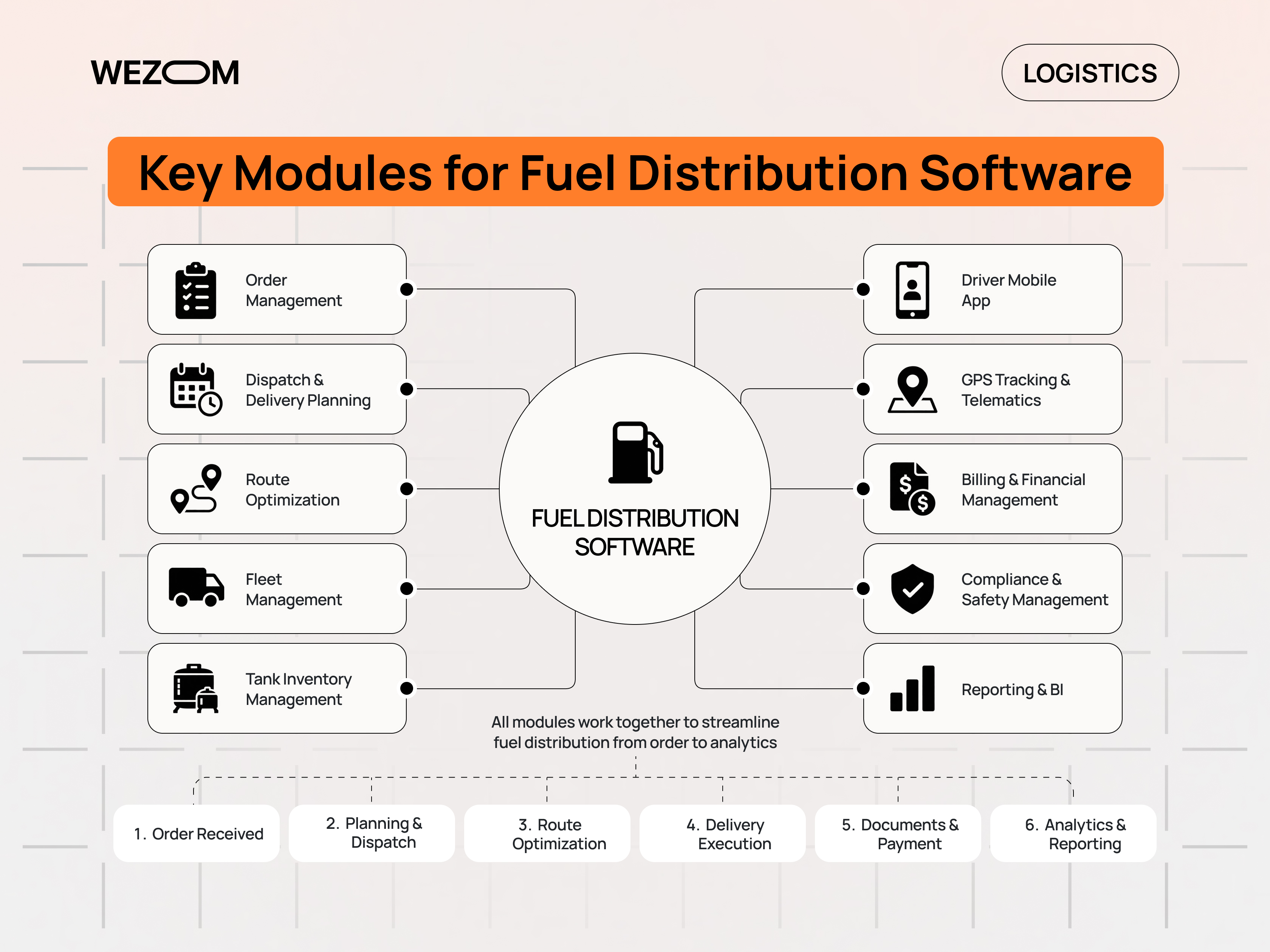
To overcome the aforementioned challenges and optimize logistics, fuel oil delivery software must include a number of essential modules, which we will explore in more detail below.
Order Management
This is the module responsible for order management. It essentially automates the entire customer interaction chain, ensuring transparency at every stage. This module typically handles the following tasks:
- Quickly accepting and registering fuel supply requests, capturing customer data through a single interface, and checking volume availability for subsequent reservation;
- Configuring automatic order reorders according to an agreed-upon schedule for regular customers (with instant calculation of their fuel requirements);
- Maintaining a contract database with the definition of individual cooperation and financing terms, as well as the recording of specific service level agreements;
- Automatic application of complex pricing policies based on purchase volumes, spot prices, or, for example, the terms of contracts for a specific customer;
- Dynamic distribution of supply requests across time windows, taking into account customer priorities and existing logistical constraints.
Dispatch & Delivery Planning
This module is responsible for the proactive allocation of company resources. It performs the following tasks:
- Creating task pools for drivers, dispatchers, managers, and vehicles without human intervention;
- Calculating the maximum occupancy of fuel tanker compartments, taking into account the density of a specific fuel type, weight restrictions, hazardous materials safety regulations, etc.;
- Selecting the appropriate fuel tanker for a specific order, taking into account its current location, tank capacity, driver qualifications, traffic conditions, etc.;
- Ranking urgent and critical orders within the overall logistics flow;
- Displaying the status of the entire fleet and the progress of current routes in real time.
Route Optimization
It's important to understand that fuel transportation is very different from, for example, courier delivery. The main differences are physical limitations, the need to adhere to a number of safety regulations specific to the industry, and the specifics of working with liquid cargo. For example, many modern solutions use mathematical modeling algorithms to solve multi-criteria routing problems, but they also need to be further tailored to the specifics of the oil and gas industry. Thanks to this sophisticated approach, this module can handle the following tasks:
- Dynamic rerouting of fuel tankers during trips (i.e., if an accident occurs en route or the priorities of urgent orders change, the system instantly recalculates the optimal trajectory);
- Avoiding traffic jams and areas with height or weight restrictions for heavy fuel tankers, achieved through integration with mapping services and traffic jam services;
- Accounting for customer-set timeframes, ensuring that fuel is delivered strictly within the agreed-upon timeframe;
- Mileage reduction achieved by compacting routes and combining multiple unloading points into a single trip (which reduces vehicle depreciation);
- Multi-stop optimization (for maximizing trip efficiency), achieved through calculating the optimal sequence for visiting multiple points, while taking into account the order of unloading different petroleum products.
Fleet Management
Since tank trucks are considered high-risk assets, their technical condition and driver operating procedures have always been under regulatory control. So, to achieve standard compliance, this oil distribution software module must perform the following tasks:
- Assessing the actual occupancy level of each vehicle in the company's fleet (to identify idle or overloaded vehicles);
- Monitoring the technical readiness of trucks for deployment, taking into account their scheduled repairs, mandatory inspections, and existing schedules (to prevent situations where the dispatcher assigns an inappropriate fuel truck to a route);
- Automated scheduled preventive maintenance of specialized equipment, based on mileage and engine hours;
- Recording personnel qualifications and the availability of special permits to ensure compliance with work and rest schedules;
- Monitoring fuel consumption by tankers by comparing data from onboard fuel level sensors with actual tank volumes (in addition to timely refueling, this also prevents any attempts by drivers to drain fuel from the truck's tanks).
Tank Inventory Management
Fuel inventory management at stationary terminals and at customer facilities is critical, as failure to do so sooner or later leads to financial losses or environmental incidents. This software module, in turn, automates the accounting of petroleum products at all stages of their use. More specifically, it covers the following areas:
- Maintaining digital passports for each tank, taking into account their calibration, maximum capacity, thermal expansion coefficients of petroleum products, etc.;
- Inventory forecasting based on algorithms that, based on historical fuel consumption data for a specific customer, detect when a tank is running low (meaning dispatchers can initiate replenishment in advance);
- Comparison of fuel volumes received from the terminal, drained into the customer's tank, and those sold through fuel dispensers;
- Automatically generating alarms for dispatchers when the fuel level in the customer's tank drops below the reorder point;
- Providing terminal inventory visibility, allowing users to view the volumes of all fuel grades in real time at all the company's distribution terminals and oil depots.
Driver Mobile Application
A mobile app for fuel tanker drivers automates last-mile processes, largely replacing paper-based information with interactive digital processes right at the unloading site. Usually, it handles the following tasks:
- Navigation for heavy-duty trucks, taking into account tank dimensions, restrictions on access through residential areas, and the shortest access routes to customer sites;
- Generating digital delivery tickets (instead of paper consignment notes) that are synchronized with the central accounting system at the time of the transaction;
- Recording fulfillment of obligations through photographic recording of fuel pump meters and other symbols at the customer's site;
- Barcode scanning using a mobile device camera to prevent fuel mis-sorting;
- Collecting the electronic signature of the responsible receiving person via the driver's smartphone/tablet screen;
- Offline operation for completing work tasks in areas with poor or no cellular coverage (data is automatically synchronized with central storage when connection is restored).
GPS Tracking & Telematics
The module, which performs satellite monitoring and collects telematics data, ensures real-time transparency of the movement of hazardous cargo (particularly fuel). This is achieved through its following capabilities:
- Continuous monitoring of the coordinates, speed, movement vector, driving style, and other indicators of each individual fuel tanker on a digital map on the dispatch dashboard;
- Dynamic calculation of estimated arrival times, taking into account current traffic conditions, traffic jams, repairs, etc., so customers can know exactly when their order will arrive;
- Geofencing around oil depots, terminals, customer facilities, etc., to instantly detect unauthorized entry/exit outside the permitted zone;
- Route monitoring, so dispatchers can see if a driver deviates from the approved safe travel corridor;
- Evaluation of the driving style of each driver to minimize the risk of accidents on the road and reduce wear and tear on tankers.
Billing & Financial Management
This module automates financial procedures between fuel suppliers, contractors, and end customers, eliminating human error due to payment errors. Its typical capabilities include:
- Instant invoicing and generation of closing documents immediately after the digital consignment note is signed by the driver at the customer's site;
- Automated calculation of excise duties, environmental fees, taxes, and other mandatory payments required by law for the circulation of petroleum products;
- Support for dynamic price tags and linking to stock indices/customized discount formulas for corporate clients;
- Contractual database management linked to credit limits, guaranteed supply volumes, and a number of specific terms of commercial contracts;
- Payment tracking, with control over accounts receivable and automatic blocking of shipments to customers with overdue accounts.
Compliance & Safety Management
Companies in the flammable liquids transportation sector often face hefty fines for violations and environmental risks in the event of accidents. This petroleum distribution software module automates and simplifies monitoring of all safety aspects with the following features:
- Integration of current legal requirements into logistics algorithms, allowing the system to automatically verify that routes and vehicle types comply with hazardous materials transportation regulations;
- Automatic generation of a complete set of mandatory documents for fuel transportation that comply with government requirements;
- Maintaining digital logs of fuel tanker inspections and tanker compliance;
- Creation of immutable system logs recording every user action in the system, ensuring complete transparency during incident investigations;
- Safety reporting with immediate recording of any incidents and deviations from safety protocols to prevent their recurrence.
Reporting & Business Intelligence
The reporting and business analytics module processes massive amounts of raw data generated during fuel delivery. As a result, businesses gain insights needed for strategic planning. Specifically, the module:
- Tracks order fulfillment performance metrics, including on-time delivery rates and overall supply chain throughput;
- Analyzes the performance of each fuel truck and driver, including utilization rates, mileage, and overall vehicle utilization;
- Monitors underfilling and volume discrepancies during unloading and transportation;
- Performs financial analysis of the profitability of individual routes and contracts, taking into account all associated transportation costs;
- Analyzes customer fuel consumption patterns and order dynamics to accurately forecast future purchase volumes;
- Displays key company performance indicators and daily plan fulfillment statuses in real time.
Essential Integrations for Petroleum Distribution Software
The efficiency of fuel logistics today depends on the ability of software to seamlessly transfer data back and forth to external platforms, which typically include:
- An ERP system for synchronizing financial flows, fuel procurement, personnel information, and the company's asset balance;
- A CRM system for centralized access to order history, contracts, terms of service for each customer, customer request statuses, etc.;
- Accounting software for instant updates of shipments, payments, taxes, excise duties, etc., in the format of branded financial statements;
- GPS providers for real-time vehicle location tracking in areas with limited wireless coverage;
- Telematics platforms for real-time data collection on fuel consumption, engine condition, driving style, etc.;
- Payment gateways for secure acceptance of electronic payments and instant transaction processing;
- IoT tank sensors for real-time automated monitoring of petroleum product balances;
- Warehouse systems for accounting of receipts and expenditures and the movement of petroleum products within tanks;
- Customer portals, to expand customer autonomy (for example, to allow them to independently submit orders and track delivery status);
- Government reporting systems, to submit reports on the turnover of excisable and hazardous goods to government agencies.
Automation Opportunities Across Fuel Distribution Operations
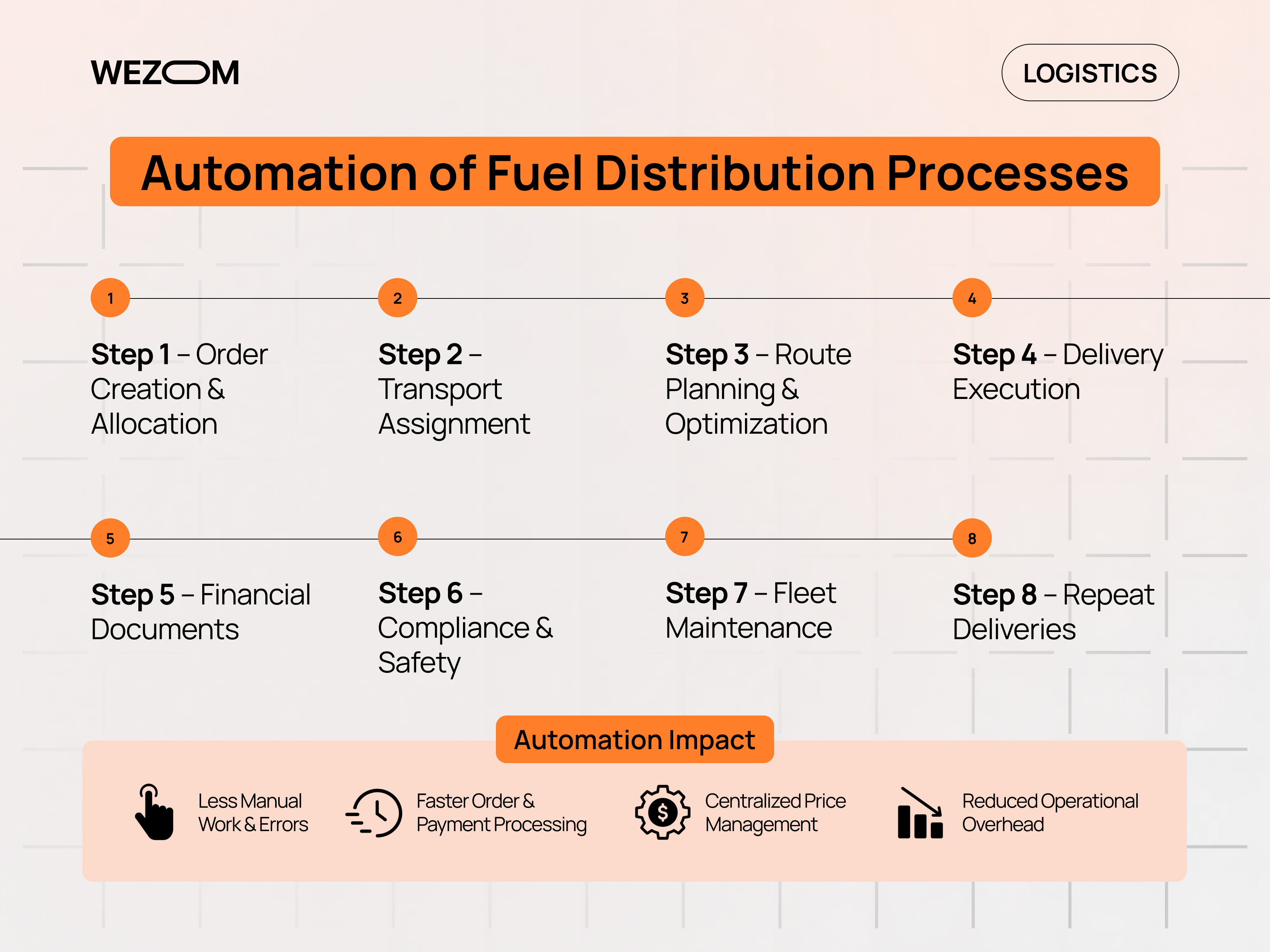
Automating manual processes in fuel distribution significantly reduces the impact of human error, accelerating data flow processing. Specifically, here are the opportunities companies gain by implementing automated software:
- Orders are now distributed using automated vehicle assignment algorithms that take into account the current availability of vehicles and drivers;
- Automatic routing and adjustment of fuel tanker routes in real time, taking into account traffic conditions and weight restrictions;
- Proactive generation of fuel purchase/delivery requests based on predictive cost analytics;
- Instant generation of financial documents and invoices after delivery confirmation with a digital signature;
- Automatic completion of transport/environmental/tax forms in accordance with regional legislation;
- Automatic notifications about order statuses (e.g., via SMS or instant messaging);
- Scheduling of tanker and truck inspections and repairs based on mileage and engine hours;
- Centralized, instant application of new price lists and discounts in all documents;
- Automatic generation of recurring shipment schedules for regular customers.
Overall, all these capabilities transform flammable liquid transportation processes into pure profit for the company, without hidden or unforeseen costs. Indeed, simply by eliminating manual data entry and communication delays, companies can reduce their order-to-payment cycle by 40-50%. This clearly improves working capital and reduces accounts receivable from the very first day.
Furthermore, the freed-up administrative resources of dispatchers are redirected toward expanding their customer base and improving service quality, which is invaluable in a highly competitive marketplace with ever-increasing energy costs.
Benefits of Custom Petroleum Distribution Software
Developing custom software tailored to the specific needs of a fuel company provides a number of competitive advantages. The first point worth noting is that, in addition to reducing vehicle mileage and optimizing fuel consumption, the company gains an effective tool that takes into account the specifics of handling hazardous and flammable cargo at all stages of the supply chain. Custom solutions also typically offer unlimited scalability and integration capabilities, meaning you can connect new terminals as needed and process a growing number of requests for a larger volume of clients without losing system stability.
Another important aspect is compliance of all workflows with current safety regulations and standards adopted in a specific region (which may be unavailable with off-the-shelf alternatives).
Ultimately, companies that choose custom development gain seamless and, importantly, precise control over the current status of orders and fuel stocks in warehouses, without the need to constantly hire new employees to handle increased requests or overload existing ones with routine manual processes.
Conclusion
As we can see, deploying software for petroleum and fuel distribution brings end-to-end automation to supply chains, allowing oil and gas companies to minimize costs without increasing staffing levels. This software also eliminates human error, guaranteeing top-quality customer service even in the face of fierce market competition. Therefore, if you're facing resource inefficiencies, a specialized platform may be all you need to maintain your business's competitive edge.

FAQ
What is fuel distribution software?
This is a narrow-focused solution for fuel companies used to automate and control their workflows. Such platforms consolidate order management, logistics operations, inventory control, invoicing/billing, fleet monitoring, and much more.
How does petroleum distribution software improve delivery operations?
These solutions optimize supply chains through proactive analysis of inventory, routes, demand, and many other factors, as well as automate dispatching, reducing order processing time and eliminating human error. As a result, companies utilizing such software significantly reduce operating costs and minimize fuel truck downtime within the first few months of implementation.
What features should fuel distribution management software include?
A modern solution typically includes modules with CRM functionality, a proactive route planner, real-time GPS tracking, a report generator, analytics, fuel inventory management functionality, and a range of integrations with measuring equipment.
Can fuel oil delivery software optimize delivery routes?
Yes, in fuel distribution software, this is achieved through algorithms for building optimal delivery routes that take into account road conditions, weather conditions, tanker capacity, customer time constraints, driver time slots, and many other factors.
How does GPS tracking improve fuel logistics?
The GPS technology provides end-to-end real-time tracking of fuel tanker movements, helps instantly identify route deviations, and monitors the status of orders. This improves transportation safety, prevents misuse of vehicles, and allows dispatchers to reroute vehicles as traffic conditions change.
