
What Is Plaid?
When teams first ask what Plaid is, they are usually trying to understand whether it is a product, a platform, or a financial intermediary. In practice, Plaid is a financial technology infrastructure provider that enables applications to connect with users’ bank accounts securely. It sits between consumer-facing apps and financial institutions, acting as a connectivity and data access layer. For many digital products, especially in the fintech ecosystem, Plaid has become a foundational component of modern banking integrations.
So, what does Plaid mean in a technical context? It is not a bank and does not hold funds in the traditional sense. Instead, it provides a platform that enables secure access to banking data through APIs. This is why questions like " What is Plaid banking or Plaid financial services?” often lead to confusion. Plaid does not replace banks–it enables software to interact with them. In other words, it powers Plaid bank integration by standardizing how applications retrieve account information, verify identities, and initiate transactions.
Understanding what Plaid is used for requires looking at its role in real-world applications. Plaid is commonly used for account linking, transaction data retrieval, identity verification, and payment initiation. This functionality is packaged into what is broadly referred to as Plaid software or the Plaid platform. Whether it’s a budgeting app aggregating multiple accounts or a lending platform verifying income, Plaid enables those workflows through Plaid integrations.
From an operational perspective, the question “How does Plaid work?” is centered around API-driven connectivity. When a user connects their bank account through an app, Plaid acts as the intermediary that authenticates the user, retrieves data, and securely passes it back to the application. This process is often described as how Plaid works in a simplified form, but under the hood, it involves multiple layers of authentication, tokenization, and data normalization.
In the broader Plaid fintech landscape, the company’s value lies in reducing integration complexity. Without such a platform, each fintech product would need to build and maintain direct integrations with hundreds of banks. Plaid abstracts this complexity into a unified API layer, making Plaid financial technology a critical enabler for scalable digital finance products.
How Does Plaid Integration Work: Technical Overview
A proper Plaid integration guide must begin with understanding its API-first architecture. At its core, Plaid technology is built around RESTful APIs that allow applications to request financial data and initiate operations. These APIs are exposed through the Plaid platform, which acts as a centralized layer connecting thousands of financial institutions to client applications.
The integration flow starts with authentication. Depending on the bank, Plaid supports OAuth-based flows or credential-based login. In modern implementations, OAuth is preferred because it enhances Plaid security by redirecting users to their bank’s authentication page. In cases where credentials are used, Plaid applies tokenization, meaning sensitive data is never stored in plain form. This is a critical component of Plaid security and aligns with industry compliance requirements.
Once authentication is completed, Plaid generates an access token. This token becomes the key mechanism for interacting with Plaid services. It allows the application to request data such as account balances, transaction history, or identity details. The token-based model also supports controlled access, enabling developers to define the exact scope of data required.
The data aggregation layer is another core component of the Plaid banking service. Plaid collects and normalizes data from different banks into a consistent format. This is essential because each financial institution has its own structure and protocols. Without aggregation, developers would need to handle inconsistent data models, increasing complexity and risk.
The bank account linking process is a user-facing part of Plaid application workflows. Users select their bank, authenticate, and grant permission. Behind the scenes, Plaid establishes a secure connection and retrieves data. This process is often optimized for user experience, as friction at this stage directly impacts conversion rates.
Real-time data synchronization is managed through webhooks. Instead of continuously polling for updates, applications receive event-driven notifications when new data is available. This approach reduces API load and improves system efficiency, which is critical for scalable Plaid integrations.
Plaid provides multiple API endpoints that define its functional scope:
- Transactions: access to historical and real-time transaction data;
- Auth: account and routing number verification;
- Identity: user identity and account ownership validation;
- Balance: real-time account balance information.
These endpoints collectively define how the Plaid payment system and Plaid payment processing workflows are implemented. Understanding these layers is essential for building reliable and scalable fintech applications.
Common Use Cases
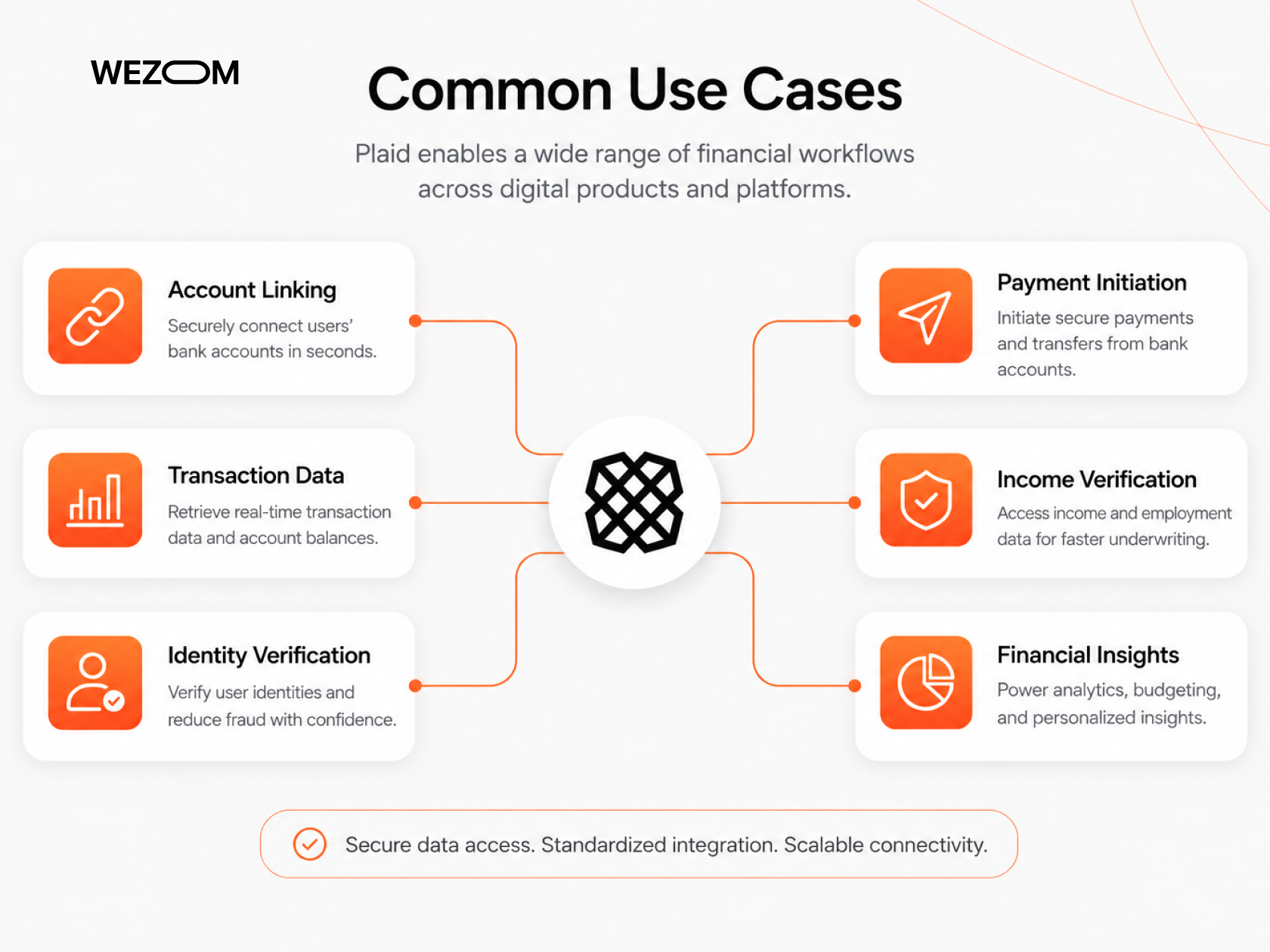
The adoption of Plaid fintech solutions is largely driven by practical use cases that solve real business problems. Understanding these use cases helps clarify what Plaid does in operational environments and why it has become a standard in digital finance.
One of the most common applications is in fintech apps such as budgeting tools, lending platforms, and neobanks. These products rely on Plaid's financial capabilities to aggregate user data from multiple accounts. Instead of asking users to manually input financial information, the application retrieves it directly via Plaid bank integration. This significantly improves accuracy and user experience while reducing onboarding friction.
Banking data aggregation is another core use case. Platforms that offer financial insights, analytics, or reporting depend on consolidated data from various institutions. Here, the Plaid platform acts as the backbone, enabling seamless connectivity across banks. This is particularly valuable for users who manage multiple accounts across different providers.
Payments and verification workflows represent a more transactional use case. Plaid payments and Plaid payment processing allow applications to verify account ownership and initiate transfers. This is especially relevant in ACH-based payment systems, where verifying account details is critical before executing transactions. Understanding how Plaid money transfer works is key in this context: Plaid facilitates the verification and authorization layer, while the actual transfer is typically executed through banking networks.
Risk scoring and underwriting also benefit from Plaid financial services. Lenders use transaction data to assess income stability, spending behavior, and financial health. This data-driven approach improves decision accuracy compared to traditional credit scoring models.
Personal finance applications represent another significant segment. These apps use Plaid software to provide users with insights into spending patterns, savings opportunities, and financial planning. The ability to access real-time data is crucial for delivering actionable recommendations.
Business accounting integrations are increasingly common as well. Companies integrate Plaid into accounting platforms to automate reconciliation processes and reduce manual data entry. This improves operational efficiency and reduces the risk of errors.
Across all these scenarios, Plaid technologies enable a consistent pattern: secure data access, standardized integration, and scalable connectivity. This is why Plaid is often considered a foundational component of modern financial ecosystems.
Plaid Security & Data Protection
“Is Plaid safe to use?” It is a critical question for any organization considering integration. From a technical standpoint, Plaid security is designed to meet the high standards required for handling sensitive financial data. However, understanding how these protections work is essential for evaluating risks and implementation strategies.
Plaid employs encryption at multiple levels. Data is encrypted both in transit and at rest, ensuring that unauthorized access is prevented during transmission and storage. This aligns with industry best practices and is a baseline requirement for any Plaid financial technology solution.
Tokenization is another key mechanism. Instead of storing user credentials, Plaid converts them into secure tokens. These tokens are used for subsequent API calls, significantly reducing the risk of data exposure. This approach is particularly important in scenarios involving Plaid payment and account verification workflows.
User data access control is managed through permission scopes. Applications can only access the data explicitly authorized by the user. This principle of least privilege is critical for maintaining trust and compliance. It also allows developers to design applications that request only the necessary data, minimizing exposure.
Compliance is a central aspect of the Plaid banking service. Plaid adheres to regulatory frameworks and undergoes regular audits to ensure security standards are maintained. This includes compliance with financial regulations and data protection laws, which is essential for operating in regulated markets.
From an operational perspective, the security model also includes monitoring and anomaly detection. Suspicious activities are flagged, and safeguards are implemented to prevent unauthorized access. This is particularly relevant for applications handling high transaction volumes or sensitive financial operations.
Despite these measures, integration teams must still consider their own responsibilities. Security is not solely provided by Plaid; it is a shared responsibility model. Developers must implement secure token storage, proper authentication handling, and robust access controls within their own systems.
Understanding Plaid security in this context helps answer not just whether it is safe, but how it should be used safely within a broader system architecture.
Challenges and Best Practices
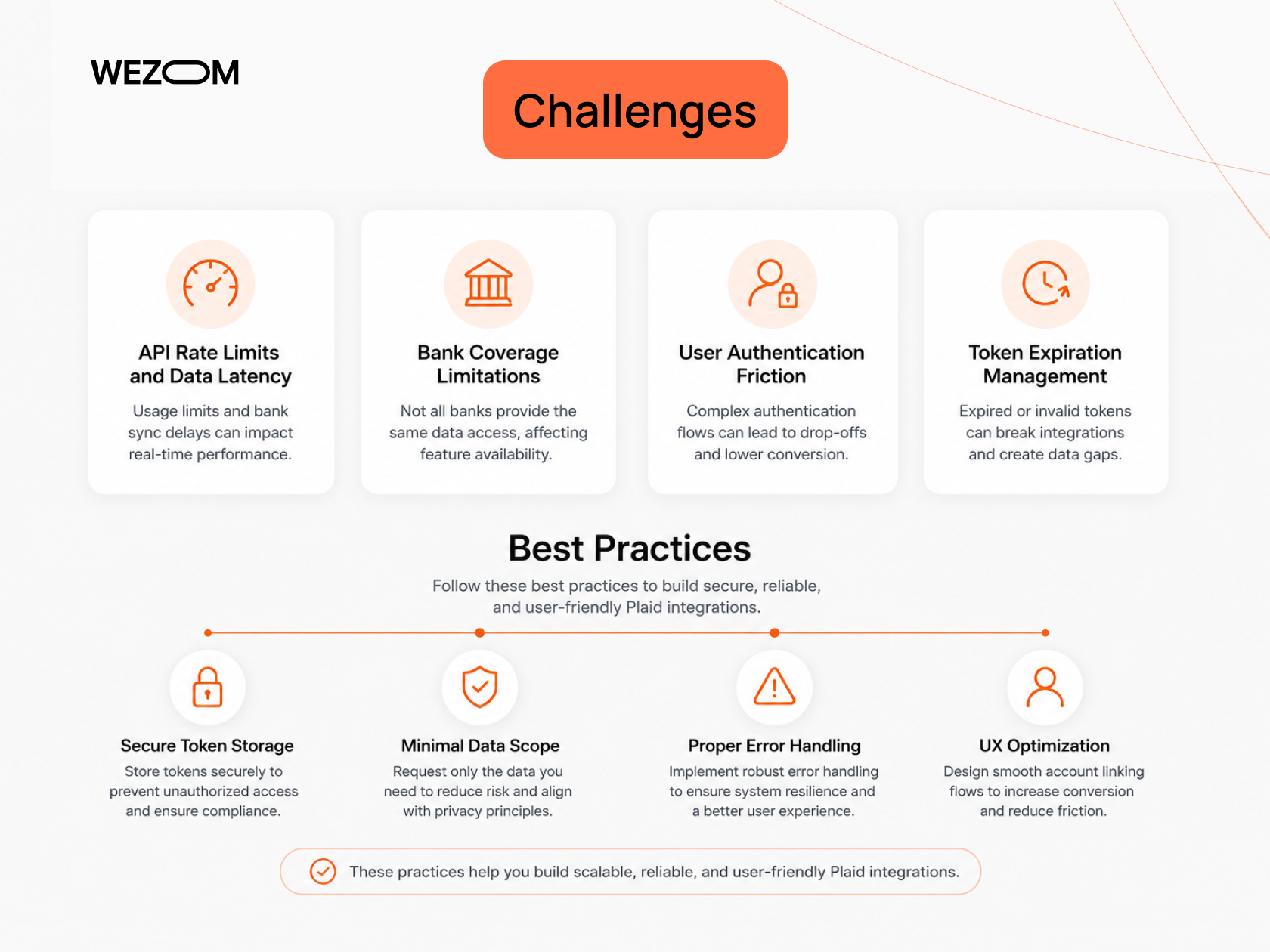
Implementing Plaid integration services is not without challenges. While the platform simplifies connectivity, there are operational and technical limitations that teams must address during development and scaling.
One of the primary challenges is API rate limits and data latency. Plaid enforces usage limits to ensure platform stability. For applications that require frequent data updates, this can create constraints. Additionally, there may be delays in data synchronization depending on the bank, which affects real-time use cases.
Bank coverage limitations also present challenges. While Plaid supports a large number of institutions, not all banks provide the same level of data access. This inconsistency can impact feature availability and user experience, particularly in international markets.
User authentication friction is another concern. The account linking process can be complex, especially if multi-factor authentication is required. Poorly designed flows can lead to drop-offs, directly affecting conversion rates.
Handling token expiration is a technical challenge that requires careful planning. Tokens may become invalid due to user actions or security policies, requiring re-authentication. Failure to manage this properly can result in broken integrations and data gaps.
To address these challenges, several best practices should be followed:
- Secure token storage is essential to prevent unauthorized access and ensure compliance.
- Minimal data access scope reduces risk and aligns with privacy principles.
- Proper error handling ensures system resilience and improves user experience.
- UX optimization for account linking increases conversion and reduces friction.
These practices are critical for building robust Plaid integrations. They not only address technical issues but also improve the overall reliability and usability of the application.
Real-World Implementation Insights
In real-world scenarios, implementing Plaid integration guide principles requires adapting to specific business requirements and technical constraints. A typical fintech integration flow begins with user onboarding, followed by account linking, data retrieval, and ongoing synchronization. Each step must be optimized for performance and reliability.
Scaling Plaid integrations introduces additional complexity. As the number of users grows, so does the volume of API calls and data processing requirements. This necessitates scalable infrastructure, efficient data pipelines, and optimized request handling.
Common architecture patterns include microservices-based designs, where different components handle authentication, data processing, and user interactions. This modular approach improves maintainability and allows teams to scale individual components independently.
Multi-bank connectivity strategies are essential for applications targeting diverse user bases. This involves handling variations in data quality, authentication methods, and API responses. Robust normalization and validation layers are required to ensure consistency.
Performance considerations are often underestimated. High latency or failed API calls can degrade user experience. Implementing caching, retry mechanisms, and monitoring systems helps mitigate these issues and ensures reliable operation.
These insights highlight that successful implementation goes beyond basic integration. It requires a comprehensive approach that considers scalability, performance, and user experience.
Wezom's Practical Integration Experience
From a delivery perspective, working with Plaid technologies in production environments reveals patterns that are not always visible in documentation. Practical experience integrating the Plaid API into fintech products demonstrates the importance of aligning technical implementation with business goals.
One key area is integrating with multiple financial institutions simultaneously. This requires handling variations in data availability and ensuring a consistent user experience. Building abstraction layers helps manage these differences and simplifies future expansions.
Working with both sandbox and production environments is another critical aspect. While the sandbox provides a controlled environment for testing, it does not fully replicate real-world conditions. Transitioning to production often reveals edge cases that must be addressed.
Building stable and scalable data pipelines is essential for processing financial data. This includes handling large volumes of transactions, ensuring data integrity, and maintaining performance under load. Efficient pipeline design directly impacts application reliability.
In practice, successful Plaid integration services require a combination of technical expertise and operational discipline. Teams must continuously monitor performance, adapt to changes in bank APIs, and optimize workflows based on user behavior.
FAQ
What is Plaid?
Plaid is a financial technology platform that enables applications to securely connect with users’ bank accounts. It provides APIs for accessing financial data, verifying identities, and enabling payments, acting as a bridge between applications and financial institutions.
What is Plaid used for in fintech?
Plaid is used for account linking, transaction data retrieval, identity verification, and payment initiation. Fintech companies rely on it to build features such as budgeting tools, lending platforms, and payment systems without directly integrating with multiple banks.
Is Plaid safe to use with bank accounts?
Plaid is designed with strong security measures, including encryption, tokenization, and strict access controls. However, safety also depends on how applications implement these features, making secure integration practices essential.
What companies use Plaid integration?
Many fintech companies, neobanks, and financial applications use Plaid to enable bank connectivity. This includes budgeting apps, payment platforms, and lending services that require access to financial data.
Can Plaid transfer money between accounts?
Plaid facilitates the verification and authorization required for transfers, but the actual movement of funds is typically handled by banking networks. It plays a supporting role in enabling secure transactions.
How secure is Plaid technology?
Plaid technology incorporates encryption, tokenization, and compliance with financial regulations. Its security model is robust, but effective protection also depends on proper implementation and adherence to best practices by developers.
