
Did you know that Chicago is considered the worst US city for traffic? In a logistics context, this problem, exacerbated by high urban density and tight time windows, makes manual route optimization planning ineffective. That's why, to survive here, your business should use route optimization software, where every turn and every minute of downtime is mathematically calibrated.
Why Route Optimization Is Critical for Chicago Logistics
Chicago has historically been the intersection of major railroads and highways, creating an unprecedented delivery density. Under these conditions, route optimization is fundamental to a company's viability, requiring pinpoint precision.
In particular, even a 15-minute delay due to traffic on the Dan Ryan Expressway can disrupt delivery schedules for the entire day, triggering penalties from retailers or manufacturing sites. Add to this the relatively high cost of a driver's hour and the constant stop-and-go nature of city traffic, and it becomes clear that freight transportation costs in Chicago can be significantly higher than in any other US city.
At the same time, even the most experienced dispatchers are unable to keep track of thousands of variables, so manual planning in a metropolis the size of Chicago will sooner or later require replacement with proactive automation.
Major Route Optimization Challenges in Chicago
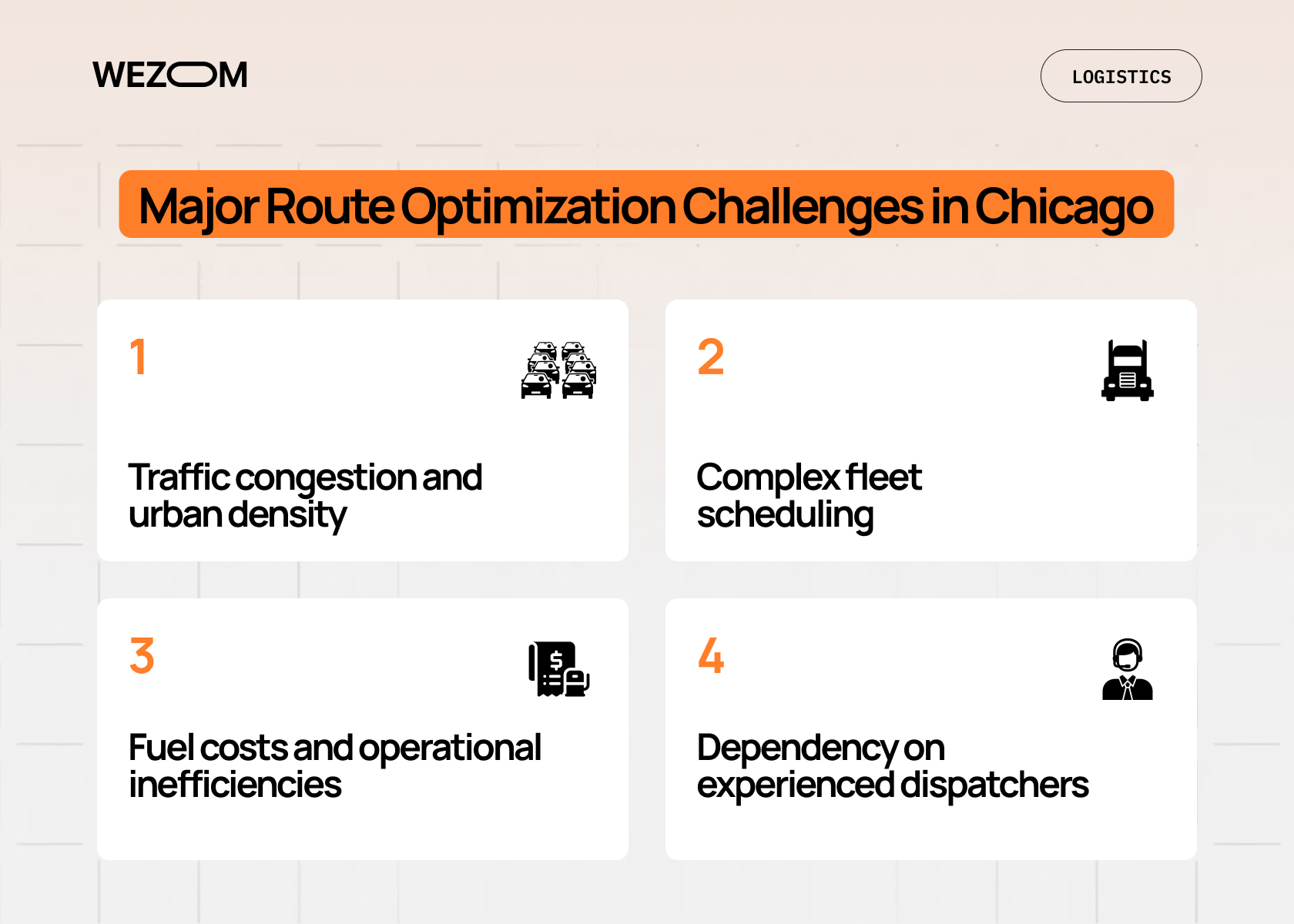
Let’s consider the main challenges logistics companies face in Chicago.
Traffic congestion and urban density
Chicago consistently ranks among the top US cities with the slowest traffic. Downtown Chicago, in particular, is a densely populated area where finding a place to unload can take longer than the road itself. It's also worth noting that during rush hour, traffic speeds here drop to pedestrian levels, while standard navigation systems often fail to account for the specifics of truck traffic, suggesting routes closed to commercial vehicles. Furthermore, lane closures and detours are a constant, completely disrupting the usual morning schedule. Finally, most retailers in the city center require deliveries within narrow windows, so missing them means returning the shipment to the warehouse and incurring double expenses.
Complex fleet scheduling
A single truck can have 15-20 unloading points per trip, so manually calculating the sequence of stops so the driver doesn't circle around one area on the way back is difficult. Shift schedules and rest breaks for drivers must also be considered to avoid turnover, as well as the truck's height for passing under low overpasses. Another challenge is compliance constraints, including HOS rules (compliance violations in Chicago lead to hefty fines, temporary suspensions for drivers, and a drop in CSA score).
Fuel costs and operational inefficiencies
Fuel costs traditionally account for up to 30% of a logistics company's total operating expenses, but in Chicago, this figure is often higher due to the city's traffic patterns. In particular, trucks can sit for hours in congested areas on the Kennedy or Dan-Ryan highways, burning up gallons of fuel. Smart fleet route optimization software, in turn, plans routes to minimize this overhead.
Dispatchers also sometimes choose routes that appear shortest in distance but turn out to be the most expensive in practice (usually in areas with a high density of traffic lights and drawbridges), which also leads to excess fuel consumption and premature wear of the brake system.
Ultimately, without highly intelligent algorithms, the total mileage of a fleet increases by 10-15% due to unnecessary turns and navigation errors, which, over a year, for a fleet of 50 vehicles, will cost thousands of extra miles. This means the actual cost of each mile will always be higher than the budgeted one.
Dependency on experienced dispatchers
One of the most dangerous threats to logistics businesses in Chicago is dependence on specific employees. For example, with manual scheduling, a dispatcher spends up to 70% of their time on routine tasks, thereby limiting their productivity to a maximum of 10-15 trucks. It's also important to note that only experienced employees understand the specifics of Chicago traffic, and given that this knowledge belongs to a specific individual, firing such a specialist risks reducing your usual productivity. Meanwhile, training a new employee to understand the specifics of this complex metropolis will take months, and during this time, you'll incur losses due to their slow performance.
This is why using truck route optimization software is irreversible – it reduces dependence on specific employees and, importantly, will never require salary increases during peak season.
How Route Optimization Software Solves These Challenges
When chosen correctly, modern route optimization system software can become a highly intelligent control center that takes on the most complex analytical work.
Automation of route planning
Algorithms can process millions of combinations in seconds, which is physically impossible for humans, especially when using AI to plot routes based on historical traffic data. Software for transportation route optimization can also instantly respond to changes, rerouting all involved vehicles in a fraction of a second and optimally sequencing unloading points to minimize loops. Finally, these solutions can account for hundreds of restrictions, including bridge heights and driver work hours, ensuring unprecedented compliance with Illinois regulatory requirements.
Fleet-wide optimization
Specialized dispatch software ensures even workload distribution among drivers, preventing overwork and downtime, as well as maximizing the available capacity of each truck. These solutions can also evaluate the efficiency of each trip, providing end-to-end analytics.
Real-time tracking and dynamic adjustments
Modern tracking solutions can identify traffic jams before drivers do and adjust routes in real time. Moreover, some of them can accurately predict arrival times and send notifications to all parties involved in the process when a route's status changes.
Automation of scheduling and dispatching
With specialized software, your dispatchers will no longer need to manually draw routes – now, they can generate them in fractions of a second. Moreover, these systems automatically pull data from ERP or CRM, eliminating errors caused by manually entering addresses or cargo weights. As a result, you'll achieve standardized workflows and be able to scale your fleet without the need for a global dispatch department expansion.
Types of Route Optimization Software for Logistics Companies
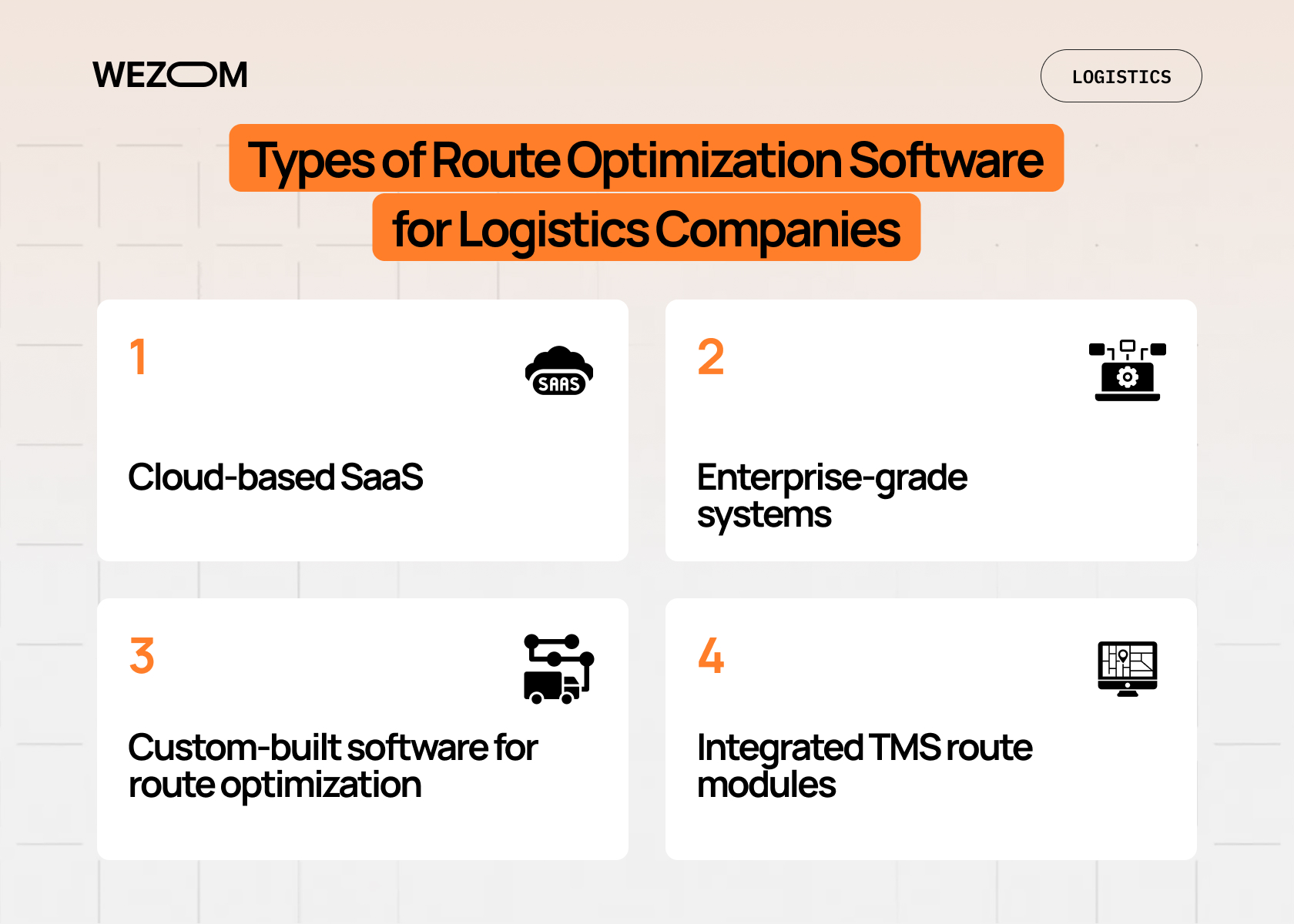
The choice of solution depends on the scale of your business, your budget, and the degree of automation. Specifically, we're talking about the following types:
- Cloud-based SaaS. This category includes cloud services like Route4Me or OptimoRoute, which help you quickly implement basic subscription optimization;
- Enterprise-grade systems. This group includes modular platforms like Oracle TMS, which are relatively complex to configure and learn but can cover 85% of the specific operations in large companies (including those in Chicago);
- Custom-built software for route optimization. These are individually developed solutions tailored to the needs of a specific business (specifically, about standard compliance) and the bottlenecks of Chicago's infrastructure;
- Integrated TMS route modules. These are separate optimization modules integrated into your transportation management system, ensuring a seamless data flow from order acceptance to final reporting.
By the way, if you're considering the last two options, you can contact us.
Benefits of Route Optimization Software in Chicago
Implementing specialized route planning and optimization software in Chicago brings a number of measurable results to logistics companies:
- By minimizing mileage and eliminating downtime in traffic jams on I-90/I-94, fuel costs are reduced by 12-18%;
- The planning process, which used to take dispatchers 3-4 hours daily, is now completed in 10-15 minutes;
- Optimizing driver work hours reduces overtime payments, while the high efficiency of dispatchers protects against costly staff expansion;
- Delivery window accuracy increases to 98%;
- Algorithms are well-aware of low bridges and truck access restrictions, minimizing the risk of fines and accidents;
- You no longer have irreplaceable employees who carry all the logistics in their heads.
Ultimately, your company's processes become transparent and predictable by eliminating the human factor.
When Should Logistics Companies Invest in Optimization Software?
If you're unsure whether it's time to consider custom development of scheduling delivery route optimization software, pay attention to the following indicators:
- Fleet growth – your fleet has exceeded 50 trucks, and manual management is starting to fail;
- Increased route complexity – the number of unloading points per truck is growing, and delivery windows are getting tighter;
- High dispatcher workload – your logistics team is burning out and doesn't have time to analyze data;
- Delivery delays – your customers are increasingly complaining about delays due to unexpected traffic jams;
- Rising operational costs – your cost per mile is growing faster than revenue, so you're looking for ways to optimize your internal resources.
If you're looking for an experienced IT partner who specializes in logistics route optimization software development, email or call us.

FAQ
What is route optimization software?
This is a system based on algorithms that create the most efficient vehicle routes, taking into account traffic, time windows, cargo characteristics, weather conditions, and road constraints.
How does route planning and optimization software work?
Vehicle route optimization software analyzes thousands of variables such as arrival addresses, traffic jams, driver schedules, parameters of vehicles, and more to find the shortest or fastest route in seconds.
How does fleet route optimization software reduce fuel costs?
This is achieved by reducing mileage, engine idling time in traffic jams, and wrong turns or unnecessary detours along the route.
What are the main routing challenges in Chicago?
Primarily, these include extreme traffic density, numerous roadwork zones, low overpasses, drawbridges over the Chicago River, and delivery time constraints in downtown.
Can route optimization software reduce dispatcher workload?
Yes, as transportation route optimization software ensures automated route calculation and order distribution.
