
Between the gate and the dock door sits an area that many distribution centers still run with radios, whiteboards, and spreadsheets. Trailers wait in unknown spots, and dock supervisors learn about a priority load only after it has sat in the yard for hours. The warehouse management system knows what is inside the building, and the transportation management system knows what is on the road, but neither tracks what happens in the yard itself. This article explains how a yard management system closes that gap, which features and technologies matter, what drives cost and ROI, and when to build rather than buy.
What Is a Yard Management System (YMS)?
A yard management system is software that plans, records, and directs the movement of trucks, trailers, containers, and other assets from the moment they approach a facility until they leave it. It keeps a live record of where each unit is parked, what it carries, its status (loaded, empty, sealed, waiting for a door), and what should happen to it next.
How Yard Management Software Works in Logistics Operations
Yard management software works by turning physical events into system events. A truck arriving at the gate creates a check-in record; a jockey moving a trailer to door 14 updates its location; a completed unload changes the trailer status to empty and releases the door. Events are captured on mobile devices, gate kiosks, or automated sensors such as cameras and RFID readers. The YMS applies rules to that stream: which trailer goes to which door, which move comes first, and which unit is nearing a detention threshold. Dispatchers, gate staff, dock leads, and carriers then work from one shared picture of logistics yard operations.
YMS vs WMS vs TMS: Key Differences and Responsibilities
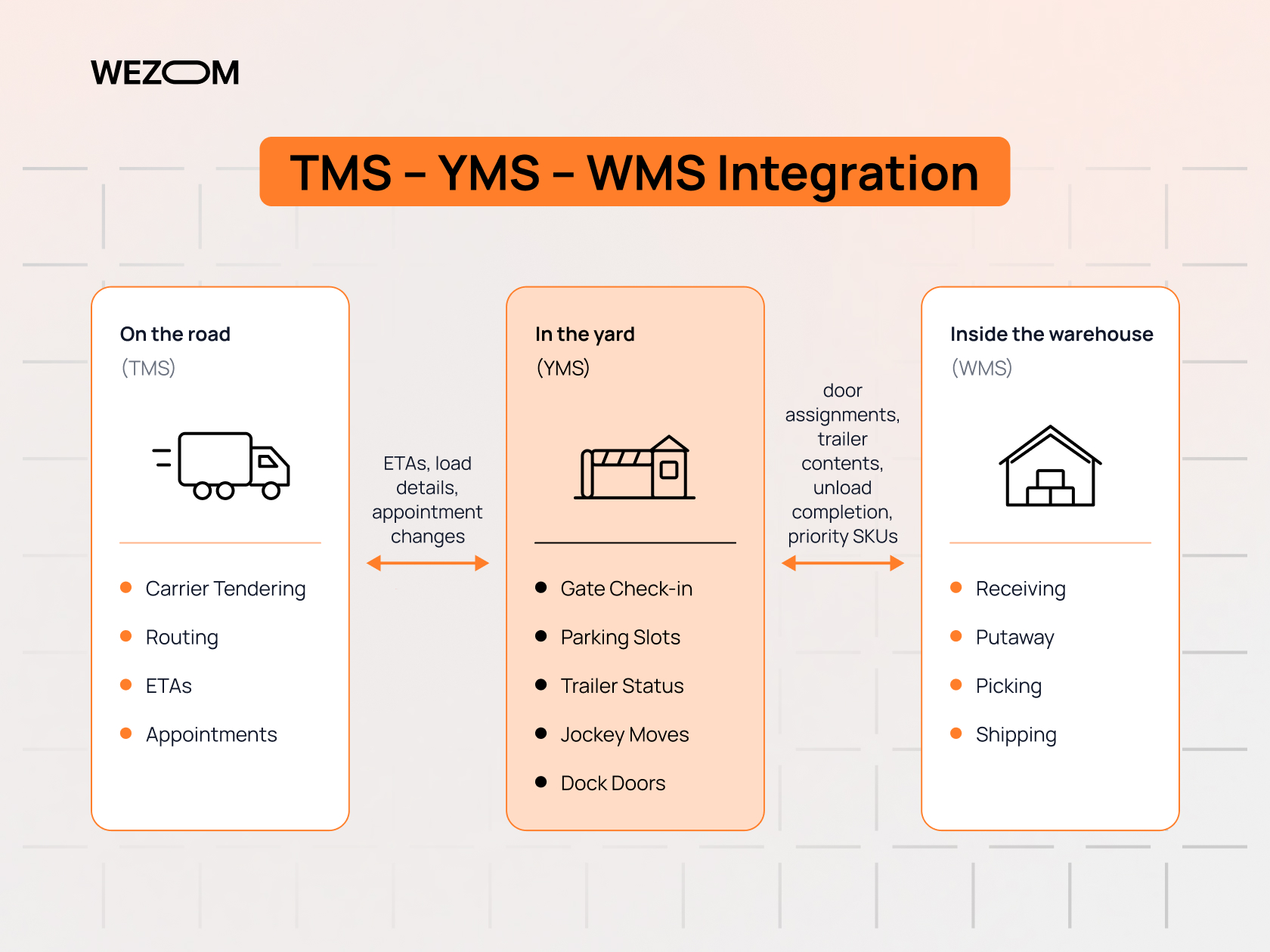
The three systems divide responsibility by physical zone and planning horizon. A TMS plans and executes freight movement between locations: carrier selection, tendering, routing, freight cost, and delivery appointments. A WMS controls inventory and labor inside the building, including receiving, putaway, picking, and shipping. The YMS owns the space and time between them: gate transactions, parking locations, trailer status, jockey moves, and dock door occupancy.
These boundaries shape design: a changed ETA from the TMS resequences door assignments, and a WMS stock-out lets the YMS prioritize the trailer holding that SKU. WMS add-on modules often cover only dock appointments, without parking-slot tracking or jockey task management.
When Businesses Need a Dedicated Yard Management Solution
Signals usually appear in operations data before anyone asks for software. Detention invoices grow, jockeys spend a large share of shifts searching for trailers, dock doors sit idle while trucks queue outside, and the yard holds drop trailers whose contents nobody can confirm without opening them. Drop-and-hook programs, shared trailer pools across facilities, and customer demands for appointment compliance reporting push in the same direction. Small sites with a few doors and only live loads can often manage with dock scheduling alone.
Yard Management Process Flow: From Gate Entry to Exit
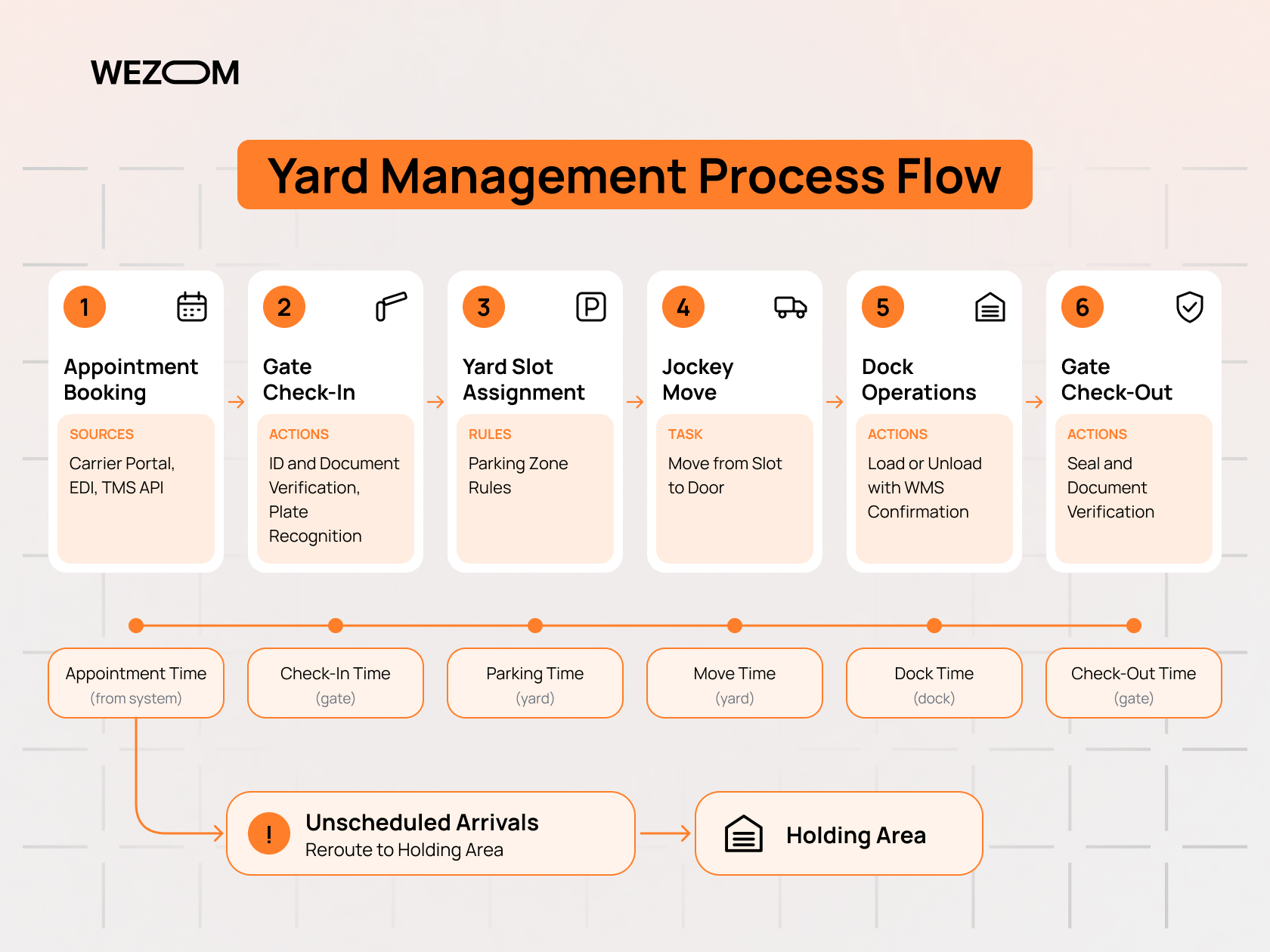
The yard management process flow follows each truck and trailer through a defined sequence of states. Mapping it is usually the first design task, because every feature, integration, and automation rule attaches to one of its stages.
Pre-Arrival Planning and Truck Appointment Scheduling
Truck appointment scheduling starts before the vehicle exists in the yard. Carriers or shippers book a slot through a carrier self-service portal, EDI, or an API call from the TMS. The YMS checks door capacity, labor availability by shift, product requirements such as refrigerated doors, and existing bookings. Advance shipment notices attach expected contents to the appointment, so labor and doors can be planned before arrival.
Gate Check-In, Driver Verification, and Vehicle Registration
At the gate, the system matches the arriving vehicle to an appointment or registers it as an unscheduled arrival. Verification covers driver identity, carrier, tractor and trailer numbers, seal, and documents such as the bill of lading. Automated vehicle check-in replaces clipboards with a kiosk, a driver mobile app, or camera-based recognition, and the gate record becomes the start of the trailer's yard history.
Yard Slot Assignment, Trailer Tracking, and Movement Coordination
After check-in, the YMS either sends the truck straight to a door or assigns a parking slot based on rules: reefer units near power outlets, hazardous loads in designated zones, outbound empties close to the shipping doors. Real-time trailer tracking then records every subsequent move. When the dock calls for a trailer, the system generates a jockey task with origin, destination, and priority, and the location updates when the move is confirmed. Because locations come from transactions rather than periodic audits, yard inventory tracking stays reliable.
Dock Scheduling, Loading, and Unloading Operations
Dock door management combines the appointment plan with real conditions. A late truck, a broken leveler, or a rush order triggers door reassignment. Loading and unloading coordination depends on status signals from the WMS: when receiving confirms the unload, the trailer becomes empty, the door is released, and the next trailer can be called.
Gate Check-Out and Yard Performance Monitoring
At exit, the gate verifies that the departing vehicle carries the correct trailer, seal, and documents, then closes the visit record. Timestamps for arrival, door time, completion, and departure feed trailer dwell time reports, carrier on-time performance, and detention exposure, which form the basis of yard performance monitoring.
Essential Features of Yard Management System Software
Feature sets vary between products, but a production-grade YMS needs the core modules below, with depth matched to the facility's volume and complexity.
Real-Time Yard Visibility and Interactive Yard Maps
Yard visibility starts with a digital yard mapping layer: a scaled model of the facility showing doors, parking slots, staging lanes, gates, and restricted zones. Each slot displays its occupant, status, dwell time, and alerts, often color-coded. Supervisors filter by carrier, priority, temperature requirement, or age. The map is only as accurate as the events feeding it, so the chosen data capture method determines how far it can be trusted.
Dock Scheduling and Yard Management Software Capabilities
Dock scheduling and yard management software capabilities overlap, but an appointment calendar alone does not manage the yard. Scheduling covers slot templates by door type, booking rules per carrier, and hourly capacity limits. With yard data, the scheduler can pull forward an early truck already on site or see that a booked door is still occupied. Predictive dock scheduling goes further by estimating unload duration from historical data on load type, carrier, and pallet count.
Trailer, Container, and Yard Asset Management
Yard asset management tracks every unit that occupies space: owned and leased trailers, carrier trailers, containers, chassis, and sometimes yard tractors. Each record holds ownership, condition, contents, seal history, and maintenance flags. Private fleets can monitor empty trailer pool levels per facility to avoid shortages and excess rental. Container records also carry free-time deadlines, linking yard data directly to demurrage risk.
Automated Gate Management and Digital Check-In
Gate entry and exit automation reduces the time each truck spends at the gate and the transcription errors of manual logs. Typical components include self-service kiosks, QR codes sent with appointment confirmations, license plate recognition cameras, and barriers controlled by the YMS. Unscheduled vehicles go to a manual lane, leaving gate staff to handle exceptions.
Yard Jockey Dispatch and Task Management
Yard jockey dispatch converts operational needs into a prioritized queue of moves. Tasks arrive from dock requests, scheduled transfers, and rule-based triggers, such as moving an empty trailer out of a door. The system assigns them to drivers based on proximity, current workload, and priority, then records start and completion times. Interleaving a drop with a nearby pickup cuts empty driving.
Alerts, Notifications, and Exception Handling
Exception logic is where a YMS shows its value under pressure. Alerts typically cover trailers approaching detention limits, reefer temperatures outside range, missed appointments, trucks waiting beyond a threshold, seal mismatches, and unauthorized moves. Every alert needs an owner and escalation path, or staff learn to ignore it.
Yard Analytics, Reporting, and KPI Dashboards
Analytics modules turn visit records into yard management KPIs: average dwell time by carrier, gate processing time, door turn time, dock utilization rate, jockey moves per hour, and detention exposure. Dashboards support shift decisions, historical reports inform carrier negotiations, and BI exports consolidate supply chain visibility across sites.
Yard Management Automation: Technologies and Architecture
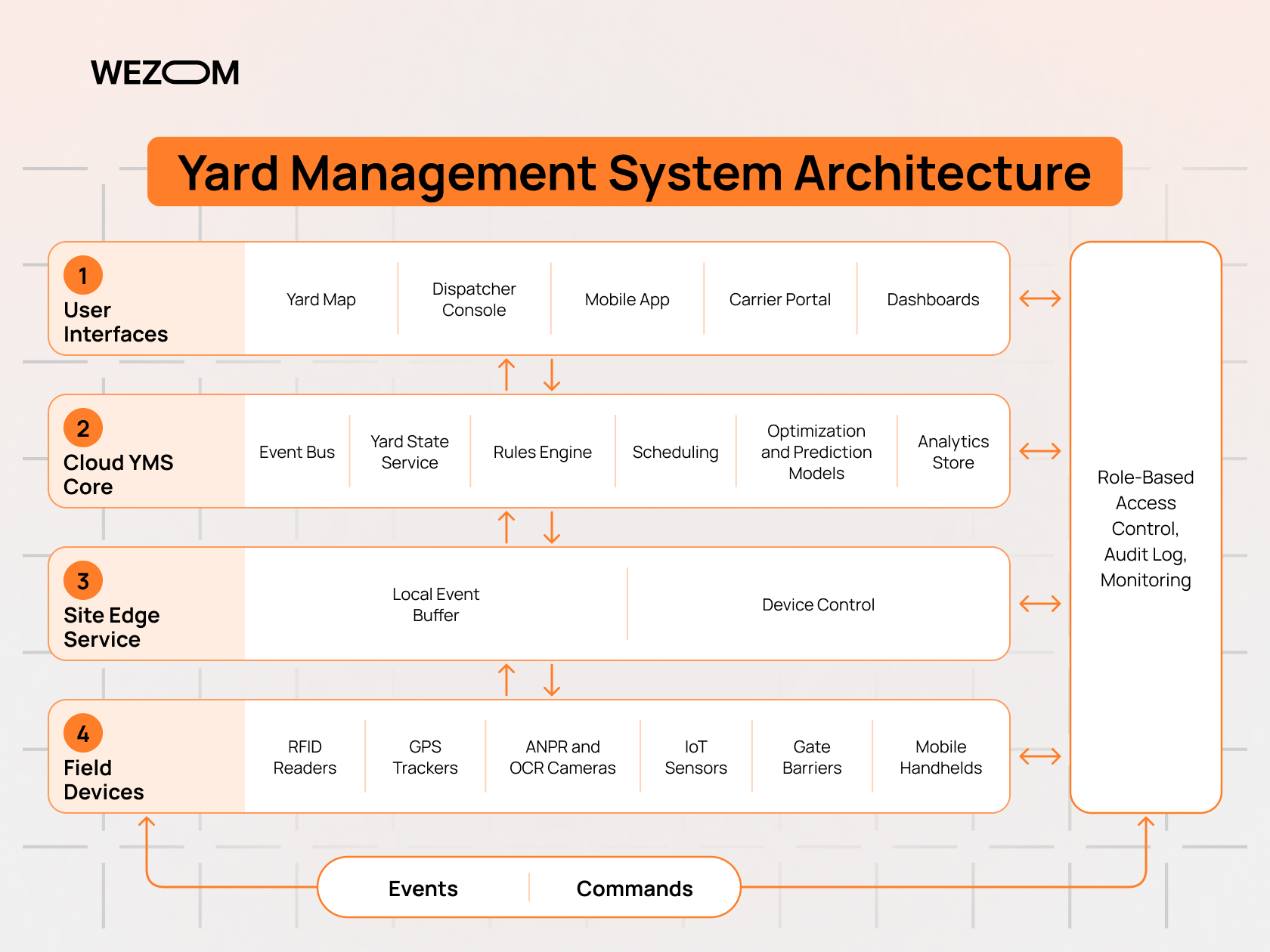
Yard management automation replaces manual data capture and decision steps with sensors, recognition systems, and rules engines. Technology should follow the problem: lost trailers call for location tracking first, a congested gate for recognition and self-service.
RFID, GPS, IoT Sensors, and Real-Time Location Tracking
RFID tracking technology uses tags on trailers and readers at gates, doors, and zone boundaries to record passage events. It works well at chokepoints but does not report a trailer's exact position within a large parking field. GPS trackers mounted on trailers provide continuous coordinates and support multi-site visibility, though accuracy near buildings and battery life must be tested. IoT-enabled logistics setups add slot occupancy sensors and reefer temperature monitors. Many facilities combine RFID at doors, GPS on owned trailers, and jockey mobile confirmations to fill the gaps.
OCR, ANPR, and Computer Vision for Automated Gate Operations
License plate recognition (ANPR) cameras read tractor plates, while OCR reads trailer and container numbers, including ISO 6346 container codes and DOT numbers. Computer vision can also detect damage and confirm seal presence. Recognition accuracy depends on camera placement, lighting, weather, and dirty or damaged markings, so the system needs a confidence threshold and a manual review queue for low-confidence reads.
AI-Powered Yard Optimization and Predictive Analytics
Optimization models assign doors and sequence jockey moves by weighing constraints such as appointment times, labor capacity, load priority, and travel distance. Predictive models estimate truck arrival times from telematics and traffic data, forecast unload duration, and flag trailers likely to exceed free time. Since these models need clean history that most facilities lack at launch, projects usually start with rule-based logic and add machine learning once reliable event data accumulates.
Cloud-Based vs On-Premises Yard Management Systems
A cloud-based logistics platform simplifies multi-facility yard operations, central updates, and carrier portal access, and it moves infrastructure work to the provider. On-premises deployment suits sites with strict data policies, unreliable connectivity, or deep coupling to on-site gate hardware. Hybrid setups pair a cloud core with a site edge service that keeps gate devices running during outages.
Mobile Applications and Offline Capabilities for Yard Personnel
Jockeys, gate staff, and dock leads work from rugged handhelds, tablets mounted in yard tractors, or smartphones. The app should show the task queue, support scanning, and confirm moves in one or two taps. Offline mode is essential: yards often have Wi-Fi or cellular dead zones, so the app must queue transactions locally with timestamps and synchronize them with conflict resolution when the connection returns.
Security, Scalability, and Role-Based Access Control
Role-based access control limits what each user can see and change: carriers view only their own appointments, gate staff cannot edit dock rules, and site managers see only their facility. Audit logs record who moved or released each trailer for security and disputes. Peak-season volumes, new sites, and growing sensor data typically call for event-driven architecture and horizontally scalable services.
Integrating Yard Management Software With Existing Logistics Systems
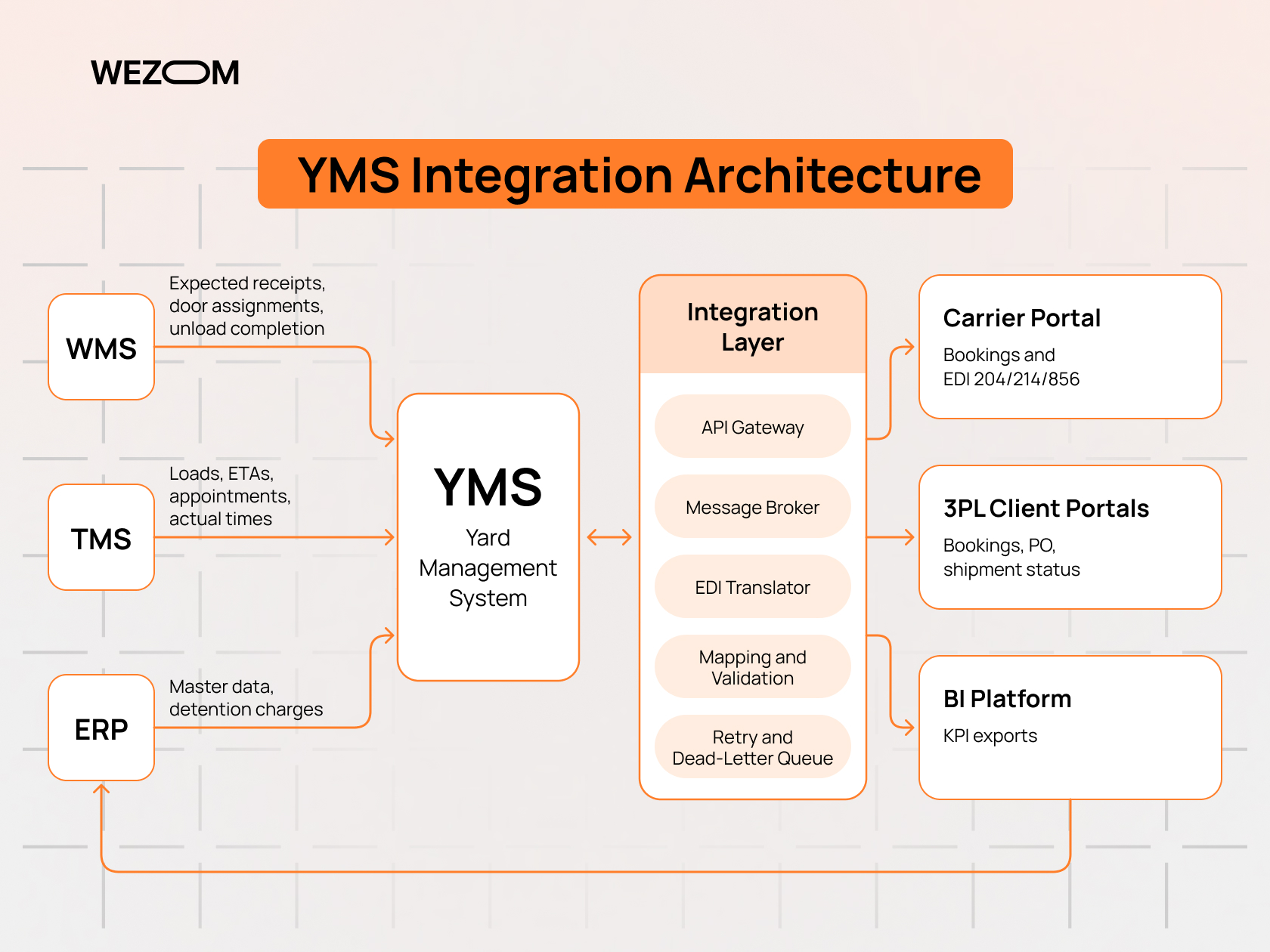
Without integrations, a YMS becomes another manual data-entry point, and integration scope often drives timelines more than features do.
YMS and Warehouse Management System (WMS) Integration
Warehouse management system integration usually covers four flows. The WMS sends expected receipts and outbound shipments, the YMS sends trailer arrival and door assignment, the WMS confirms unload or load completion, and the YMS releases the door. Advanced setups add priority signals, such as trailers holding SKUs that are short in pick locations, and automatic pre-receipt when a trailer reaches its door.
Connecting YMS With Transportation Management Systems (TMS)
Transportation management system integration provides load details, carrier assignments, appointments, and live ETAs. When a carrier reports a delay, the YMS can reshuffle door assignments before the truck arrives. The YMS returns actual arrival, door, and departure times for detention billing and carrier scorecards.
ERP, Carrier Portals, and Third-Party Logistics Platforms
ERP integration typically handles master data (suppliers, customers, materials, sites) and financial events such as detention charges. Carrier portals let dispatchers book appointments, receive door assignments, and upload documents without phone calls. 3PLs also need data and billing separated by client.
API Integration, EDI, and Real-Time Data Synchronization
Modern integrations use REST APIs and webhooks for event-level updates and message brokers for high-volume streams. EDI remains standard with many carriers and retailers: X12 204 for load tenders, 214 for shipment status, and 856 for advance ship notices, with EDIFACT equivalents in Europe. A sound system integration architecture places a middleware or integration layer between the YMS and external systems to handle mapping, validation, retries, and dead-letter queues, so a failing ERP endpoint does not stop gate operations.
Custom Yard Management System Development: Step-by-Step Process
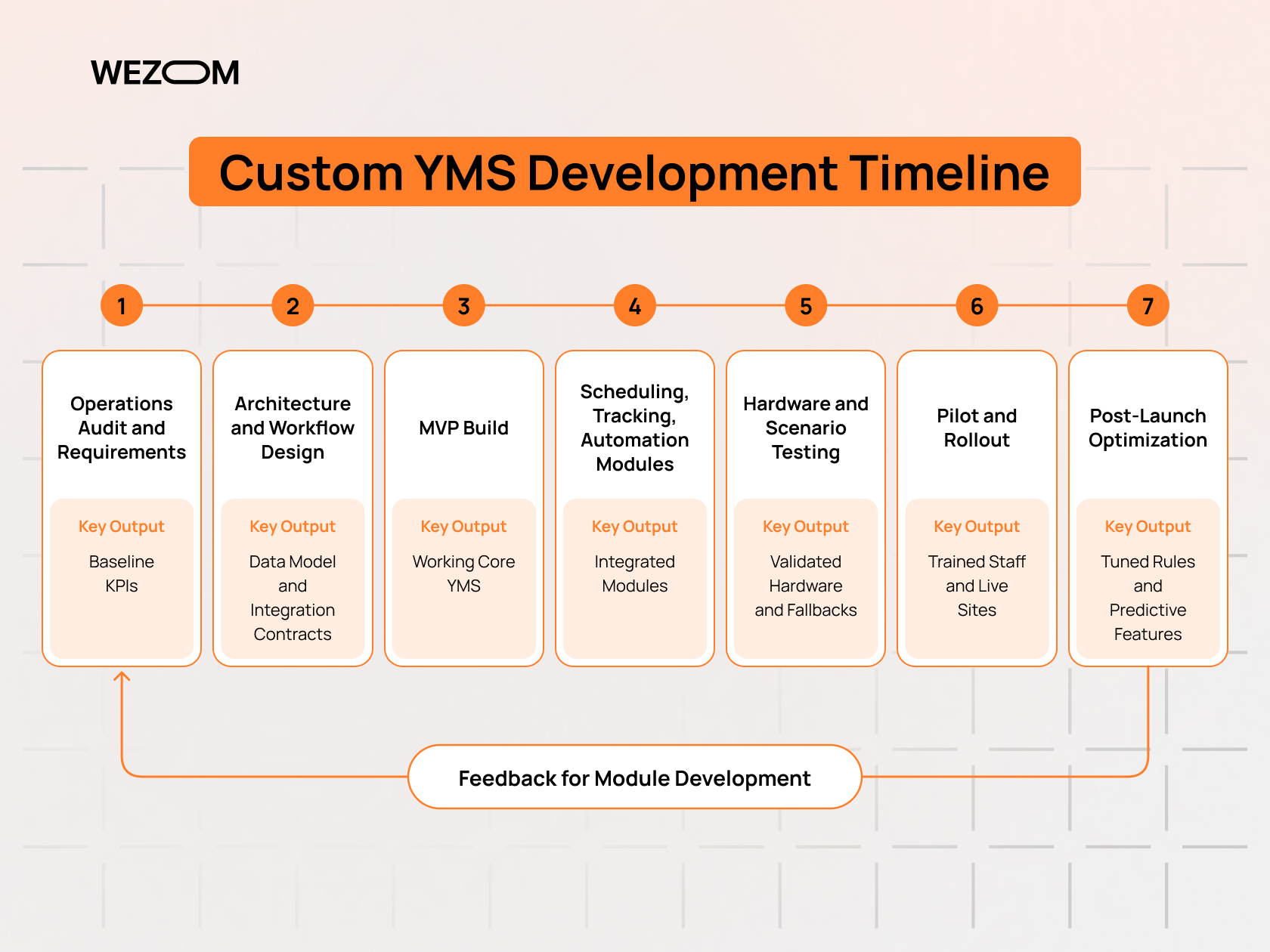
Yard management system development follows a sequence that reduces risk by validating operational assumptions before large investments in hardware and integrations.
Yard Operations Audit and Business Requirements Analysis
Discovery begins on site. Analysts observe gate, yard, and dock activity across shifts, interview staff, and collect baseline data: visit volumes, dwell times, detention invoices, door utilization, and jockey activity. They also document layout, network coverage, hardware, and connected systems. The output is prioritized requirements plus a baseline for ROI.
Designing YMS Architecture and User Workflows
The architecture phase defines the data model (visit, trailer, slot, door, task, appointment), event flows, integration contracts, deployment model, and device strategy. Role-based workflows are tested with real users, such as a jockey confirming moves with gloves on or a supervisor reassigning doors during a late-truck surge.
Building an MVP With Core Yard Management Features
An MVP usually covers appointments, gate check-in and check-out, a digital yard map, trailer status, jockey tasks, and basic reports, often with manual or barcode-based data capture. It replaces spreadsheets and radios and validates the data model before automation.
Developing Scheduling, Tracking, and Automation Modules
Subsequent releases add advanced dock scheduling rules, RFID or GPS tracking, ANPR gate automation, alert engines, full WMS and TMS integration, carrier portals, and optimization logic. Releasing modules per site or behind feature flags keeps working processes stable.
Testing Hardware Integrations and Operational Scenarios
Testing goes beyond software QA. Camera recognition must be validated at night, in rain, and with dirty plates; RFID read rates checked at actual approach speeds; mobile apps tested in coverage dead zones. Scenario tests cover surges, double-booked doors, integration outages, and gate hardware failure.
Pilot Deployment, Staff Training, and System Rollout
A pilot on one site or one shift exposes workflow gaps that design sessions miss. Training is short, role-specific, and done on real devices. After a limited parallel run, rollout proceeds site by site using a template configuration.
Post-Launch Support, Maintenance, and Continuous Optimization
After launch, the team monitors system health, integration queues, and device status, and handles hardware replacement and OS updates on handhelds. KPI data then guides rule tuning and later predictive features.
Yard Management System Benefits and Business ROI
Yard management system benefits come from specific mechanisms: faster gate processing, better door sequencing, fewer search moves, and earlier warnings. Each mechanism maps to a cost or capacity metric that can be measured against the discovery baseline.
Reducing Truck Dwell Time and Detention Costs
Detention and demurrage costs accumulate when trucks wait beyond carrier free time or containers stay past their allowed period. A YMS tracks the clock for every unit and alerts staff before the threshold, prioritizes at-risk trailers for doors, and produces timestamped evidence to dispute incorrect invoices.
Improving Dock Utilization and Yard Throughput
Doors are often the capacity bottleneck. When completion events release doors immediately and the next trailer is already staged nearby, idle time between door turns shrinks. Higher yard throughput can postpone building additional doors.
Minimizing Manual Work and Operational Errors
Digital check-in removes manual log entry, automated tasks replace radio dispatch, and recognition systems cut transcription errors in trailer numbers. A mistyped trailer ID can send a jockey to pull the wrong unit or attach a load to the wrong carrier, so each removed manual step also removes a source of downstream correction work.
Increasing Trailer Visibility and Asset Utilization
Knowing which trailers are empty, loaded, or waiting allows planners to return empties faster, cut trailer rental, and right-size owned fleets. Contents-level visibility also stops loaded drop trailers from being forgotten in remote yard rows, which otherwise surface only when a customer asks about a late order.
Measuring ROI Through Yard Management KPIs
ROI is calculated by comparing post-launch KPIs with the baseline: detention spend, average dwell time, door turn time, gate processing time, jockey moves per trailer, and trailer pool size. Translating each improvement into money (detention invoices avoided, labor hours saved, rentals reduced) and comparing it with total cost of ownership gives a defensible business case.
Yard Management Solutions for Different Industries
Yard management solutions share a common core, but industry context changes priorities, rules, and hardware.
Distribution Centers and High-Volume Warehouses
High-volume distribution centers handle many appointments per day, mixed live and drop loads, and tight outbound departure windows. Priorities include appointment compliance, fast gate processing, and door sequencing aligned with wave planning in the WMS.
Manufacturing Facilities and Industrial Logistics
Plants use the yard as a buffer for inbound materials. Just-in-time and just-in-sequence supply require the YMS to call trailers to specific lines based on production schedules, often with ERP or MES integration and strict tracking of hazardous materials.
Retail, E-Commerce, and 3PL Operations
Retail and e-commerce networks face sharp seasonal peaks, so scalability and temporary yard configurations matter. 3PLs need multi-client data separation, client-specific rules, and billing for yard services such as storage days and jockey moves.
Container Yard Management Systems for Ports and Intermodal Terminals
A container yard management system handles stacking positions, chassis pools, crane and reach-stacker tasks, and free-time tracking. It integrates with terminal operating systems, customs, and rail schedules, and relies heavily on OCR for ISO container codes.
Cold Chain Logistics and Temperature-Sensitive Cargo
Cold chain yards need reefer monitoring, power-plug slot assignment, temperature excursion alerts, and documented chain-of-custody records for food safety and pharmaceutical compliance audits.
Yard Management System Development Cost and Timeline
Custom YMS cost depends on facility scope, automation, and integration depth rather than a fixed price list.
Key Factors Affecting YMS Development Costs
The main drivers are the number of facilities and yard complexity, the number of user roles and workflows, the integration list and the state of existing APIs, the level of automation, deployment model, data migration, and compliance requirements.
MVP vs Enterprise Yard Management Software
An MVP targets one site, core workflows, and limited integrations, and its purpose is to prove value and stabilize data. Enterprise yard management software adds multi-site management, optimization engines, full hardware automation, carrier and client portals, advanced analytics, and high-availability infrastructure.
Cost of IoT Hardware, Integrations, and Infrastructure
Hardware includes RFID readers and tags, GPS trackers, ANPR cameras, kiosks, barriers, handhelds, and network upgrades such as yard Wi-Fi or private LTE. Installation and civil works add to equipment prices. Cloud hosting, middleware licenses, and EDI service fees form recurring infrastructure costs.
Development Timeline and Implementation Complexity
Timelines scale with scope: an MVP with manual capture moves considerably faster than a multi-site rollout with hardware and deep integrations. Lead times for hardware procurement, site installation windows, and third-party integration testing often set the critical path more than coding does.
Ongoing Maintenance, Licensing, and Total Cost of Ownership
Total cost of ownership includes hosting, support, bug fixes, feature updates, device replacement, sensor maintenance, third-party licenses, and integration upkeep when partner systems change. Comparing options over several years gives a more accurate picture than comparing launch costs alone.
Custom vs Off-the-Shelf Yard Management Systems
Commercial YMS products and custom builds solve the same core problem with different trade-offs in fit, speed, and control.
When Ready-Made Yard Management Software Is Sufficient
A packaged product fits when yard processes are standard, the existing WMS or TMS vendor provides a native connector, and the organization accepts adapting workflows to the product.
When Custom YMS Development Offers Greater Value
Custom development pays off when processes are distinctive (complex manufacturing sequencing, multi-client 3PL billing, mixed container and trailer yards), when integrations involve legacy or proprietary systems, or when the company wants to own its logistics workflow optimization logic and roadmap. Custom logistics software development also avoids per-site or per-user licensing that grows with the network.
Comparing Flexibility, Scalability, Integration, and Long-Term Costs
The comparison below summarizes typical trade-offs; individual products and projects can differ.
| Criterion | Off-the-shelf YMS | Custom YMS |
|---|---|---|
| Flexibility | Configurable within product limits | Built around actual workflows |
| Time to first use | Shorter for standard processes | Longer, reduced with an MVP |
| Integration | Strong with partner ecosystems, harder with legacy systems | Designed for the existing system landscape |
| Scalability | Depends on vendor architecture and licensing tiers | Planned for the company's growth path |
| Long-term costs | Recurring licenses and paid customizations | Higher initial investment, owned codebase, maintenance costs |
How to Choose a Yard Management Software Development Partner
The partner's understanding of yard operations often matters as much as engineering skill, because many YMS failures come from workflows that do not match how gates and docks actually work.
Experience With Logistics Software and Warehouse Operations
Look for teams that have built enterprise logistics software and understand appointments, ASNs, detention rules, and dock operations. They should handle edge cases like drop trailers without paperwork.
Expertise in Real-Time Tracking, Automation, and Enterprise Integrations
The partner should have practical experience with RFID, GPS, computer vision, IoT device management, event-driven systems, and WMS, TMS, ERP, and EDI integrations, including error handling and monitoring for integration queues.
Technical Discovery, Proof of Concept, and Delivery Approach
A credible partner proposes paid discovery, a proof of concept for risky elements such as plate recognition accuracy at a specific gate, and iterative delivery with regular demos to operations staff, not just IT.
Support, System Ownership, and Future Scalability
Clarify source code and IP ownership, documentation, SLAs, and knowledge transfer. The architecture should allow new sites, modules, and in-house development later without a rewrite.

FAQ
Can a yard management system operate without a warehouse management system?
Yes. A YMS can run standalone, with staff confirming door assignments and unload completion manually on mobile devices. The trade-off is that door release and trailer prioritization depend on human input rather than WMS events.
How many trucks or trailers should a facility handle before implementing YMS?
There is no universal threshold. Volume is one factor, but drop-trailer programs, recurring detention charges, multiple shifts, frequent trailer searches, and multi-site trailer pools are stronger indicators. A baseline audit of dwell time and detention spend usually shows whether the investment is justified.
Can yard management software support multiple facilities from one platform?
Yes, if the architecture is multi-tenant or multi-site by design. A central platform holds shared master data, carriers, and trailer pools, while each site keeps its own layout, rules, and devices.
How does a YMS handle unexpected truck arrivals and missed appointments?
Unscheduled arrivals are registered at the gate, sent to a holding area, and inserted into the dock schedule according to rules such as priority or available capacity. Missed appointments trigger alerts, carrier notifications, and rebooking, and they are recorded for carrier compliance reporting.
Can existing RFID readers, cameras, and gate equipment be reused with a new YMS?
Often, yes, provided the equipment exposes data through standard protocols, SDKs, or APIs. A technical audit should check hardware age, read accuracy, firmware support, and integration options. Older proprietary devices may need middleware adapters or replacement.
What happens to yard operations if the internet connection fails?
A well-designed system keeps working. Mobile apps queue transactions offline, and a local edge service at the site can continue gate control and task dispatch. When connectivity returns, data syncs with timestamps and conflict resolution. Manual fallback procedures cover complete failures.
How can a business migrate from spreadsheets to a digital yard management system?
Start by cleaning and standardizing current data: trailer IDs, carrier lists, slot names, and door attributes. Conduct a physical yard check on go-live day to load the starting inventory, run a short parallel period, and retire spreadsheets once staff trust the system's records.
