
Do your drone operators manually coordinate flight missions? This can lead to safety protocol violations and battery health issues, which, in turn, often result in the loss of expensive equipment. Indeed, without centralized software, regularly adding new drones to the fleet becomes a nightmare due to human error. However, specialized software solutions exist to solve this problem, consolidating disparate flights into a scalable system.
Challenges of Managing Enterprise Drone Fleets
Let's look at the main challenges that businesses face when operating large and growing UAV fleets.
Scaling from Individual Flights to Fleet Operations
The transition from operating a few drones (say, up to 10) to managing a full fleet requires a change in the management architecture, as this implies an increase in data entropy. This means that manual resource accounting becomes ineffective. Meanwhile, specialized systems make it possible to create a single source of truth, where all data, including telemetry and equipment status, is collected and transformed into valuable business insights in real time.
Operational Bottlenecks
Without the implementation of specialized enterprise drone fleet management software, UAV operators sooner or later encounter barriers that hinder subsequent scaling:
- Manual planning and dispatching, where operators lack specialized automation solutions for resource allocation. This leads to flight slot conflicts and equipment downtime;
- Decentralized systems, which create a disconnect between flight controllers and ground controllers. This leads to disparate information silos;
- Ineffective pilot coordination, with associated difficulties in distributing tasks and optimizing shift schedules in real time;
- Maintenance tracking, which is carried out without taking into account engine hours and repair history. This increases the risk of UAV failures;
- Battery management without end-to-end monitoring of lithium-polymer cell degradation and discharge-charge cycles. This can disrupt temperature regimes and fail to account for the remaining battery life;
- Poor regulatory compliance due to the inability to check adherence during flight protocols in restricted airspace in real time;
- Insufficient mission visibility, meaning no single pane of glass to track the status of flight missions;
- Insufficient fleet utilization, with a corresponding lack of asset utilization analytics. As a result, some drones remain idle while others are overloaded.
Core Features Every Enterprise Drone Fleet Management Software Should Include
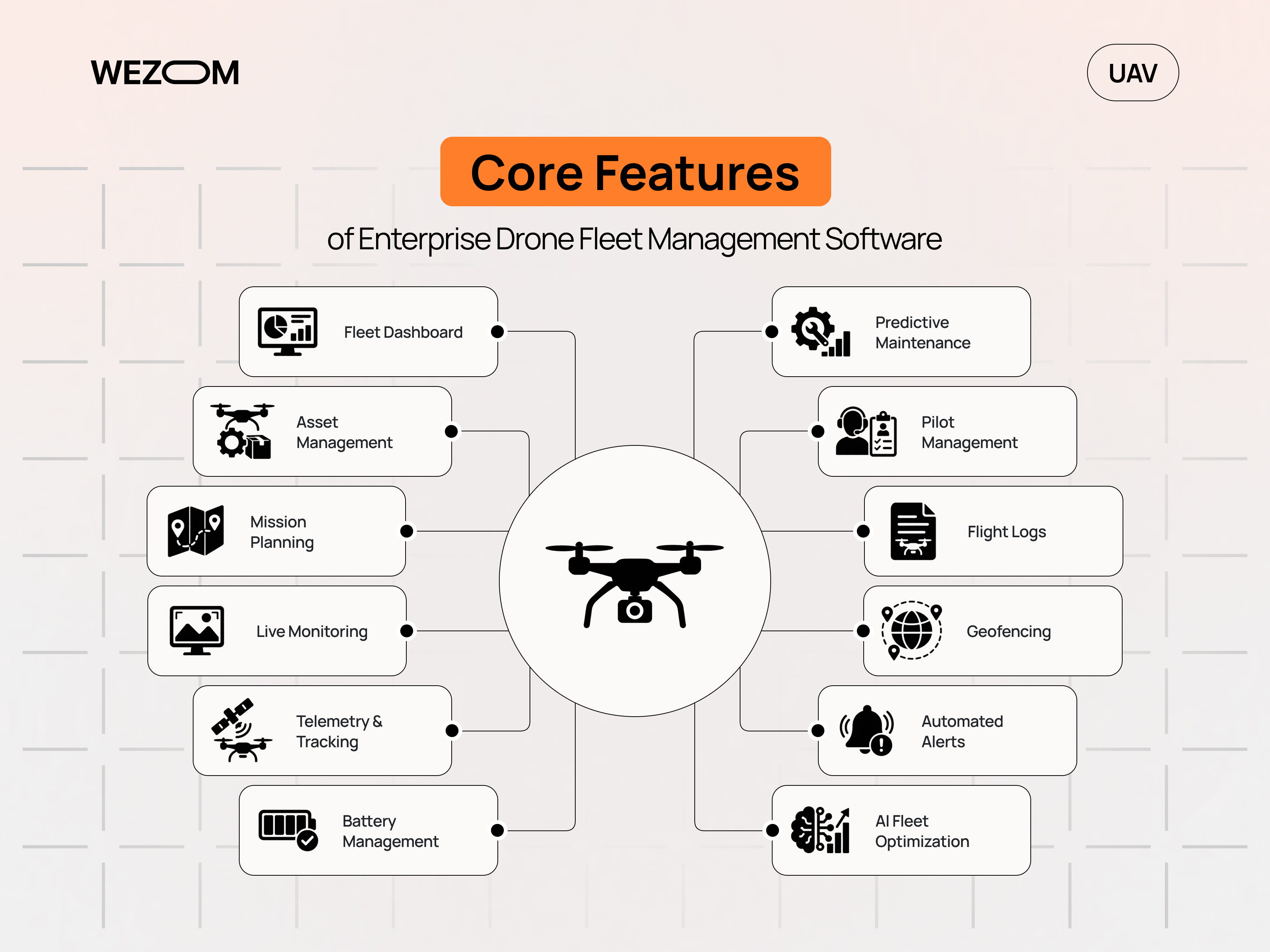
To ensure the resilience of each drone and maximize their return on investment, UAV fleet management software should include the following modules:
- Fleet dashboard. This is a centralized interface for real-time visualization of drone fleet KPIs. It should display availability, mean time between failures, and drone utilization rates.
- Drone registration and asset management. These are essentially digital twins of drones, storing inventory history, serial numbers, firmware versions, hardware configurations, and other parameters.
- Mission planning and scheduling. These capabilities are handled by automated flight mission planning tools. They must take into account terrain topography, weather conditions, meteorological data, operator schedules, and other factors.
- Live fleet monitoring. This category includes real-time monitoring tools. They allow dispatchers to simultaneously monitor the status of all active UAVs on a single map.
- Telemetry and flight tracking. These tasks are covered through functionality for collecting and streaming flight data. It typically uses standard protocols such as MAVLink/DDS.
- Battery health management. This module monitors battery health to prevent power failures.
- Predictive maintenance. This module utilizes machine learning-based analytics, predicting the wear and tear of drone components long before actual failure occurs.
- Pilot and team management. This module includes everything needed for personnel management, including qualifications, pilot certificates, work schedules, etc.
- Flight logs and reporting. This module automatically generates flight log entries and reports in full compliance with regulatory requirements.
- Geofencing and airspace awareness. This refers to integration with UTM systems, which is needed to dynamically create virtual barriers and bypass no-fly zones.
- Automated alerts. This includes a customizable trigger notification system for dispatchers (usually, it notifies about geofencing violations, battery voltage drop, etc.).
- AI-based fleet optimization. Here, AI is used to optimize logistics and resource planning for the UAV fleet.
Autonomous Drone Fleet Software: Advanced Capabilities
Each component of the unmanned aerial vehicle control system solves a number of highly specific tasks to minimize human intervention and improve the efficiency of workflows involving drones. Actually, these components include:
- Autonomous missions. This refers to the ability of UAVs to perform complex flight missions without operator intervention, relying on pre-defined logic for handling unforeseen situations.
- Automated takeoff and landing. This primarily refers to automated takeoff and landing operations using onboard sensors, computer vision, and RTK correction.
- AI navigation. This is where onboard AI accelerators come in handy, performing real-time flight trajectory modifications based on external factors.
- Obstacle avoidance. This component uses spatial scanning systems (based on lidar and optical cameras) to enable drones to instantly recognize surrounding objects and reroute.
- Remote supervision. This drone control principle involves the operator monitoring the entire fleet of drones simultaneously, intervening only if something goes wrong.
- Dock integration. This requires hardware and software integration with drone ports, which protect the drone fleet from external threats, recharge batteries, and handle the upload of collected telemetry.
- Autonomous inspections. This component includes regular overflights of industrial facilities using predefined scripts, automatically analyzing the data with neural networks for defects.
- Fleet orchestration. This is an engine that distributes flight missions among drones based on their remaining battery charge and physical location.
- BVLOS operations. These operations include performing missions over long distances when the UAV is out of visual range of the operator.
- Multi-drone coordination. This includes swarm technologies and mesh networks, which allow multiple UAVs to synchronously perform joint tasks (for example, distributing scan zones over large areas or coordinating movement).
Enterprise Integrations That Maximize Operational Efficiency
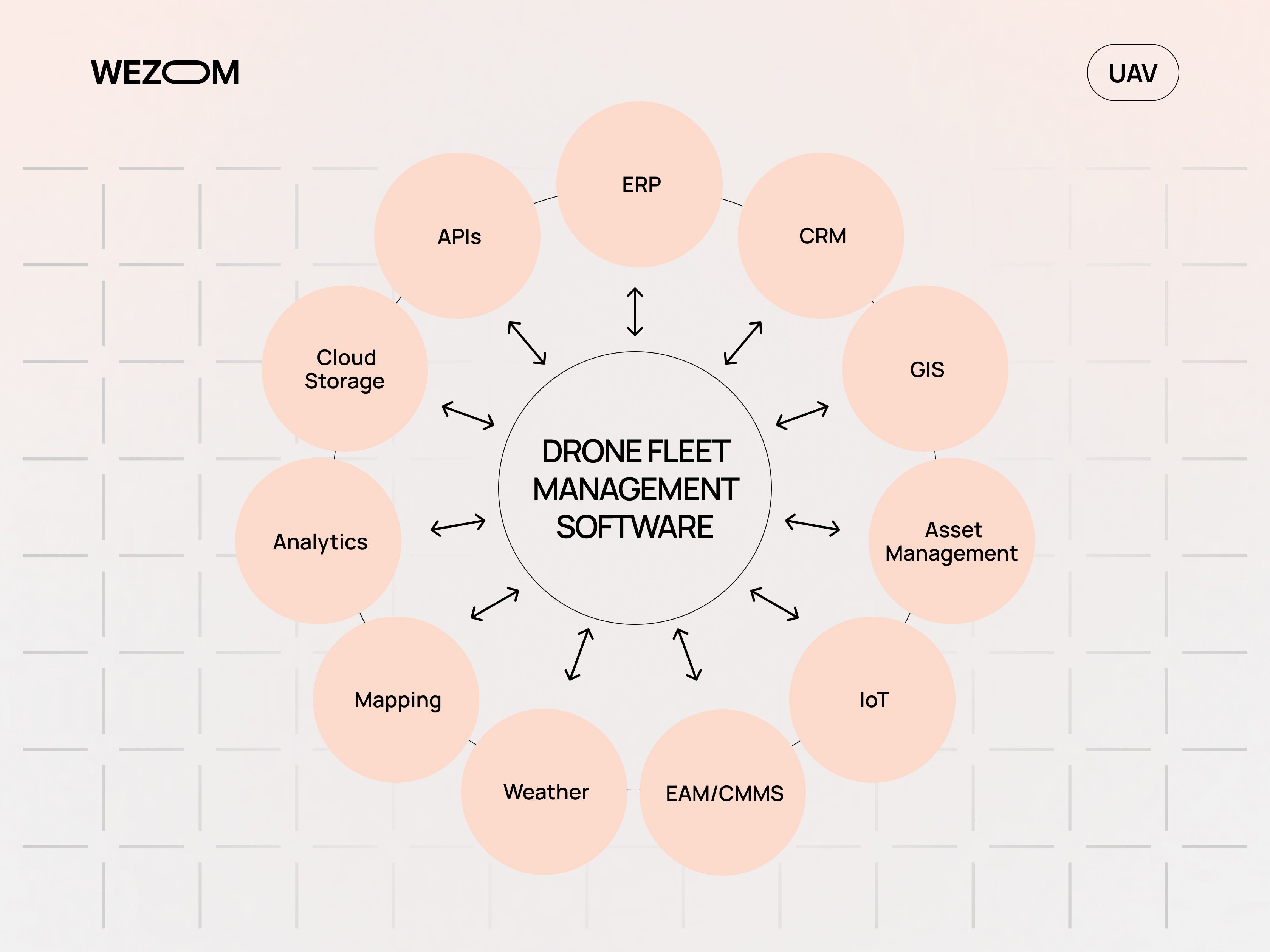
A drone used for business purposes shouldn't operate autonomously, which is why seamless integration of the drone fleet management software into the company's IT ecosystem is so important. This typically includes:
- ERP system. Integration with such systems allows businesses to calculate flight mission costs and write off UAV components and associated equipment, enabling proactive resource planning for future flight missions.
- CRM system. This integration is useful for directly transferring inspection reports to customer cards, which speeds up billing and confirms service SLA fulfillment.
- GIS platform. Real-time communication with such platforms enables the rapid overlay of orthophotos and thermal maps onto a single enterprise geographic map.
- Asset management platform. This synchronization enables real-time updating of digital twins of infrastructure assets through continuous flight data updates.
- IoT platform. This integration allows businesses to combine telemetry with industrial sensor data (e.g., vibration sensors on-site), opening up extensive opportunities for monitoring technological safety.
- EAM and CMMS. Connection to these systems makes it possible to automatically generate maintenance requests based on drone wear and infrastructure defect analytics.
- Weather services. Integration with meteorological APIs enables businesses to predictively assess flight risks due to weather conditions and implement triggers for automatic mission cancellation.
- Mapping software. Integration with software like Pix4D enables instant conversion of RAW or JPEG imagery into orthophotos or digital elevation models.
- Analytics platforms. By uploading inspection data to BI systems, company engineers can build dashboards on drone performance.
- Cloud storage. Using highly scalable cloud storage, companies can quickly and affordably archive terabytes of 4K/8K video streams.
- APIs. The availability of open architectural interfaces opens up great opportunities for any custom integrations, including proprietary and legacy systems.
Security, Compliance, and Enterprise Governance
Managing a fleet of drones, for addressing a number of regulatory requirements and withstanding potential cyber threats, requires top-level software security. Therefore, before choosing a specific solution, you must review the following aspects (or, if developing, consider them at the project architecture’s level from the start).
- User roles. It's important to ensure a role-based access control model with granular permissions is implemented (these should be separate for pilots, dispatchers, security administrators, engineers, etc.).
- Encryption. You must ensure the use of end-to-end encryption such as AES-256 (for data on onboard drives) and TLS 1.3 (for telemetry and video transmission channels).
- Secure cloud infrastructure. The software must be deployed on fault-tolerant cloud clusters compliant with ISO/IEC 27001 and SOC 2 Type II standards and support on-premise installation.
- Data protection. The software must comply with personal data protection standards such as the GDPR and ensure automatic blurring of faces and license plates in videos.
- Cybersecurity. Multi-layered protection against cyberattacks, including spoofing and jamming mitigation, regular pentesting, and enhanced security for API gateways are essential.
- Regulatory compliance. The software must implement compliance monitoring for each mission with the current aviation legislation of the specific region of jurisdiction.
- Remote ID. The software must integrate digital identification standards for drones in flight – this is essential for ground-based airspace control services.
- FAA/EASA requirements. Developers must adapt the system logic to the requirements of leading aviation regulators (e.g., the US Federal Aviation Administration), including flight scenario certification (such as Specific Category for BVLOS missions).
- Audit trails. The system must provide immutable system audit logs that record all user actions, modified drone missions, incidents, etc., to enable a reasoned investigation when incidents occur.
Analytics and Performance Metrics That Matter
For effective enterprise-wide drone management, it's important to rely on measurable KPIs, and this is where software solutions that automate data collection and analysis come in. Here's a basic set of metrics:
- Mission success rate, which determines the percentage of successfully completed missions out of the total planned number, allowing businesses to identify planning failures and those related to UAV technical malfunctions;
- Drone utilization, which shows the ratio of drone active operating time to the total time it's in the company's fleet;
- Battery lifecycle, which allows companies to identify lithium-polymer battery degradation and track charge/discharge cycles to predict the optimal replacement date (which is useful for preventing airspace emergencies);
- Maintenance costs, including repair and component replacement expenses, as well as scheduled maintenance for each individual drone;
- Fleet availability, which determines the fleet's readiness to perform missions, taking into account scheduled repairs and weather restrictions;
- Flight time, displaying the total flight time statistics for each drone, which is valuable for effective maintenance planning;
- Incident reporting, with accompanying analytics on all abnormal situations and deviations from previously set routes;
- Operational efficiency, a metric that evaluates the overall effectiveness of work processes involving drones;
- ROI, which takes into account the cost of the drones themselves, their firmware, high-level software, maintenance, and other expenses;
- Productivity, which determines the volume of work performed per unit of time.
Industry Use Cases
Each industry where drone use is common has its own unique application scenarios. For example, in logistics, software platforms automate last-mile cargo delivery thanks to their ability to seamlessly integrate with autonomous droneports. This enables contactless dispatch and receipt of parcels. Software can also coordinate supply chains and optimize flight schedules in real time, taking into account parcel restrictions and weather conditions. And of course, the ability to track shipment statuses in real time is extremely valuable for end customers.
In the energy and utilities sectors, software automates inspections of high-voltage power lines, heating mains, solar farms, and other large structures. This allows dispatchers to accurately plan repairs (as drones, using thermal imaging, can detect microcracks and heat leaks).
Construction is also worth mentioning here. For companies in this sector, UAV fleet management software deployment provides end-to-end monitoring of the construction process. Specifically, through regular photogrammetric missions, it automatically generates 3D models of objects and point clouds, determines excavation volumes, and compares actual progress with BIM schedules.
Another industry where drones are frequently used is agriculture. There, specialized software platforms are utilized for precision farming, processing multispectral field images, calculating real-time vegetation indices, identifying moisture/fertilizer deficiency zones, creating maps for differentiated pesticide application, and much more.
In the mining industry, drone fleet management platforms automate surveying, ensuring centimeter-level accuracy for mined rock volumes. The software is also responsible for monitoring the geomechanical stability of quarry walls and inspecting hard-to-reach mining equipment.
Finally, such platforms are often used in public safety: they provide aerial monitoring (important for real-time analysis of emergency situations), thereby helping to deploy search and rescue operations in challenging conditions. They can also be applied to assess the scale of natural disasters or coordinate attendance at mass events.
How to Choose Enterprise Drone Fleet Management Software
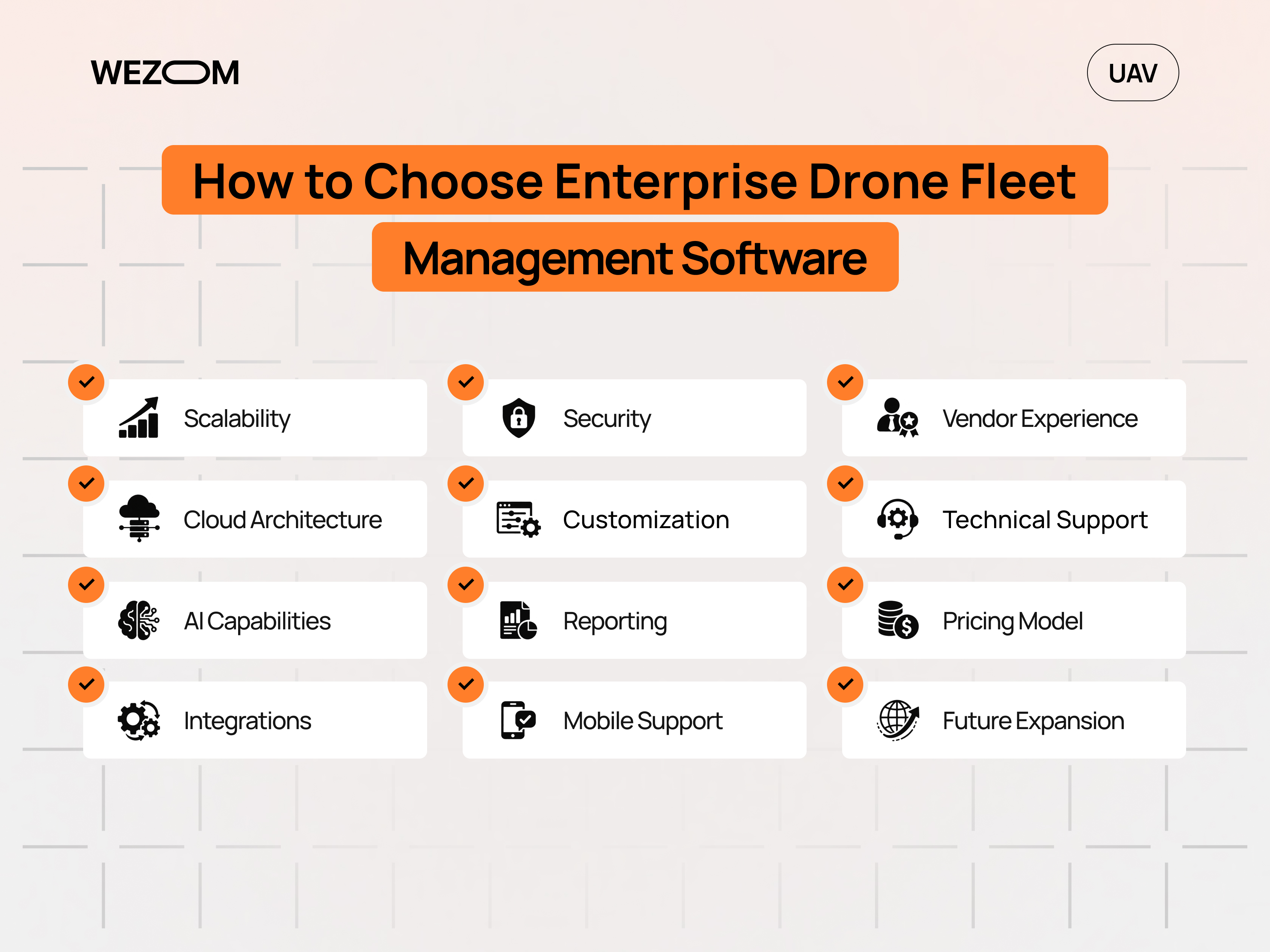
Selecting a platform for managing a UAV fleet requires a thorough assessment of both technological and business criteria. Specifically, focusing on solutions from leading vendors like DroneDeploy and DJI FlightHub 2, we would include the following parameters:
- Scalability. This refers to the system's ability to regularly increase the number of managed aircraft, operators, and spatial data without performance degradation.
- Cloud architecture. It is important that the autonomous drone fleet software be based on a fault-tolerant distributed cloud infrastructure, preferably with microservices support and the ability to deploy on-premises to private facilities.
- AI capabilities. AI algorithms perform predictive analytics on drone component wear and tear and take over route planning without direct operator intervention.
- Integrations. It's crucial to ensure compatibility with corporate systems such as ERP and CRM, as well as GIS platforms and maintenance systems. All integrations must be implemented strictly through open APIs.
- Security. The software you choose must ensure compliance with information security standards (for example, through TLS 1.3/AES-256 protocols), as well as have protection against spoofing and provide the ability to isolate corporate circuits.
- Customization. In this context, you need to evaluate the potential for interface customization and role-based access. You also have to check whether the software supports the implementation of unique flight procedures and pre-flight checklists (preferably based on your internal corporate templates).
- Reporting. The software must include tools for generating analytical dashboards and reports that fully comply with the requirements of both internal management and external regulatory bodies.
- Mobile support. It is desirable for the software to also be available in a highly accessible mobile version, which is useful for field specialists.
- Vendor experience. The vendor must have years of developer expertise in both the unmanned technology market and your niche – evidence of this is usually demonstrated by successful implementation cases in your segment.
- Technical support. The vendor must specify the maximum acceptable technical support response time to incidents and, if necessary, provide dedicated support specialists.
- Pricing model. The vendor must have a transparent licensing pricing policy, regardless of the model it adheres to (SaaS, volume of processed data, corporate perpetual licenses, etc.).
- Future expansion. Finally, you should evaluate the platform's potential for future integration of emerging technology trends, such as swarm intelligence and automated drone ports.

FAQ
What is drone fleet management software?
This is specialized software for centralized control of a fleet of unmanned aerial vehicles. Such solutions consolidate telemetry data, flight missions, maintenance schedules, task assignments between operators, and more, into a single dashboard.
Why do enterprises need drone fleet management software?
Companies need such drone fleet software to optimize workflows and eliminate human error when scaling air operations. Specifically, such platforms handle dispatching, regulatory compliance, and the consolidation of flight missions into a single system.
What features should enterprise drone fleet management software include?
Such a software solution should include a centralized dashboard, functionality for remote control of drones (both individually and in swarms) and digital twins, a mission planner, real-time telemetry tracking, predictive maintenance, battery health monitoring, geofencing, and other advanced AI-powered features.
How does autonomous drone fleet software work?
To achieve autonomy, the system must integrate with onboard autopilots and use AI navigation algorithms to help avoid obstacles in real time. It must also connect to docking stations to orchestrate tasks without operator intervention (they are responsible only for remotely monitoring all the drones).
Can one platform manage hundreds of drones?
Yes, in today's reality, this is the standard for enterprise-grade systems. To achieve this, these platforms typically rely on cloud technologies and distributed databases.
