
Since March 16, 2024, when the FAA ended its enforcement discretion period, nearly every registered drone flying in U.S. airspace has had to broadcast its identity and position. For operators, compliance is mostly a hardware purchase. For manufacturers, integrators, and companies building custom UAV platforms, drone remote id is an engineering problem with its own accuracy thresholds, radio standards, and firmware architecture. This guide explains how the FAA rule works, how broadcast modules and integrated systems are built, what compliant software must do, and how to plan and staff an implementation.
What Is Drone Remote ID and Why Is It Required?
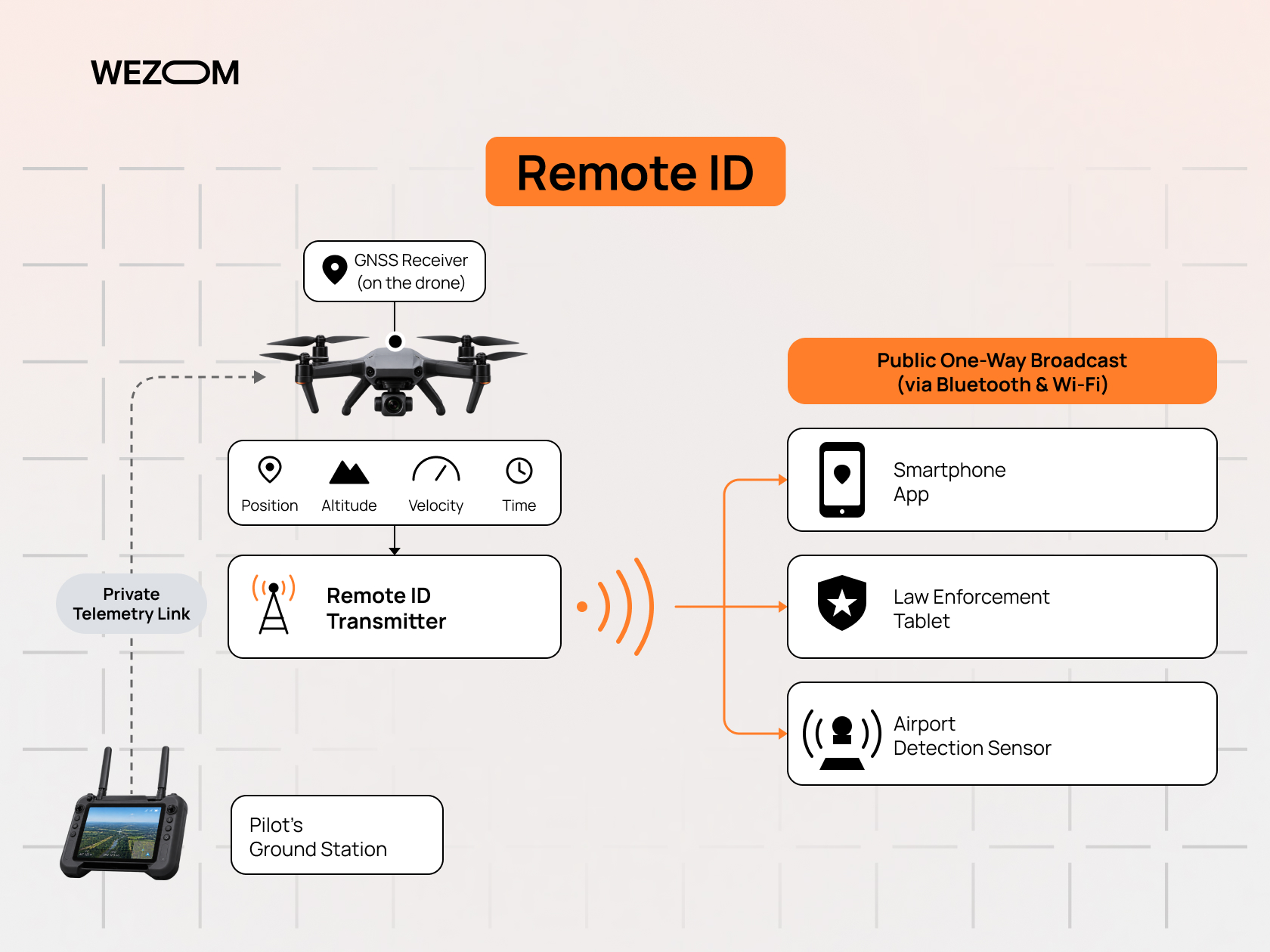
Remote ID is the ability of an unmanned aircraft in flight to broadcast identification and location information that other parties can receive. It works like a digital license plate: the broadcast contains no name or address, only an identifier that authorized agencies can link to a registration record.
How drone remote identification works
The drone, or a module attached to it, reads its position from a GNSS receiver, packages it with an identifier and other required fields, and transmits the result over Bluetooth or Wi-Fi at least once per second. Any compatible receiver in radio range, including many smartphones running a receiver app, can decode it. The U.S. model needs no network connection or ground infrastructure, so it works in remote areas without cellular coverage.
What information does Remote ID broadcast?
Under 14 CFR 89.305, a Standard Remote ID drone broadcasts its identity (serial number or session ID), its latitude, longitude, geometric altitude, and velocity, the control station's latitude, longitude, and geometric altitude, a UTC time mark, and an emergency status. A broadcast module sends its own serial number and the same aircraft data, but reports the takeoff location instead of the control station, because it usually has no way of knowing where the pilot stands.
The role of Remote ID in drone identification, tracking, and airspace safety
Remote ID lets the FAA, law enforcement, and security teams locate the control station or launch point when a drone is flying unsafely or where it is not allowed. It also serves as the cooperative layer of a wider drone identification system. Airports, prisons, and stadiums often pair Remote ID receivers with RF detection or radar, because non-cooperative drones must be found by other sensors.
Drone Remote ID vs GPS tracking and traditional drone telemetry
Conventional drone telemetry travels over a proprietary or MAVLink-based link to the operator's ground station and includes battery state, attitude, and mission progress. GPS trackers report position to a private cloud. Remote ID is a one-way public broadcast in a non-proprietary format that any third party can decode, limited to the regulated fields. The source data overlaps, but the recipients and the compliance obligations differ.
FAA Remote ID Regulations and Drone Compliance Requirements
The faa remote id regulations cover both people who fly drones and companies that build them: operator rules define what the product must support in the field, and design rules define what must be demonstrated before it ships.
FAA Remote ID rule summary: 14 CFR Part 89
A practical faa remote id rule summary starts with dates. The final rule took effect on April 21, 2021. Design and production requirements for drones without a type certificate apply after September 16, 2022, operating requirements after September 16, 2023, and enforcement discretion ended on March 16, 2024.
Part 89 gives operators three compliance paths, described below. Subpart F obligates producers to use ANSI/CTA-2063-A serial numbers, design to an FAA-accepted means of compliance, run independent audits, retain records, and report noncompliance within 15 calendar days, so FAA Part 89 compliance depends on a quality process as well as a working product.
Which drones must comply with FAA Remote ID regulations?
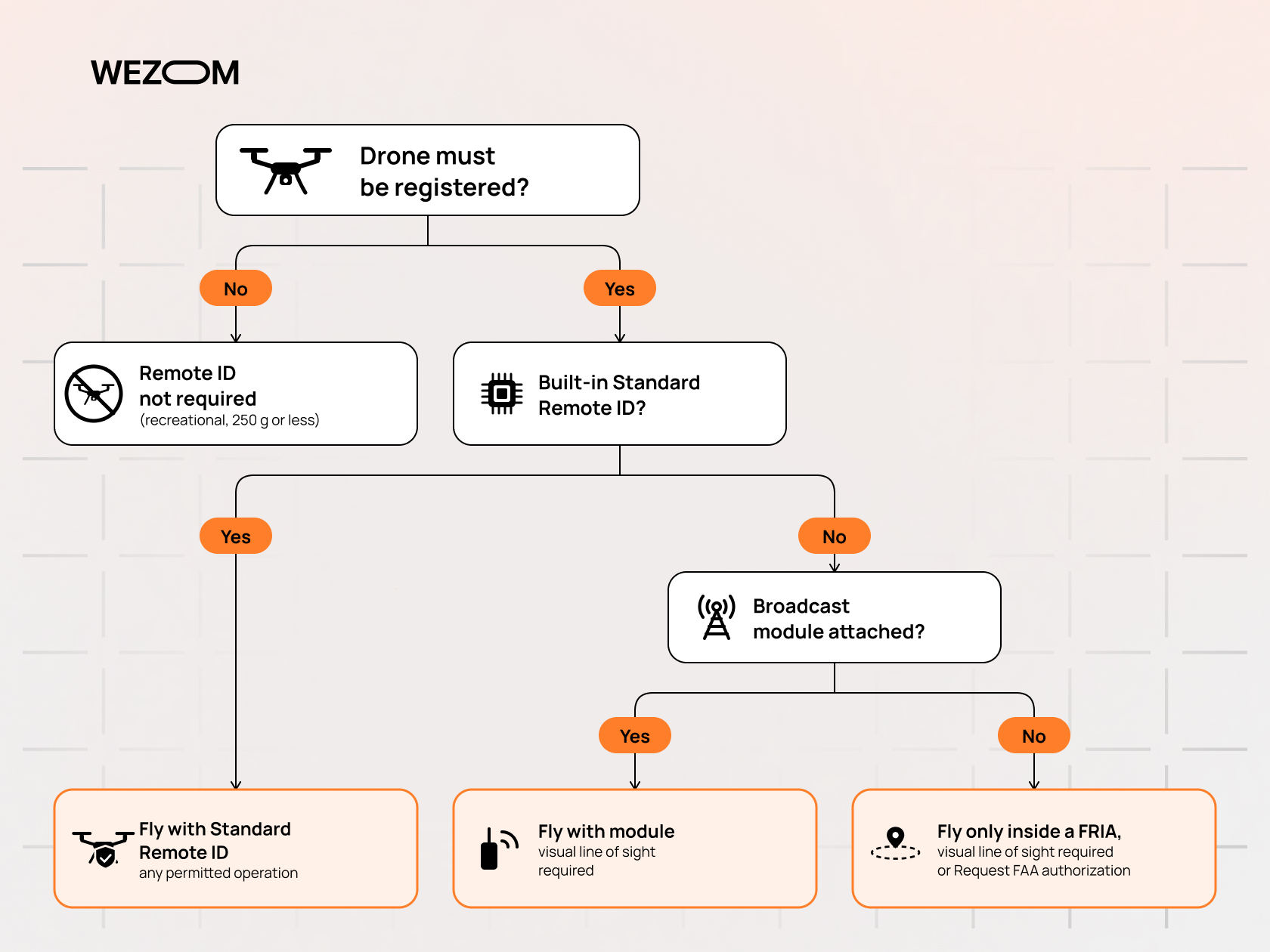
Any drone that must be registered, or is registered, must comply. In practice, faa remote id drones include every aircraft over 250 grams (0.55 lb) and any drone flown under Part 107 regardless of weight. Unregistered recreational drones at or below 250 grams fall outside the requirement. Home-built and research aircraft are exempt from the production rules, but a registered home-built drone still needs a module or FRIA operation.
Remote ID requirements for commercial drones and Part 107 operations
For Part 107 operators, drone remote id requirements add a registration step per aircraft. Each Standard Remote ID drone or broadcast module is registered separately in FAADroneZone with its Remote ID serial number. Pilots must check the system before each flight, and some waived operations, such as light shows, can request a Letter of Authorization to deviate from the rules.
Standard Remote ID, broadcast modules, and FAA-Recognized Identification Areas (FRIAs)
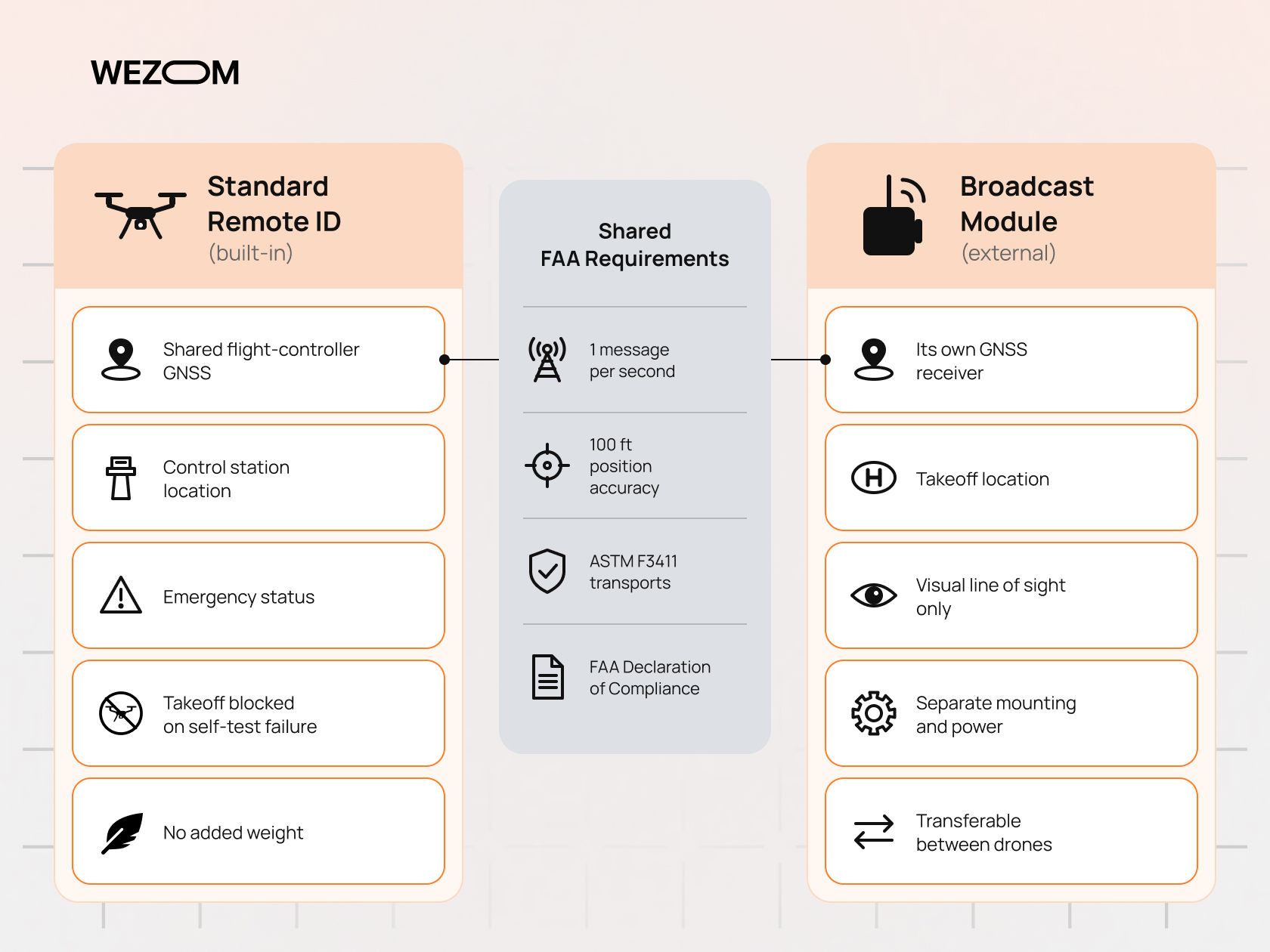
Standard remote identification is built in by the manufacturer. It broadcasts the control station location and an emergency status, and it must prevent takeoff if the pre-flight self-test fails. A remote id broadcast module is an add-on that reports the takeoff location instead, and drones using one must stay within the pilot's visual line of sight for the whole flight. An FAA-Recognized Identification Area is a defined site, requested by a community-based organization or educational institution, where drones without Remote ID may fly within visual line of sight and inside the boundary.
Remote ID registration and Declaration of Compliance requirements
The FAA Declaration of Compliance is the producer's formal statement that a drone model or module meets Part 89 through an accepted means of compliance. Only manufacturers submit DoCs. Each declaration lists the make and model, serial number range, the FCC ID of the Part 15 radio, the means of compliance, and a statement that the radio was integrated without altering its authorized RF parameters. Operators check the public list of accepted products before entering the drone registration serial number in FAADroneZone. Because the FAA can rescind acceptance, ongoing quality control matters as much as initial approval.
Exemptions, operational limitations, and consequences of noncompliance
Beyond the weight and FRIA exceptions, the FAA authorizes flights without Remote ID only for aeronautical research or compliance demonstration, and ADS-B Out cannot substitute for it on drones. Operators who fly without compliant Remote ID risk fines and suspension or revocation of their remote pilot certificates. For manufacturers, a rescinded DoC removes a product's eligibility for legal flight and can force field updates across the customer base.
How Does a Drone Remote ID Module Work?
A drone remote id module is a small embedded system that must meet strict accuracy and timing thresholds within tight power and weight budgets.
Remote ID broadcast module components and architecture
A typical module combines a GNSS receiver, a microcontroller or SoC with integrated Bluetooth and Wi-Fi, an antenna, power circuitry, and non-volatile storage for the serial number. Many designs use an ESP32-class chip for both radios and application logic, with the GNSS receiver on a UART. The firmware samples position, fixes the takeoff location, runs a self-test, and schedules transmissions.
Wi-Fi and Bluetooth technologies for Remote ID broadcasting
The ASTM F3411 standard defines four transports: Bluetooth 4 legacy advertising, Bluetooth 5 Long Range (extended advertising on the coded PHY), Wi-Fi Neighbor Awareness Networking (NAN), and Wi-Fi Beacon broadcasting. Bluetooth Remote ID transmission via legacy advertising is the most widely receivable, since nearly every smartphone supports it, but each advertisement carries a single 25-byte message, so the transmitter rotates through message types. Bluetooth 5 Long Range reaches further but needs receiver support. Wi-Fi Beacon places data in vendor-specific information elements and can carry a message pack of several messages at once. Many modules transmit on several transports simultaneously.
GNSS positioning, altitude, velocity, and timestamp transmission
GNSS position data drives nearly every broadcast field. Part 89 requires aircraft position within 100 feet and geometric altitude within 150 feet, both at 95% probability, and control station altitude on standard systems within 15 feet. Position must be broadcast within 1.0 second of measurement, at least once per second. Each position should carry GNSS-provided UTC time rather than a drifting local clock. Loss of GNSS fix is a failure the system must report.
Built-in Remote ID vs external UAS Remote ID modules
Built-in Standard Remote ID reuses the drone's GNSS and radios, reports the control station, enforces the takeoff restriction, and adds no weight. An external uas remote id module is self-contained and easy to retrofit, but limits flights to visual line of sight and adds weight, wiring, and sometimes a separate battery.
How to select a compliant Remote ID module for an existing drone
The first check is whether the remote id module appears on an FAA-accepted Declaration of Compliance. After that, buyers should compare weight against payload margin, power source, supported transports, GNSS performance, and mounting guidance that keeps the antenna clear of carbon-fiber shielding. Fleet operators benefit from modules that connect to the flight controller over MAVLink or DroneCAN, so the autopilot can block arming when Remote ID is unhealthy.
Drone Remote ID Software: Architecture and Core Features
Most of what Part 89 regulates, from self-testing to timing and fault reporting, is implemented in remote identification software.
Firmware architecture for Remote ID broadcasting
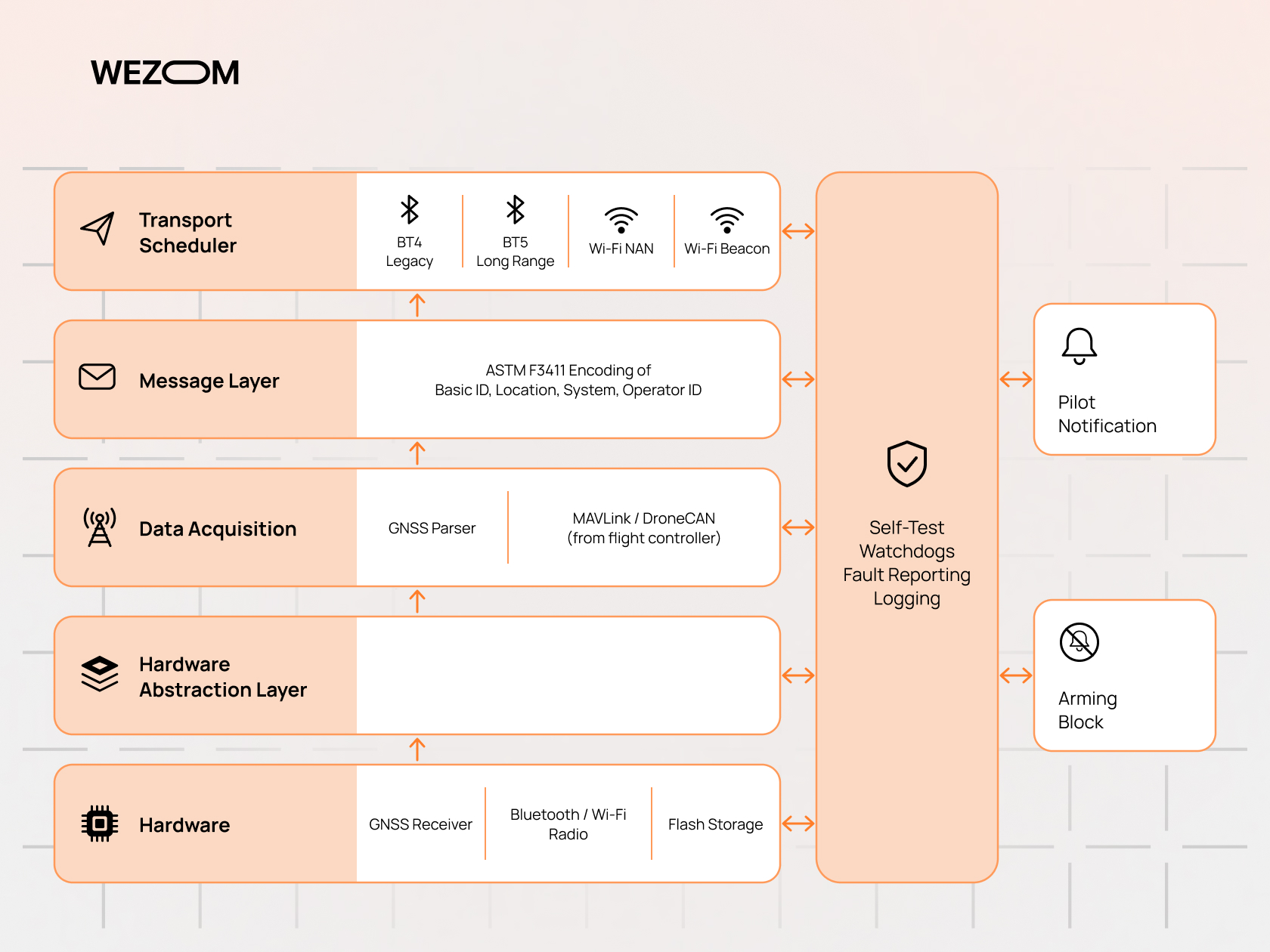
Remote ID firmware is usually layered. A hardware abstraction layer drives the GNSS receiver, radios, and storage. A data acquisition layer parses GNSS sentences or flight controller messages. A message layer builds ASTM F3411 messages, a transport scheduler decides what goes out on which radio and when, and a supervision layer runs self-tests and raises faults.
Remote ID message encoding, decoding, and data validation
The Remote ID message protocol in ASTM F3411 defines fixed 25-byte messages: Basic ID, Location/Vector, Authentication, Self-ID, System, and Operator ID, plus a Message Pack. Encoding scales coordinates into integers, converts altitude with a fixed offset and resolution, and sets accuracy indicators. The open-source opendroneid-core-c library is a common reference. Before encoding, firmware should reject positions with poor accuracy estimates, confirm timestamps advance, verify the CTA-2063-A serial format, and never broadcast stale data as current.
Integration with flight controllers through MAVLink and other protocols
The MAVLink communication protocol includes a dedicated message set: OPEN_DRONE_ID_BASIC_ID, OPEN_DRONE_ID_LOCATION, OPEN_DRONE_ID_SYSTEM, OPEN_DRONE_ID_OPERATOR_ID, and OPEN_DRONE_ID_ARM_STATUS, which tells the autopilot whether the transmitter is ready. The ground station supplies the operator location through OPEN_DRONE_ID_SYSTEM_UPDATE. DroneCAN offers equivalent messages. This UAS flight controller integration lets the autopilot refuse to arm when Remote ID fails.
Real-time telemetry processing and broadcast synchronization
Drone telemetry integration creates timing issues. The flight controller may publish position at 5–10 Hz while different message types go out at different rates, and the one-second latency limit applies throughout. Firmware should treat each position as a timestamped sample, discard samples older than the latency budget, and keep position, velocity, and time mark describing the same instant.
Remote ID receiver software and drone identification interfaces
Remote identification receiver software scans Bluetooth advertisements and Wi-Fi frames, filters for Remote ID identifiers, decodes messages, and merges them into one aircraft record keyed by serial number. A useful interface shows position, operator or takeoff location, altitude, speed, and signal age, and flags anomalies such as an aircraft jumping between distant positions.
Error handling, system diagnostics, and broadcast health monitoring
Part 89 requires continuous monitoring from takeoff to shutdown with pilot notification on malfunction. That requires task watchdogs, GNSS fix-quality checks, and a fault state machine. Drone broadcast signal monitoring reports status through LEDs, MAVLink messages, and logs. Loss of one transport may warrant only a warning, while loss of GNSS or all transports must alert the pilot immediately.
How to Develop FAA-Compliant Remote ID Software
The encoder is the well-documented part. The harder work is producing behavior that can be demonstrated and documented to the FAA.
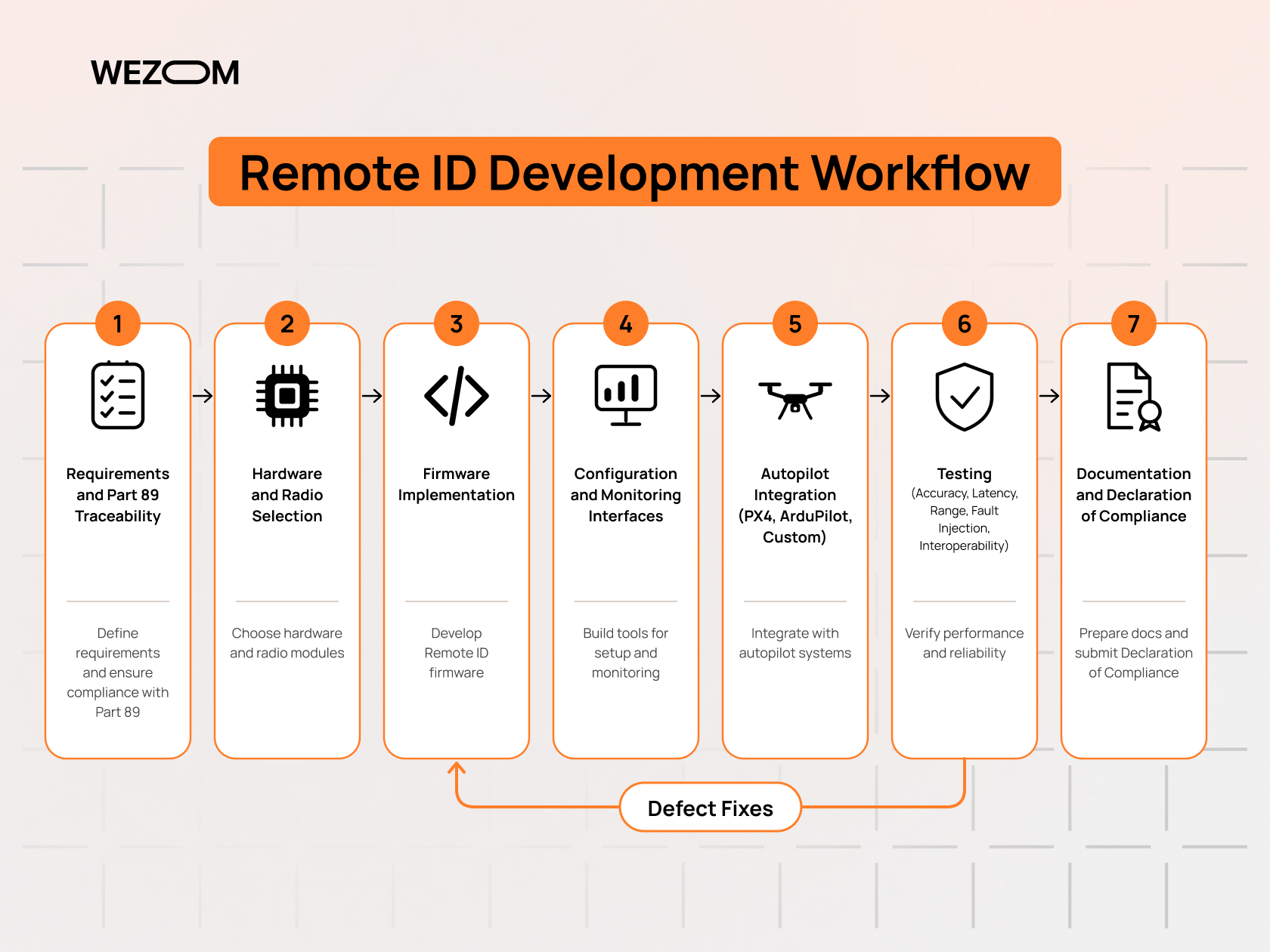
Defining functional and regulatory requirements
Requirements begin with the compliance path: Standard Remote ID for a new aircraft, or a broadcast module design. Each Part 89 clause, including position accuracy, latency, self-testing, tamper resistance, error correction, and non-interference, should trace to a functional requirement and then to a test.
Choosing hardware, embedded platforms, and communication protocols
Embedded drone software for Remote ID usually runs on a low-power microcontroller or SoC. The selection depends on whether the system reuses the autopilot's GNSS, which transports are needed, and power and weight limits. Using an FCC-authorized radio module without altering its RF parameters simplifies Part 15 compliance and matches what the DoC must declare.
Implementing Remote ID broadcasting in drone firmware
Implementation follows the layered architecture above. Tamper resistance needs attention here: the serial number belongs in protected memory, compliance-relevant settings should not be user-editable, and debug interfaces should be locked in production builds.
Building software interfaces for configuration and monitoring
Operators need to read the serial number, check status, update firmware, and in some jurisdictions enter an operator registration ID. A mobile app over Bluetooth or ground control software parameters usually serve this role, with operator settings kept apart from fixed compliance settings.
Integrating Remote ID with PX4, ArduPilot, and custom drone systems
PX4 Remote ID integration uses the OPEN_DRONE_ID MAVLink messages to work with external transmitters and includes an arming check that can require a healthy Remote ID system. ArduPilot Remote ID integration supports modules over MAVLink and DroneCAN, configured through its DID parameters, and the open-source ArduRemoteID firmware runs on low-cost ESP32 boards. ArduPilot can also lock Remote ID settings, which supports tamper resistance. Custom flight stacks need an equivalent message contract, an arming interlock, and a path for the operator location.
Testing broadcast accuracy, reliability, and interoperability
Remote ID testing and validation covers encoding checks against reference decoders, GNSS accuracy tests, latency measurement from fix to transmission, range tests with various receivers, interference tests with onboard radios, and fault injection (GNSS loss, radio failure, power interruption) to verify alerting.
Preparing technical documentation for FAA compliance verification
The DoC depends on documentation: the requirements trace, test procedures and results, the means of compliance, module installation instructions, and evidence of the audit and noncompliance-notification process. Part 89 requires these records to be kept for the production period plus 24 months and made available to the FAA on request.
Remote ID Standards, Security, and Data Protection
ASTM F3411 and its role in Remote ID implementation
The ASTM F3411 standard turns Part 89's performance requirements into concrete message formats, transports, and test methods. The FAA accepted ASTM F3586-22, which builds on F3411-22a, as a means of compliance, so designs following it can be declared compliant. Europe's EN 4709-002 uses the same message structure.
Broadcast Remote ID vs Network Remote ID
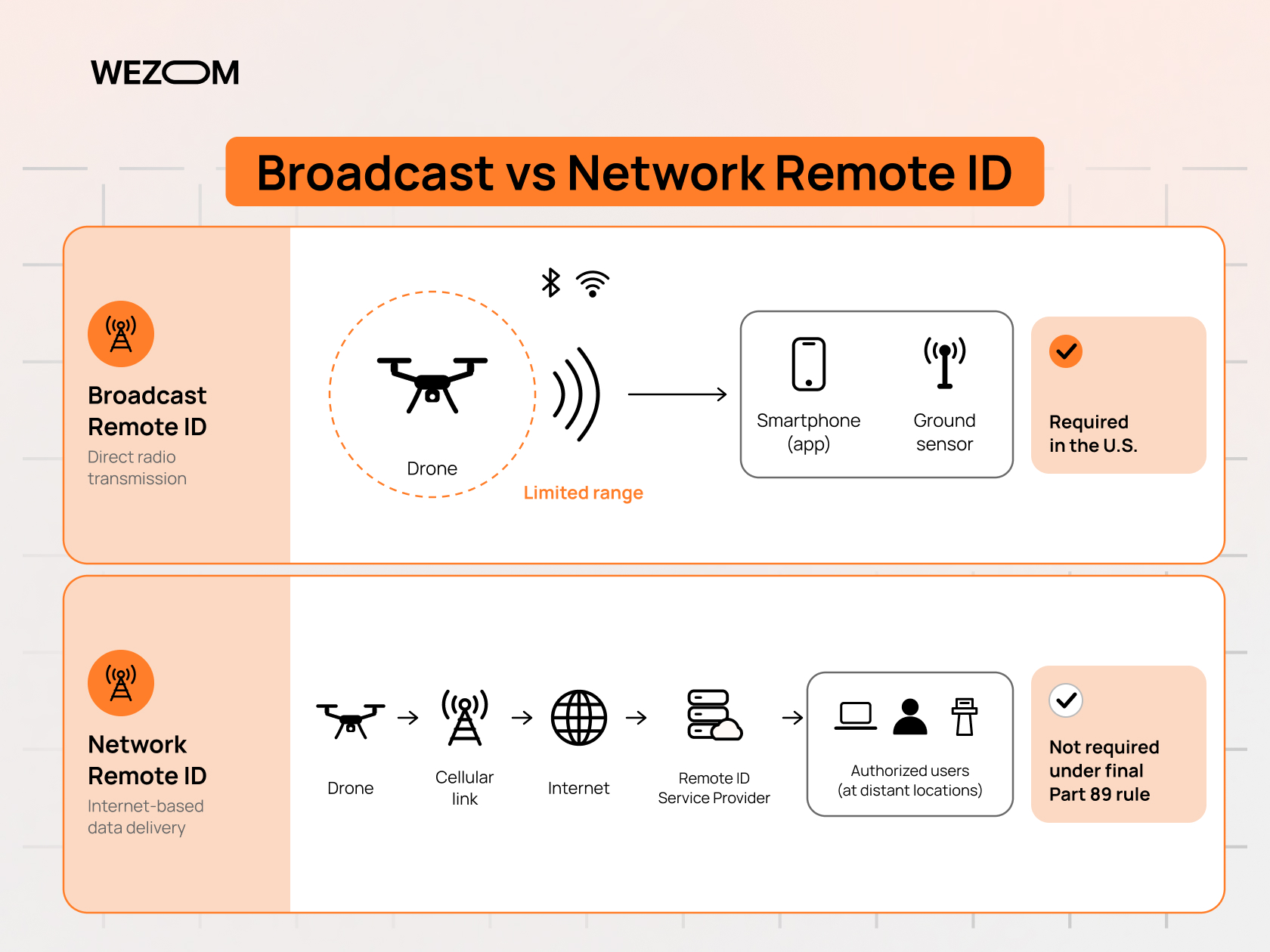
Broadcast Remote ID goes directly from aircraft to nearby receivers. Network Remote ID sends data over the internet to a Remote ID service provider, making it visible beyond radio range. The proposed FAA rule included a network requirement, but the final rule dropped it after concerns about privacy, security, and cost, so U.S. compliance is broadcast-only.
Remote ID message integrity, spoofing risks, and cybersecurity
Remote ID broadcasts are unencrypted and usually unauthenticated, so anyone with suitable hardware can inject fake aircraft or replay real messages. ASTM F3411 defines an Authentication message, but the FAA rule does not mandate signatures. Detection platforms therefore cross-check Remote ID against RF direction finding or radar. For manufacturers, drone cybersecurity priorities center on protecting the transmitter from tampering and the update channel from compromise.
Privacy considerations for drone operators and fleet owners
Standard Remote ID broadcasts the control station location, so an operator's position is visible to anyone nearby. Fleet owners also expose operating patterns, since repeated serial numbers can reveal clients, routes, or job sites. The FAA's planned session ID option would replace the permanent serial number with a temporary identifier that only the FAA can link to the operator.
Secure firmware updates and ongoing compliance maintenance
Firmware over-the-air updates should be cryptographically signed, verified by a secure bootloader, and protected against rollback to vulnerable versions. Any update affecting compliant behavior should pass the same regression suite used for the original declaration, because the producer stays responsible for continued compliance.
Drone Remote ID Integration with Fleet Management Software
Connecting Remote ID data with drone fleet management platforms
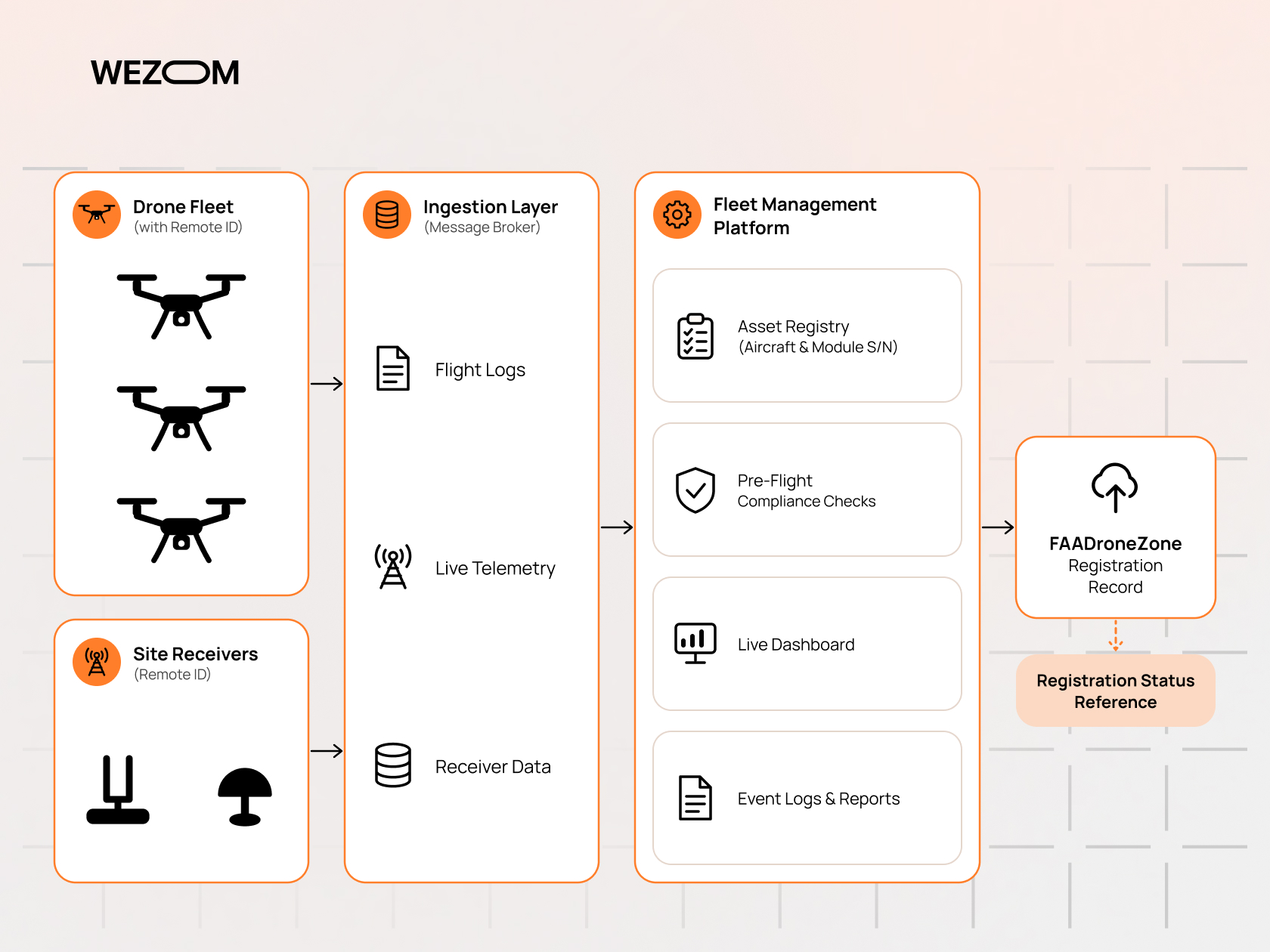
A drone fleet management platform already tracks aircraft, batteries, pilots, and maintenance. Adding Remote ID means storing each aircraft's Remote ID serial, recording which module is mounted on which airframe, tracking DoC status, and importing transmitter health from flight logs or live telemetry.
Real-time drone identification and operational dashboards
Dashboards can combine internal telemetry with feeds from Remote ID receivers installed at operating sites. Dispatchers then see their own aircraft next to third-party drones broadcasting nearby.
Automated compliance checks and pre-flight validation
Pre-flight compliance checks can confirm that registration is current, that the Remote ID serial matches the registration, that the module runs an approved firmware version, and that the latest self-test passed. Drone compliance software can block mission dispatch when any check fails and tell the pilot exactly which condition is unmet.
Remote ID event logging, monitoring, and reporting
Timestamped logs of self-test results, faults, and broadcast interruptions create an audit trail. Drone compliance monitoring reports built on this data reveal recurring problems, for example a module that repeatedly loses GNSS fix on one airframe type because of antenna placement.
Scaling Remote ID infrastructure for enterprise drone fleets
At enterprise scale, the main concerns become configuration management across hundreds of devices, staged firmware rollouts, receiver networks at multiple sites, and data retention policies. An event-driven architecture that ingests telemetry and receiver data through a message broker scales more predictably than polling devices individually.
Remote ID Compliance Challenges for Commercial Drone Operations
Retrofitting legacy drones with Remote ID broadcast modules
Many older commercial aircraft will never receive a manufacturer firmware update that adds Standard Remote ID, which leaves modules as the only option. Retrofitting raises mounting, antenna placement, and center-of-gravity questions, and the visual line of sight restriction can rule out missions the aircraft previously flew under waivers.
Hardware compatibility and firmware integration challenges
Connecting a module to an older autopilot may require a firmware upgrade that introduces unrelated regressions. Interference with control links and noisy power rails cause intermittent faults that often appear only in flight.
Managing Remote ID in multi-drone and autonomous operations
When one operator controls several drones, each aircraft broadcasts its own identity, but the control station position must be accurate for all of them. Drone-in-a-box systems need automated self-test verification and remote alerting, since no pilot is on site to watch a status LED.
Remote ID limitations for BVLOS drone missions
Broadcast modules cannot be used beyond visual line of sight, so BVLOS drone operations require Standard Remote ID. Broadcast range is also much shorter than typical BVLOS distances, so Remote ID does not provide the traffic awareness these missions need. BVLOS approvals typically rely on detect-and-avoid systems and network-based services in addition to Remote ID.
Maintaining compliance across different regulatory jurisdictions
The EU requires direct remote identification that also broadcasts the operator registration number, and Japan and other countries enforce their own rules. Manufacturers selling internationally need firmware with regional profiles, a way to lock the correct profile per market, and separate documentation for each authority.
Drone Remote ID Software Development Costs and Implementation Timeline
Key factors influencing Remote ID software development costs
Scope drives cost. The main variables are whether the product is a broadcast module or a fully integrated standard system, how many transports it supports, whether the autopilot is open source or proprietary, whether international profiles are required, and how much testing and documentation the DoC demands.
Ready-made Remote ID modules vs custom embedded software
Off-the-shelf modules have a low unit price and need no development, but they add weight, require separate maintenance, and cannot support BVLOS operations. Custom embedded software makes sense when Remote ID must be integrated into a new airframe or when the manufacturer needs control over firmware and data.
Development stages from prototype to production-ready solution
A typical path runs from requirements and architecture to a prototype built on reference libraries, then autopilot integration, field testing, production hardening (secure boot, locked configuration, manufacturing provisioning of serial numbers), documentation, and DoC submission. Duration depends mainly on scope and on how quickly field-test findings are resolved.
Testing, certification-related expenses, and maintenance costs
Beyond engineering hours, budgets should include RF and range testing, test equipment and receivers, independent audits required by Part 89, documentation, and long-term maintenance for firmware updates and regulatory changes.
When custom Remote ID development makes business sense
Custom work pays off for manufacturers launching new platforms, companies planning BVLOS services, and operators whose fleets are large enough that integrated compliance and automated monitoring reduce per-aircraft overhead.
How to Choose a Drone Remote ID Software Development Partner
Required expertise in embedded systems and drone communication protocols
A partner should have production experience with embedded C/C++, real-time operating systems, Bluetooth and Wi-Fi stacks, GNSS integration, MAVLink, and DroneCAN, plus PX4 or ArduPilot internals.
Experience with FAA regulations and aviation software standards
The team should understand Part 89 and ASTM F3411 in detail and know how to build traceable requirements and test evidence that support a Declaration of Compliance.
Hardware-software integration and compliance testing capabilities
Drone hardware-software integration skills, including antenna placement, interference testing, and fault injection, matter as much as code quality.
Long-term technical support, scalability, and regulatory updates
Remote ID products need maintenance for years. Drone software development services should cover update pipelines, fleet monitoring, and adaptation to rule changes such as session IDs or new international requirements.

FAQ
Can Remote ID work without an internet connection?
Yes. U.S. Remote ID is broadcast directly over Bluetooth or Wi-Fi and decoded locally, so neither the drone nor the receiver needs internet access, although a receiver app may need data for map tiles. Network Remote ID is not required by the FAA.
Can a drone's Remote ID signal be detected with a smartphone?
Yes, with a receiver app. Almost all phones can receive Bluetooth 4 legacy advertising, while Bluetooth 5 Long Range and Wi-Fi NAN reception depend on the phone's chipset and operating system.
Does a Remote ID broadcast module require a separate battery?
It depends on the model. Some modules have an internal battery, others draw power from the drone, and some support both. A battery-powered module that dies mid-flight stops the broadcast and forces the pilot to land.
Can one Remote ID module be used on multiple drones?
Yes, but only on one drone at a time. Recreational flyers can move a module between drones listed in their FAADroneZone inventory. Part 107 pilots register the module with a specific aircraft and must keep that record accurate when they move it.
Can Remote ID be added to a custom-built FPV drone?
Yes. A registered FPV build can carry a lightweight FAA-accepted broadcast module, optionally connected to an ArduPilot or similar flight controller, or fly without Remote ID inside a FRIA. Unregistered recreational builds at or below 250 grams do not need it.
Does FAA Remote ID work outside the United States?
The faa remote id rule applies only in U.S. airspace. The EU, the UK, Japan, and other jurisdictions have their own requirements and message details, such as the EU's operator registration number field. Compliance must be confirmed separately for each country.
Can Remote ID software be updated without replacing hardware?
Often yes. Several manufacturers added Standard Remote ID to existing drones through firmware updates, and modules can receive fixes the same way. Updates should be signed and retested against the original means of compliance.
What happens if a drone loses its Remote ID broadcast during flight?
The system must notify the pilot, and Part 89 requires the pilot to land as soon as practicable. A Standard Remote ID drone cannot take off again until the broadcast works, and fleet operators should investigate the cause before returning the aircraft to service.
