
Developers of solutions based on drone swarm technology typically encounter a range of common challenges, such as unstable communication channels (for instance, when faced with electronic warfare equipment), the need to process heavy data streams on-board, and critical latency exceeding the millisecond threshold. As an experienced company specializing in such software, we will explore some unobvious insights regarding its development.
What Is Drone Swarm Technology and How Does It Work?
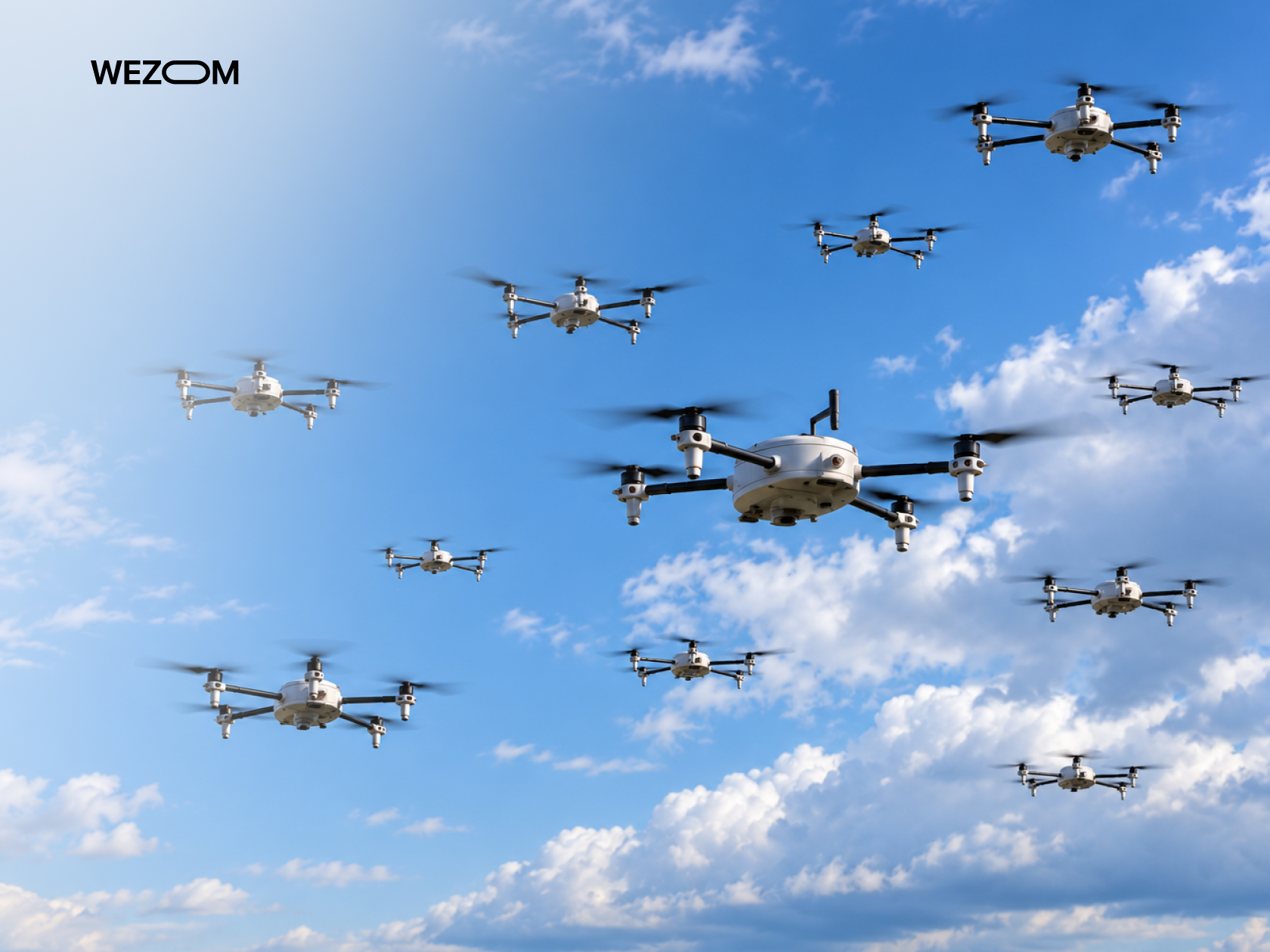
Product owners very often confuse a "drone swarm" with a "group" of drones – the latter typically being controlled by a single operator, either directly or via automated scripts running from a console.
Drone Swarm vs. Multiple Independently Controlled UAVs
Multi-UAV control is linear in terms of complexity; essentially, N drones require N communication channels and direct control by an operator. A swarm, by contrast, is a decentralized system in which each drone node possesses local intelligence and ensures distributed decision-making based on data received from other nodes (rather than relying on a single central authority). This provides the swarm with a distinct advantage: the failure of a lead server cannot bring the entire system to a halt.
How Swarm Robotics Enables Collective Drone Behavior
Swarm algorithms are based on principles of collective robotic behavior. Instead of calculating a specific trajectory for each individual UAV, the system relies on separation (to avoid collisions), alignment (of velocity vectors), and cohesion (to maintain a unified formation). As a result, the system is able to adapt missions in real time, emerging from these simple, fundamental interactions.
Main Components of an Autonomous Drone Swarm
The scalable UAV architecture is built upon four pillars:
- Onboard sensor suite (depth-sensing cameras, LiDARs, and high-frequency inertial measurement units);
- A local mesh network enabling high-speed inter-vehicle data exchange;
- An onboard software stack (including a real-time kernel with multi-drone mission planning modules);
- A ground control station with a high-level interface for mission objective setting.
Levels of Autonomy in Swarm Drone Operations
The autonomy of a swarm is measured according to the following scale:
- L1-L2 (Assisted and Conditional, respectively), which entails flight along pre-programmed, pre-compiled paths with basic obstacle avoidance;
- L3 (High Autonomy), where the swarm can independently select optimal transit corridors, while the allocation of tasks remains the prerogative of an operator at a ground control station;
- L4-L5 (Full Swarm Autonomy), where the operator sets a high-level objective (such as “explore a specific sector”), and the swarm – operating in a decentralized manner – breaks this objective down into subtasks, assigns roles among its individual nodes, handles reconfiguration if connectivity with certain nodes is lost, and ensures autonomous mission execution.
Drone Swarm Software Architecture: Main Components
Now, let’s explore the main components of drone swarm control software.
Flight Control, Perception, and Mission Management Layers
The software architecture of a drone’s onboard computer is divided into three layers. The first is the flight control layer, which runs low-level PID controllers for flight stabilization at frequencies of 400 Hz or higher. Next is the perception and SLAM layer, containing computer vision and localization modules that generate an occupancy grid. The third is the mission management layer, which employs state machines to coordinate the execution of each stage of a swarm mission.
Centralized vs. Decentralized vs. Hybrid Swarm Architectures
Centralized systems are vulnerable to loss of connection; in contrast, a decentralized architecture solves the problem of a central node failing by replicating the state to each node (however, this introduces another problem: the need for colossal computing resources for synchronization). To resolve this, a hybrid architecture can be employed, in which clusters of drones are divided into sub-swarms relying on decentralized consensus-based control internally, while communication between them is coordinated by dynamically elected leaders.
Edge Computing and Onboard AI for Real-Time Decisions
Transmitting real-time video streams and telemetry from hundreds of drones to a ground station for processing by neural networks is unfeasible due to the limited bandwidth of the radio link. To address this challenge, it makes sense to use edge AI for drones, shifting the inference of lightweight computer vision models to on-board computing units. This allows each UAV to make decisions locally.
Ground Control Stations and Swarm Management Interfaces
The ground control station for a swarm serves as a monitoring dashboard for the distributed allocation of tasks. Its interface should visualize not the individual trajectories of every unit, but rather the swarm envelope – a representation of the swarm’s overall state, including device density, battery levels, mission completion percentage, areas of uncertainty within the coverage map, and more.
Integrating Heterogeneous UAVs Into a Single Swarm
A heterogeneous swarm incorporates drones of various form factors; therefore, the primary challenge lies in creating a hardware abstraction layer. This layer enables software to translate a unified kinematic command for the swarm into the distinct dynamic flight models of the individual drones.
Drone Swarm Coordination and Control Algorithms
Let’s consider coordination and control swarm intelligence algorithms.
Leader-Follower vs. Distributed Swarm Coordination
A leader-follower coordination scheme creates a single point of failure; therefore, it is worth considering distributed coordination – an approach based on graphs and distributed consensus algorithms. This allows each drone to communicate only with its k-hop neighbors, enabling the system to scale rapidly without degrading network throughput.
Consensus Algorithms and Multi-Agent Decision-Making
To ensure a swarm functions as a unified whole without a central controller, Raft-like algorithms or distributed bidding mechanisms (such as the Contract Net Protocol) are employed. If a drone needs to select a landing spot, the agents exchange status packets and automatically reach a consensus in a fraction of a second.
Formation Control and Cooperative Flight Planning
Formation control algorithms include artificial potential fields and virtual structures algorithms. These allow the swarm to maintain a specific geometric configuration, with each node hovering at a predetermined position relative to a virtual reference point. Simultaneously, an onboard trajectory planner performs "minimum-snap" trajectory generation, accounting for the dynamic constraints of neighboring UAVs.
Dynamic Task Allocation and Autonomous Role Assignment
As a mission unfolds, the situation may change; therefore, it is important to use market-based task allocation. Drones evaluate their own distance, remaining battery life, and current workload, after which the drone with the lowest cost function takes on the task – all without human intervention.
Collision Avoidance and Real-Time Trajectory Optimization
Avoiding collisions in a dense swarm can be either reactive with local algorithms like ORCA (they calculate safe speed zones based on the motion vectors of neighbors in real time) or proactive (taking on the recalculation of time flight corridors when unexpected obstacles are detected).
Swarm Reconfiguration When Individual Drones Fail
If one of the drones loses power/crashes, its neighbors detect the disappearance of the node by monitoring the timeout of heartbeat packets within the mesh network. The topological graph is immediately reconfigured: the remaining units recalculate their respective zones of responsibility and tighten their formation.
Communication Networks for Autonomous Drone Swarms
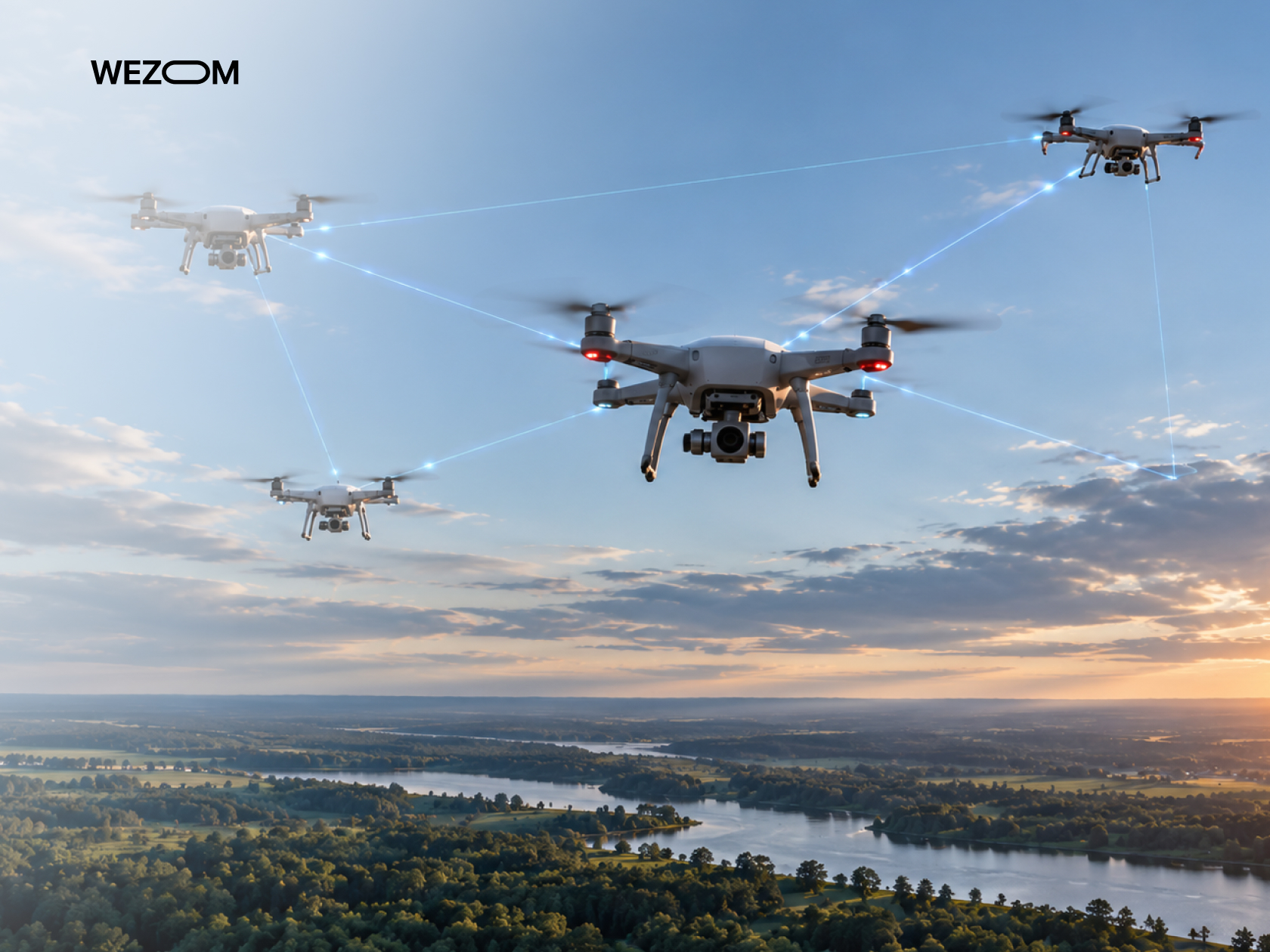
Building a reliable system requires not only specialized system software; it is also essential to properly select communication protocols and dynamic collaborative path planning methods that operate directly on the onboard computing units.
Drone-to-Drone and Drone-to-Ground Communication
The drone-to-drone communication channel must be optimized for the transmission of low-latency service packets, utilizing modulation schemes such as LoRa, Wi-Fi Raw, or specialized radio modems. The drone-to-ground channel is used to transmit high-level commands and compressed metadata to the ground control station, thereby sparing it from having to process unnecessary traffic.
Mesh Networks and Flying Ad Hoc Networks (FANETs)
For multi-agent systems, the best solution are flying ad hoc networks (FANETs) based on an UAV mesh networking topology, where each drone acts simultaneously as an end node and a relay. The use of protocols such as OLSR/AODV/B.A.T.M.A.N. allows data packets to automatically find the shortest route through neighboring units, thereby ensuring network self-healing, even if some swarm drones fail or leave the operational area.
Communication Protocols: MAVLink, DDS, and ROS 2
At the software level, the MAVLink communication protocol is typically used for data exchange between an autopilot and an onboard computer; however, for communication within a swarm, developers often opt for the Data Distribution Service – the very foundation upon which a ROS 2 robotics framework is built. DDS provides a publisher-subscriber decentralized swarm architecture with configurable QoS settings.
Managing Latency, Bandwidth, and Synchronization
The limited bandwidth of a radio channel necessitates traffic filtering; this is why it is crucial to implement data categorization and temporal synchronization using protocols such as IEEE 1588/GPS-PPS. Specifically, the critical loop encompasses all signals in the 100-200 Hz range, which are essential for collision avoidance algorithms and the precise positioning of each drone. Next is the UAV swarm coordination loop (10-20 Hz), which handles task vectors and the states of consensus algorithms. Finally, there must be the information loop (1-2 Hz, or event-triggered), which contains metadata on recognized objects as well as system logs.
Maintaining Coordination During Network Disruptions
In environments where electronic warfare systems are active or physical obstacles are present, a loss of communication becomes inevitable; therefore, the swarm’s tech stack must be resilient to network partitioning – a scenario in which the swarm splits into several isolated sub-clusters. In such cases, each sub-cluster must be capable of recalculating the connectivity graph and designating temporary subgroup leaders to continue executing sub-tasks. Subsequently, once communication is restored, synchronization algorithms merge the data structures without causing malfunctions in the flight controller.
AI and Swarm Intelligence in Drone Swarm Technology
To ensure the system can respond correctly and in a timely manner to unpredictable environmental changes, it is important to rely on adaptive behavioral models (rather than rigid if-else algorithms).
Bio-Inspired Algorithms: Flocking, Particle Swarm Optimization, and Ant Colony Optimization
Bionic algorithms include flocking algorithms (for implementing repulsion/alignment/attraction functions), particle swarm optimization algorithms (for distributing exploration zones), and ant colony optimization algorithms (for allocating patrol routes and logistics).
Multi-Agent Reinforcement Learning for Autonomous Coordination
The application of multi-agent reinforcement learning (based on architectures such as MAPPO/QMIX) enables agents to learn how to perform tasks like collaborative area coverage, field-of-view distribution, maneuvering in confined spaces, and various other complex operations through simulations. Furthermore, neural network inference using the learned weights takes only a fraction of a millisecond and requires minimal computational resources.
Computer Vision and Collaborative Environment Perception
Collaborative perception enables agents to combine local data from their onboard sensors into a unified spatial map. For instance, a Drone A positioned behind a building can instantly receive a map of obstacles from a Drone B flying at a higher altitude. Furthermore, the data fusion method proves invaluable here: it eliminates the duplication of objects and minimizes both the number and the extent of blind spots.
Cooperative Localization and Navigation in GNSS-Denied Environments
A swarm must be capable of using GNSS-denied navigation, and this is achievable in decentralized, collaborative visual-inertial SLAM systems. In this mode, the drones rely on ultra-wideband ranging and visual markers – observed on one another – to correct the drift errors that accumulate over time in their inertial navigation systems. If even a single drone has a reliable reference point, the entire group can establish a coordinate system relative to that point.
Drone Swarm Software Development: Tools and Frameworks
Creating commercial software for a swarm of UAVs typically involves combining off-the-shelf open-source solutions with custom development (for middleware layers and the programming of flight missions).
PX4 and ArduPilot for Autonomous Flight Control
At the flight control level, the open-source stacks PX4 Autopilot/ArduPilot are most commonly used. For distributed autonomous systems, the PX4 autopilot integration is preferred due to its modular microkernel architecture (based on the NuttX OS), native support for uORB messages, and integration with the Micro-XRCE-DDS interface. This enables developers to transmit flight commands from an external computing unit to the low-level controller layer with minimal latency.
ROS 2 and Middleware for Multi-Robot Coordination
Unlike the first generation, ROS 2 is designed according to a "no ROS Master" principle, which meets the requirements for swarm decentralization. It also features built-in security mechanisms (such as encryption for DDS traffic and node authentication) that help protect the local network against the hijacking of control or the spoofing of commands.
Gazebo, AirSim, and Other Drone Swarm Simulation Environments
Field testing a swarm of 20+ UAVs is both costly and risky for the devices themselves; therefore, it is far more rational to first perform drone swarm simulation within Software-in-the-Loop/Hardware-in-the-Loop simulation environments. Notable options include Gazebo (an engine for simulating kinematics and integrating with ROS), Microsoft AirSim (a simulator for sensor data streams, useful for debugging computer vision algorithms), and ARGoS (a simulator designed for the accelerated modeling of swarms comprising thousands of UAVs).
Open-Source Swarm Robotics Projects and Development Platforms
Nowadays, engineering teams often rely on off-the-shelf frameworks, especially during the prototyping phase. Examples include the Crazyflie Ecosystem (well-suited for indoor research on autonomous UAV coordination algorithms), Crazyswarm2 (a stack for the synchronized control of dozens of micro-drones within motion-capture systems), and the Swarm-ROS2 packages (libraries containing algorithms for formation control and collision avoidance).
Custom Drone Swarm Software vs. Existing Frameworks
Using open-source frameworks makes sense during the MVP development stage; however, when it comes to building full-scale commercial solutions, developers should consider a hybrid approach. In this model, the stabilization core and foundational connectivity libraries are usually based on solutions like PX4/ROS 2/FastDDS, while modules for swarm consensus, multi-agent task allocation algorithms, communication channel security protocols, and the like are built from scratch, taking into account the specific UAV’s hardware constraints.
Drone Swarm Technology Applications Across Industries
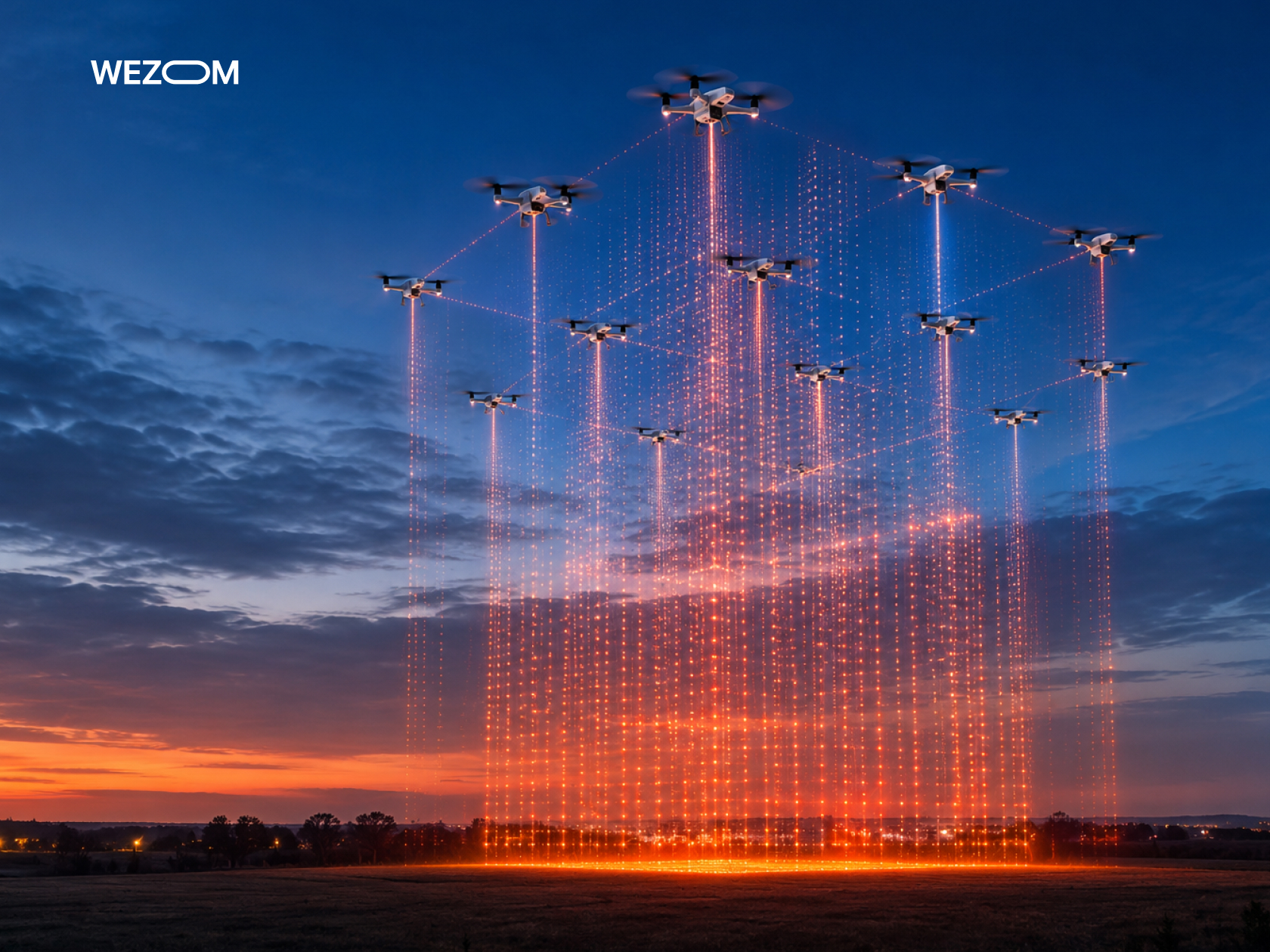
Transitioning to swarm operations alters the economics of UAV deployment, as task completion time decreases exponentially and the success of a mission no longer depends on the operational status of every individual drone. So, what are the main drone swarm technology applications?
Precision Farming and Agricultural Monitoring
In agriculture, a swarm of multispectral drones can audit fields spanning thousands of hectares in just a few hours. The UAVs coordinate a scanning grid, synchronously generate NDVI data, identify areas of plant disease, and create variable-rate application maps for fertilizers.
Search/Rescue Operations
In search-and-rescue operations conducted in forests or disaster zones, the speed is critical. In this context, drones equipped with thermal imagers/optical sensors can carry out a decentralized search using a "scatter" algorithm: one drone hovers over a detected object, acting as a beacon, while the others continue scanning the sector.
Infrastructure Inspection and Large-Scale Asset Monitoring
Monitoring extensive industrial facilities requires the use of a heterogeneous swarm. Such platforms carry out high-level overflights and cooperative localization of defects, subsequently relaying the coordinates to quadcopters for close-range inspection.
Logistics and Warehouse Automation
Inside enclosed spaces, a swarm of drones handles automated inventory tasks on a 24/7 basis. These systems rely on cooperative navigation based on optical flow and UWB tags, scanning RFID labels/barcodes on high-bay shelving. This enables real-time data updates within WMS platforms.
Light Shows and Aerial Performances
Drone shows are increasingly being used in the commercial sector; they involve hundreds of UAVs equipped with bright LEDs that form 3D shapes/animations in the air. This process requires precise temporal synchronization and the kinematic planning of collision-free, fluid trajectories.
Military Drone Swarm Applications
In the defense sector, these technologies enable the execution of so-called "swarm saturation attacks" and distributed surveillance. A swarm of tactical drones can rapidly overwhelm an adversary’s air defense systems through sheer numbers; furthermore, such swarms are highly effective at conducting reconnaissance (even amidst intense electronic jamming), as well as distributing targets among individual units and carrying out strikes (even if the connection to a human operator is lost).
Security and Reliability in Drone Swarm Operations
Since the swarm robotics system must be capable of functioning without constant operator oversight, its software stack must incorporate architectural-level fault tolerance to prevent a catastrophic failure that could affect the entire fleet of drones.
Secure Communication and Authentication Between Swarm Drones
Inter-node traffic within a swarm is frequently susceptible to interception and the injection of malicious commands. It is essential to secure the device-to-device channel – for instance, by employing cryptographic protocols based on asymmetric encryption (such as ECDSA/ECDH) combined with regular session key rotation. This ensures that every node in the network verifies the digital signature of an incoming telemetry packet before passing it on to distributed consensus algorithms.
Fault Tolerance and Recovery from Drone or Network Failures
Fault tolerance is achieved by eliminating single points of failure; for instance, if a drone experiences a motor failure or a depleted battery, built-in watchdog timers detect the critical event. Subsequently, neighboring units, communicating via a heartbeat protocol, instantly recalculate the topological connectivity graph, redistributing areas of responsibility without requiring operator intervention.
Geofencing, Operational Constraints, and Human Oversight
Virtual boundaries and no-fly zones should be defined at the level of the onboard computer firmware. If a drone loses its connection to the swarm and/or the control station, an emergency protocol is triggered, initiating a return-to-home sequence or a safe landing within an authorized area. In this setup, the operator acts as a supervisor, with the ability to take over manual control at any moment.
Cybersecurity Risks in Distributed UAV Networks
Distributed UAV networks are vulnerable to Man-in-the-Middle cyberattacks, DDoS attacks (targeting onboard computing units), and navigation signal spoofing. Consequently, swarm cybersecurity must be built upon the isolation of system domains: the flight controller must be physically separated from the high-level onboard computer (for instance, via SPI/Ethernet interfaces), while software daemons must run within isolated containers with minimal privileges.
Regulatory and Operational Challenges for Multi-Drone Missions
The legislative framework in most countries (including under EASA/FAA regulations) is currently largely ill-suited for swarm operations. In this context, it is essential to secure authorizations for BVLOS flights and obtain certification for decentralized on-board AI, while also minimizing the risk of damage should any aircraft deviate from their intended flight paths due to unforeseen circumstances.
How to Develop and Deploy Drone Swarm Software
Developing software for swarm systems requires a strictly predefined pipeline.
Defining Mission Requirements and Swarm Size
Everything begins with the decomposition of the business objective: first, you must define the geographic coverage area, followed by the required payload resolution and operational endurance, and finally, the maximum number of units in the air. Once these parameters are clear, you will be able to appropriately select the network topology and the computing power for the onboard modules.
Selecting UAV Hardware, Sensors, and Computing Platforms
When it comes to multicopters, such projects require a careful balance between battery capacity and payload mass (a challenge compounded by the need to carry onboard computing hardware, such as an NVIDIA Jetson or a Raspberry Pi Compute Module). Furthermore, these systems must be equipped with a suite of inertial sensors, LiDAR/depth-sensing cameras, and radio modems that support mesh networking protocols.
Designing Scalable Coordination and Communication Architecture
At this stage, you need to determine the balance between decentralized algorithms and hybrid schemes (for sharing global mission maps). Based on this, developers design the middleware architecture (built on ROS 2) and the DDS framework, with traffic prioritized according to QoS settings.
Testing Swarm Behavior Through Simulation and Digital Twins
Before a system is deployed, its swarm software code must be tested on thousands of virtual agents within environments such as Gazebo/AirSim. To achieve this, developers must conduct digital twin simulations, while taking into account wind disturbances, radio link failures, the sudden breakdown of individual units, and more.
Hardware-in-the-Loop Testing and Real-World Flight Validation
During the Hardware-in-the-Loop testing phase, flight controllers and onboard computers must be connected to the simulator’s virtual physical environment. This allows you to verify that drivers are functioning correctly, evaluate data bus latency, and check how the hardware responds to emergency scenarios.
Deployment, Monitoring, and Continuous Software Optimization
Following successful testing, the software is ready for deployment across the entire fleet of UAVs, which is carried out via secure OTA update channels. It is essential that the ground control station performs real-time telemetry monitoring of each unit’s status and collects logs for the subsequent optimization of algorithms.
Main Challenges and Future Trends in Drone Swarm Technology
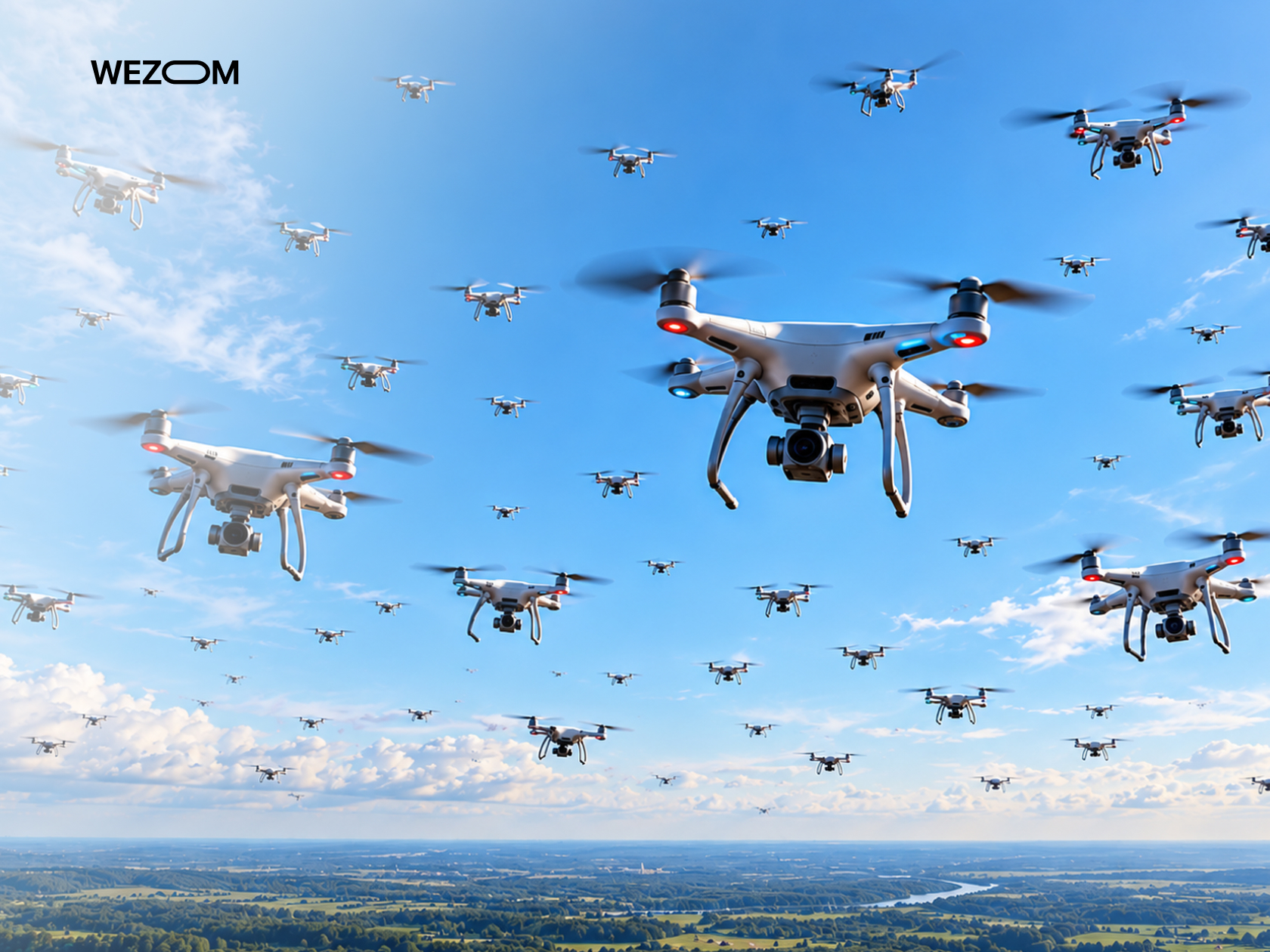
The swarm robotics industry is still in its formative stage, so it is important to understand which challenges are the most critical and which technologies developers are betting on the most.
Scalability Limitations in Large Autonomous Drone Swarms
As a swarm scales to thousands of devices, the volume of overhead traffic (specifically the exchange of coordinate data) also increases. To address this, you need to implement advanced clustering protocols, dynamically reduce the status update frequency for distant agents, and, optionally, consider transitioning to optical communication channels.
Energy Efficiency and Battery-Aware Mission Coordination
Energy efficiency is achieved through advanced task-allocation algorithms that take into account the remaining charge of each drone. These algorithms allow the software to automatically reassign patrol sectors, ensuring that drones with low battery levels are replaced by others without interrupting the mission.
Interoperability Between Different Done Manufacturers
Proprietary protocols from leading UAV manufacturers hinder the creation of heterogeneous swarms; consequently, you may need to implement unified industry standards for hardware abstraction, alongside open APIs based on ROS 2.
Emerging Developments in Decentralized AI and Collaborative Autonomy
The primary trend remains the shift from regular mathematical algorithms to multi-agent reinforcement learning, which enables drones to collectively solve tasks under conditions of complete uncertainty and adapt to a changing environment significantly faster (compared to manually predefining rules).

FAQ
How many drones are needed to create a functional drone swarm?
In terms of numbers, a swarm begins with at least three units, allowing each node to maintain a geometric formation and exchange data. When it comes to practical applications in the industrial sector, an effective group size typically ranges from 5 to 30 drones.
Can drone swarm software coordinate UAVs from different manufacturers?
Yes, you can build heterogeneous UAV systems, but only when using middleware such as ROS 2 or MAVLink, along with custom hardware abstraction drivers tailored for each vendor's flight controllers.
Can a drone swarm operate without a continuous internet connection?
Yes, it can (thanks to fault-tolerant swarm coordination), because swarm architecture is autonomous and relies on local radio communication between units, rather than on the global internet.
What is the difference between a drone swarm and a drone fleet?
A fleet is managed centrally by human operators, with each drone carrying out its own task independently, whereas an autonomous drone swarm is a decentralized system in which drones coordinate their actions with one another without operator involvement.
How much does custom drone swarm software development cost?
Everything depends on the complexity of the tasks, the scope of custom development (since it is sometimes possible to build a solution based on existing open-source frameworks), and certification requirements.
How long does it take to develop and test a drone swarm system?
Creating a prototype based on SaaS platforms takes 4-8 months, whereas custom development of enterprise-grade swarm robotics projects (including testing in simulators) requires 1-2 years.
Can existing commercial drones be upgraded for swarm operations?
Partially, but this requires installing a custom onboard computer and flashing the flight controller with an open-source stack (such as PX4).
What are the main differences between military and civilian drone swarm software?
Civilian drone swarm software development focuses on ensuring sensor accuracy, maximizing energy efficiency, and complying with regulatory standards, whereas military drone swarm software must be designed with an emphasis on resilience against electronic warfare measures, reliable encryption, autonomous operation in the absence of connectivity, and accurate target allocation.
