
Most companies spend the majority of their IT budget just keeping old systems running.
Not improving them. Not innovating. Just maintaining.
That's like spending most of your salary on keeping a 20-year-old car barely functional instead of buying something reliable. Except in logistics, that old car is costing you customers, frustrating your team, and giving your competitors a massive advantage.
So what are we actually talking about here? Legacy systems in logistics are outdated software platforms — warehouse management systems, transportation management systems, ERP solutions — that can no longer keep pace with modern operational demands. They're systems built for a different era, running on old programming languages, unable to integrate with modern tools, or so heavily customized that nobody really understands how they work anymore.
And they're not always ancient. Sometimes a system that's only five years old already feels outdated if it can't keep up with how fast digital transformation in logistics is moving.
Companies keep these systems around for various reasons — fear of migration, budget constraints, or simply because it's easier to stick with what you know. But in this article, we'll show you exactly what those legacy systems are really costing you, how they're impacting every part of your operation, and what modern alternatives can do that your current software can't.
Common Challenges of Legacy Systems in Logistics
Outdated logistics software creates bottlenecks costing real money. Legacy systems weren't built for the speed we need now. They process data sequentially when they should be working in parallel. They crash during peak times. And they force your team to develop weird workarounds that become "just how we do things around here."
What about data silos and integration issues? Your warehouse management system doesn't talk to your transportation management system. Your TMS doesn't talk to your ERP. And your customer service team? They're calling the warehouse directly because the tracking system is "unreliable."
Data silos in legacy systems logistics create a version of the broken telephone. Except instead of a funny misunderstanding, you get missed deliveries, inventory discrepancies, and a lot of angry emails.
The digitalization of logistics should mean everything's connected. Instead, with legacy systems, you've got islands of information that nobody can bridge. Your team wastes hours reconciling data from different systems, and even then, they're never quite sure which version is correct.
Let's talk numbers for a second. According to Gartner, by 2025, companies will spend 40% of their IT budgets on maintaining technical debt, with legacy application costs making up to 80% of the entire IT budget. That's money that could go toward innovation, automation, or actually solving problems.
But it gets worse. When something breaks — and with legacy software in logistics, something always breaks — you're paying premium rates for specialists who still know how to work with outdated technology.
And the opportunity cost? That's the real killer. While you're patching old systems, your competitors are implementing AI-powered route optimization and real-time visibility platforms.
And here's what usually scares about legacy systems logistics more than anything else: security vulnerabilities that haven't been patched in years because the vendor stopped supporting the software in 2018.
Cybersecurity incidents have risen 48% in the past five years, placing transport and logistics among the top three targeted sectors. And guess what hackers love? Legacy systems with known vulnerabilities and no active security updates.
Your outdated logistics software might be the weak link that compromises your entire supply chain. One breach can expose customer data, disrupt operations, and damage your reputation in ways that take years to recover from.
Impact on Supply Chain and Operations
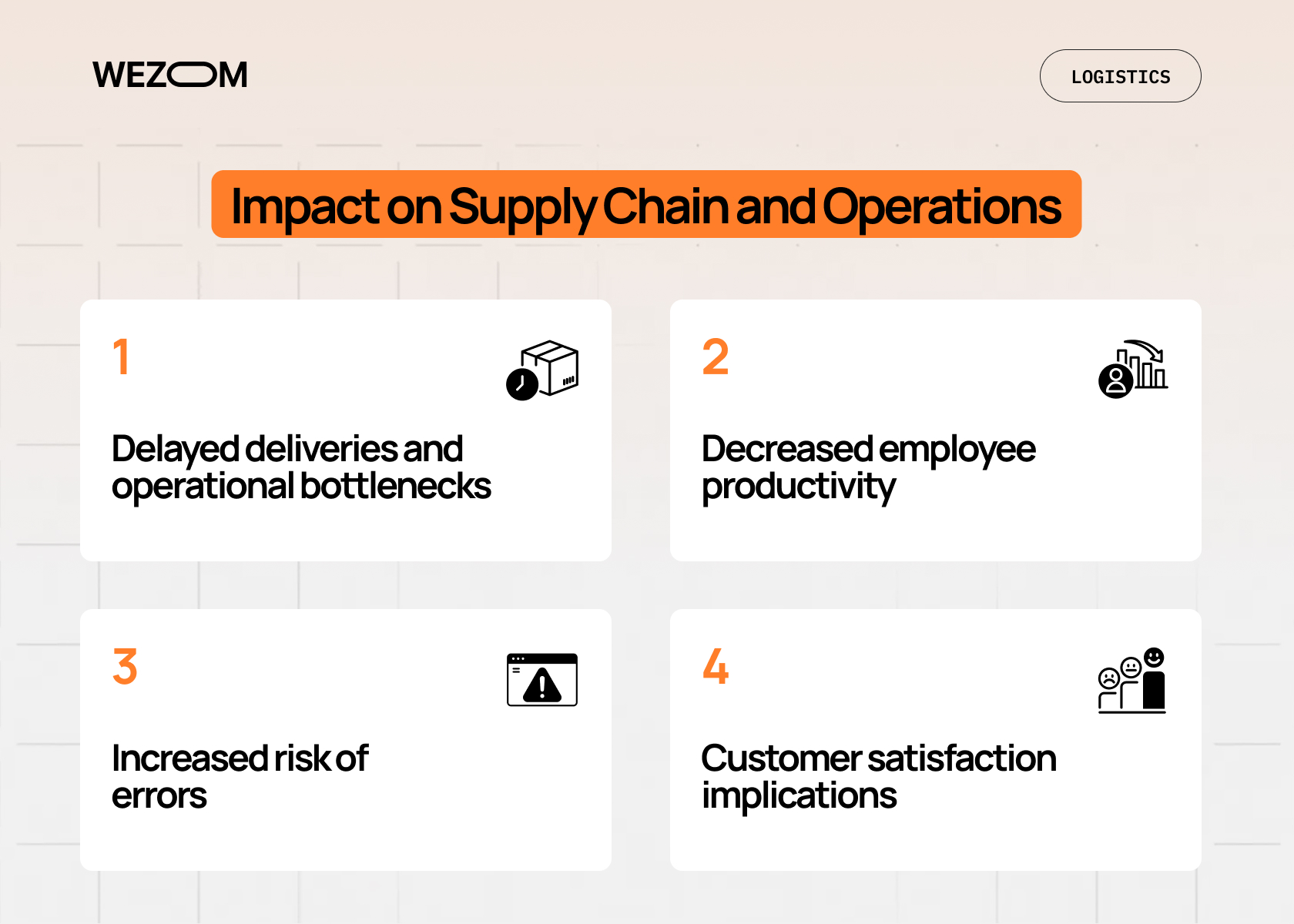
Now let's talk about what this actually costs you beyond the IT budget. Because legacy systems logistics problems don't stay contained — they spread through your operation like cracks in a foundation.
Delayed deliveries and operational bottlenecks
Legacy software doesn't just slow down your computers, it slows down your entire supply chain. Your transportation management system takes ten minutes to reroute a delivery. Your warehouse system can't update inventory in real-time. And your customer-facing tracking portal? It's showing information from three hours ago.
In logistics, timing is everything. When your software can't keep up, deliveries get delayed. And when deliveries get delayed, customers get frustrated.
"We knew we had a problem when our on-time delivery rate dropped to 73%," one supply chain director told us. "But we didn't realize the root cause was our legacy TMS until we did a full audit. The system literally couldn't process route changes fast enough during peak hours."
Decreased employee productivity
Let's be real about employee productivity for a second. Nobody went into logistics to spend their day fighting with software that works badly. Your best people get frustrated and leave. And the ones who stay? They develop workarounds that make the process even more convoluted.
New digital technologies in logistics are about giving your team tools that actually help them do their jobs well.
Increased risk of errors
Here's how it usually goes: someone enters data manually into the legacy system (because it can't import from the source). They make a typo. That error propagates to three other systems. By the time anyone notices, you've shipped the wrong product to the wrong address, and now you're paying for expedited shipping to fix it.
Legacy systems increase the risk of errors exponentially because they rely so heavily on manual data entry and lack proper validation checks. Every touchpoint is an opportunity for something to go wrong.
Customer satisfaction implications
Your customers don't know (or care) that your legacy software in logistics is the reason they can't get real-time tracking updates. They just know the experience is worse compared to what they get from your competitors.
In 2026, customer expectations for supply chain visibility are higher than ever. They want to know where their shipment is right now, not where it was three hours ago. They want accurate delivery windows, not vague estimates. And they want to be able to modify orders or delivery preferences without having to call your support team.
Modern Alternatives and Solutions
We've spent a lot of time on what's wrong, now let's talk about what's possible:
- Cloud-based logistics software.
Cloud-based logistics software isn't just about accessing your systems from anywhere (though that's nice). It's about scalability, automatic updates, and integration capabilities that legacy systems could never dream of.
Think about it: when was the last time your legacy system got a feature update? With modern cloud solutions, you're getting improvements constantly. Security patches? Handled automatically. New integration options? They just appear.
We've seen companies reduce their IT overhead by 40-50% after migrating to cloud-based logistics solutions. No more server maintenance. No more paying for specialists to keep ancient code running. Just a system that works.
- Transport and warehouse management system upgrades.
Modern transport and warehouse management systems are built with integration in mind. APIs. Webhooks. Real-time data synchronization. All those buzzwords actually mean something practical: your systems share information seamlessly.
When a driver updates a delivery status on their mobile app, that information instantly flows to your warehouse system, your customer portal, and your billing system. No manual entry. No delays. No errors from transcription.
That's how it should work.
- Automation and AI integration.
Route optimization algorithms can process thousands of variables in seconds — something your legacy TMS literally can't do. Predictive maintenance can spot equipment issues before they cause downtime.
One of our clients implemented AI-powered demand forecasting and reduced their inventory carrying costs by 22% in the first year. Their legacy system could barely generate basic reports, let alone predict future trends.
Automation isn't about replacing people. It's about freeing them from the tedious stuff so they can focus on problems that actually require human judgment.
The Real Benefits of Modernizing
Here's what digital transformation in transportation and logistics actually gets you.
| Benefit | What It Means | Real Impact |
|---|---|---|
| Operational efficiency that you can measure. | Faster processing, automated workflows, streamlined operations. | Order processing time: 45 minutes → 8 minutes per order. That's not marginal — that's transformative. |
| Real cost savings beyond just IT budget. | Reduced errors, optimized resource use, better visibility. | Win business from competitors still stuck with legacy systems logistics. |
| Competitive advantage that actually matters. | Better tracking, accurate ETAs, faster fulfillment. | Win business from competitors still stuck with legacy systems logistics. |
When you can offer better tracking, more accurate ETAs, and faster order fulfillment, you're not just keeping pace — you're pulling ahead.
Best Practices for Transitioning from Legacy Systems
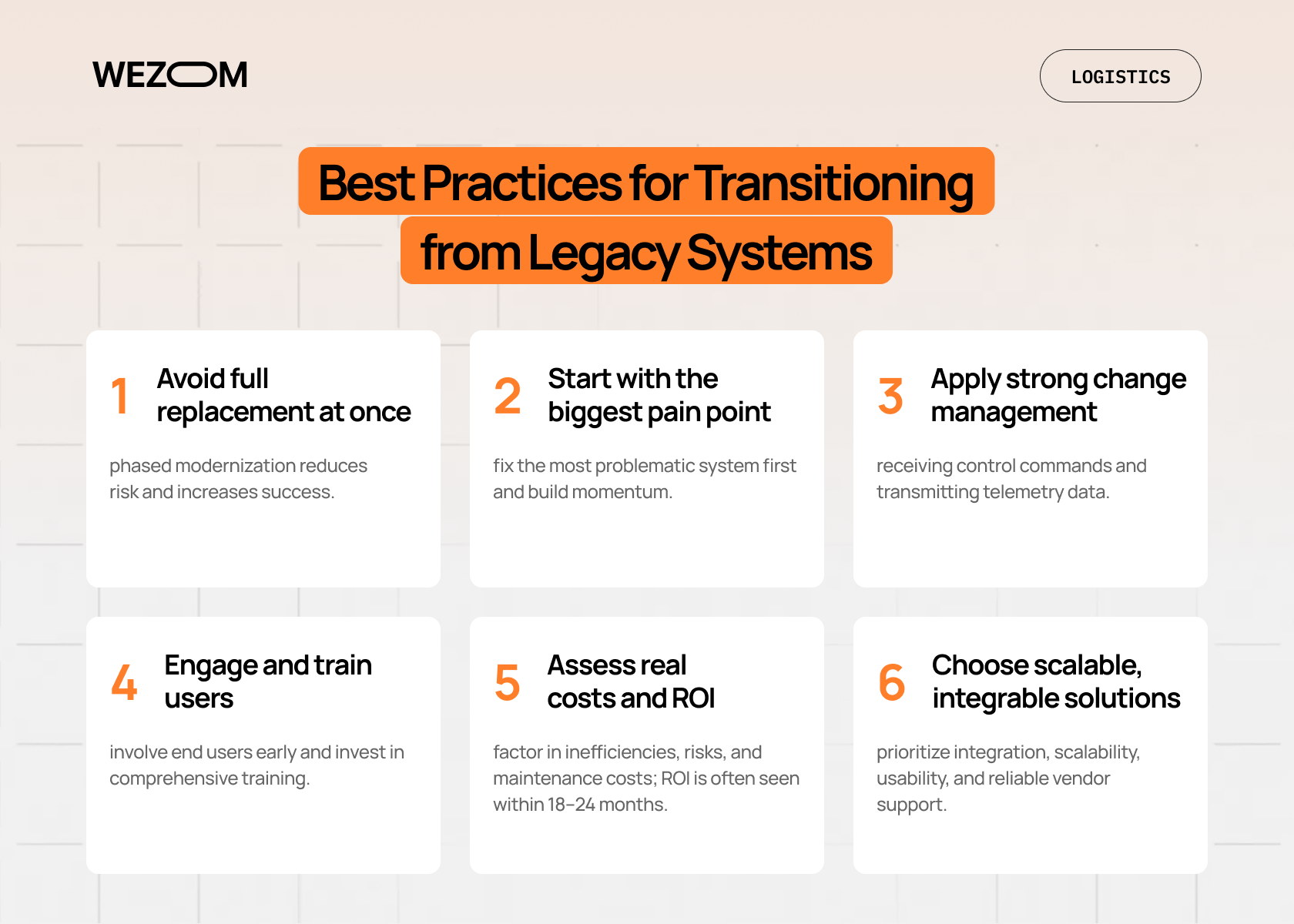
The biggest mistake companies make with legacy software modernization? Trying to replace everything simultaneously. That's a recipe for disaster.
Start with the system causing the most pain. Maybe it's your warehouse management system that crashes twice a week. Maybe it's your customer portal that looks like it was designed in 2008 (because it was).
Pick one. Fix it. Learn from the process. Then move to the next one.
Phased migration lets you manage risk, demonstrate value to stakeholders, and actually complete the project instead of getting bogged down in endless implementation.
Change management isn't just HR jargon — it's the difference between successful modernization and expensive shelf-ware.
Get input from the people who actually use the systems. They know where the pain points are. They understand the workarounds. And they'll be your biggest advocates if they feel heard and supported during the transition.
Training can't be an afterthought. Budget for it. Plan for it. Make it comprehensive. Your shiny new system won't deliver results if nobody knows how to use it properly.
Yeah, modernizing legacy systems logistics costs money upfront. But frame it correctly: what's the cost of not modernizing?
Calculate the hours wasted on manual processes. Factor in the revenue lost from delayed deliveries and customer churn. Include the risk of security breaches and system failures. Add up the premium you're paying to maintain outdated systems.
Suddenly, the investment in modern digital logistics solutions doesn't look so expensive.
Most companies see ROI within 18-24 months. Some see it even faster if their legacy systems were particularly problematic.
Not all modern solutions are created equal. Some are just as inflexible as the legacy systems you're trying to replace — they're just newer.
Look for:
- Integration capabilities with your existing tools (yes, even during transition);
- Scalability, so you're not doing this again in five years;
- User-friendly interfaces that your team will actually want to use;
- Vendor support and roadmap because you want a partner, not just a product.
Real Case Studies Examples
Let’s look at some examples of companies that improved logistics via modernization:
- Case study 1: regional distributor cuts costs by 35%.
A mid-sized regional distributor was running a 12-year-old warehouse management system that couldn't handle their growth. They were processing 40% more orders than five years ago, but their system capacity hadn't changed.
They implemented a modern cloud-based WMS with AI-powered inventory optimization. Within six months, they reduced picking errors by 82%, cut order processing time by 55%, and decreased their inventory carrying costs by 35%.
But here's what really mattered: their team was happier. Turnover in the warehouse dropped because people weren't fighting with broken technology anymore.
- Case study 2: freight forwarder transforms customer experience.
A freight forwarding company replaced their legacy TMS that couldn't provide real-time tracking. Customers constantly called asking "Where's my shipment?" — a question the old system couldn't answer without someone manually checking various sources.
After implementing a modern logistics transformation solution with real-time visibility, customer service calls dropped by 60%. Not because they had fewer customers, they actually gained market share. But because customers could answer their own questions through the portal.
Their Net Promoter Score increased from 32 to 68 in the first year.
That's the kind of impact modernization can have.
- Case study 3: national carrier improves on-time performance.
A national LTL carrier was using legacy dispatch software that couldn't optimize routes dynamically. Everything was based on pre-set routes, which meant they couldn't adapt to traffic, weather, or last-minute changes efficiently.
They implemented AI-powered route optimization as part of their digital transformation in logistics initiative. On-time delivery performance increased from 78% to 94%. Fuel costs decreased by 16% despite rising fuel prices. And driver satisfaction improved because they weren't stuck in traffic or scrambling to meet impossible schedules.
The ROI? They recouped their entire investment in 14 months.
Conclusion
Legacy systems in logistics aren't just old software, they're actively holding your business back. Every day you delay modernization is a day you're:
- Losing money to inefficiency and errors.
- Falling behind competitors who've already made the leap.
- Frustrating customers who expect better.
- Burning out your team with antiquated tools.
But modernizing doesn't have to be a massive, all-or-nothing gamble. Start with the systems causing the most pain. Get your team involved. Choose partners who understand logistics, not just technology.
We specialize in helping logistics companies navigate this transition — from assessment to implementation. Whether you're looking to replace a single system or transform your entire tech stack, we can help you do it without disrupting your operations. Contact us to discuss your modernization roadmap.

FAQ
How do legacy systems affect supply chain efficiency?
Legacy systems create bottlenecks through slow processing speeds, lack of integration between different platforms, and inability to handle real-time data. They force manual workarounds that waste time and increase errors, directly impacting how quickly products move through the supply chain. In practical terms, this results in longer order processing times, delayed deliveries, and reduced capacity to handle peak demand.
Can old software increase operational costs?
Yes. Companies typically spend 60–80% of their IT budget maintaining legacy systems, diverting funds from innovation. Additional costs come from process inefficiencies, operational errors, and the need to pay premium rates for specialists who can support outdated technologies. There is also a significant opportunity cost due to reduced competitiveness compared to more agile organizations.
What risks do legacy systems pose to logistics security?
Legacy systems often rely on unsupported software that no longer receives security updates, making them vulnerable to cyberattacks. With logistics-related cyberattacks increasing by 43% in 2024, outdated systems represent a critical security gap. A breach can expose sensitive customer data, disrupt operations, and severely damage company reputation.
How does outdated software impact customer satisfaction?
Modern customers expect real-time tracking, accurate delivery estimates, and easy order modifications. Legacy systems struggle to provide these capabilities, often delivering outdated information and requiring manual customer support interactions. This inability to meet expectations negatively affects customer experience and directly impacts revenue and brand loyalty.
Are there modern alternatives to legacy logistics systems?
Yes. Cloud-based logistics platforms provide real-time integration, automatic updates, scalability, and AI-driven capabilities such as route optimization and predictive analytics. Modern warehouse and transportation management systems are designed for seamless integration, delivering the flexibility and connectivity that legacy systems lack.
