
Companies exploring artificial intelligence initiatives often begin with a straightforward question: how much does it cost to hire an AI developer? The answer depends on multiple variables, including experience level, technical specialization, geographic location, project complexity, and hiring model. As AI adoption accelerates across industries, demand for qualified specialists continues to increase, influencing both salaries and contract rates.
Organizations that want to hire AI developer talent should understand that AI development differs significantly from traditional software engineering. AI projects require expertise in machine learning, neural networks, data processing, model training, inference optimization, and deployment. Depending on the business goals, an AI developer may also need experience with LLM technologies, NLP applications, computer vision systems, analytics platforms, cloud infrastructure, and enterprise integration.
Junior specialists typically assist with dataset preparation, algorithm implementation, model testing, and API integration. Mid-level engineers usually handle end-to-end development, training workflows, deployment pipelines, and automation initiatives. Senior professionals often design AI architecture, optimize scalability, select frameworks, and lead engineering teams.
Junior AI Developer Cost Range
A junior AI developer generally has one to three years of experience working with Python, machine learning frameworks, and basic model deployment. Businesses often hire junior specialists for MVP development, prototype validation, or internal automation projects.
Typical rates:
- Hourly: $25–$50
- Monthly salary: $4,000–$7,000
- Experience: 1–3 years
Mid-Level AI Engineer Cost Range
Mid-level professionals are capable of building production-ready solutions and managing larger project components independently. They typically possess experience with TensorFlow, PyTorch, cloud environments, data engineering, and AI integration workflows.
Typical rates:
- Hourly: $50–$120
- Monthly salary: $8,000–$15,000
- Experience: 3–6 years
Senior AI Developer Cost Range
Senior AI engineers are responsible for architecture decisions, model optimization, infrastructure planning, and complex enterprise implementations. Their expertise often extends to LLM deployment, distributed training, advanced analytics, and large-scale AI systems.
Typical rates:
- Hourly: $120–$250+
- Monthly salary: $16,000–$35,000+
- Experience: 6+ years
Hourly vs Monthly vs Project-Based Pricing
The pricing structure significantly impacts the overall AI developer cost. Hourly engagements provide flexibility for short-term initiatives and consulting. Full-time hiring offers long-term continuity and deeper product knowledge. Project-based contracts are often suitable when requirements are clearly defined, and deliverables can be estimated accurately.
Before selecting a pricing model, companies should evaluate expected project duration, internal management capacity, and future maintenance requirements.
| Level | Hourly Rate | Monthly Salary (Full-time) | Typical Experience |
|---|---|---|---|
| Junior | $25–$50 | $4,000–$7,000 | 1–3 years |
| Mid-Level | $50–$120 | $8,000–$15,000 | 3–6 years |
| Senior | $120–$250+ | $16,000–$35,000+ | 6+ years |
Key Factors That Influence AI Developer Rates
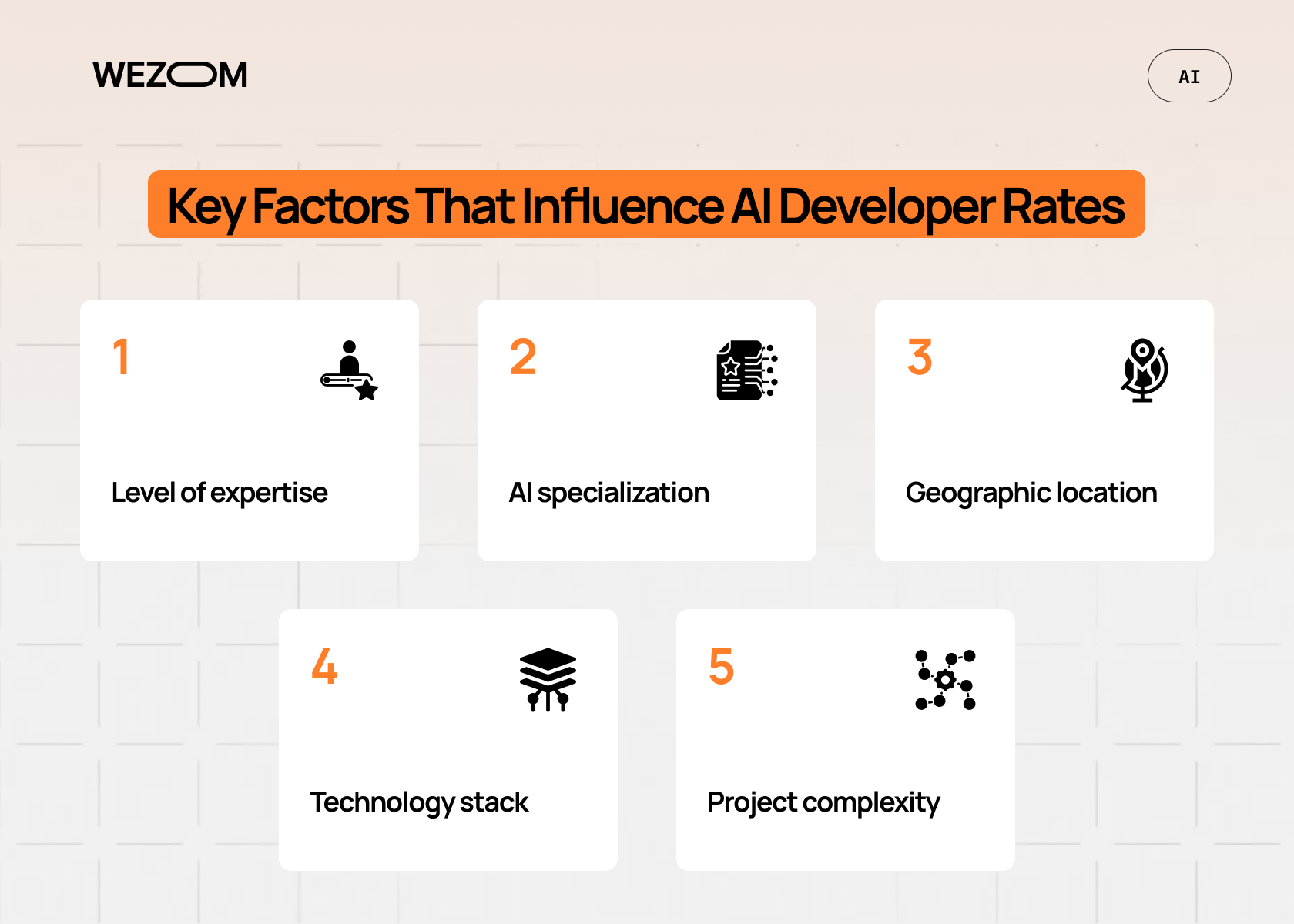
The AI developer cost can vary significantly, even among specialists with similar experience levels. While many companies focus primarily on hourly rates or salaries, the actual price of hiring AI developer talent depends on a combination of technical, business, and market-related factors.
Organizations planning an AI initiative should look beyond basic compensation figures and evaluate the broader context of the project. The technologies involved, the level of expertise required, the location of the developer, and the complexity of implementation can all have a substantial impact on the final budget. Understanding these factors helps businesses make more informed hiring decisions and avoid unexpected costs during development.
The most important factors that influence AI developer pricing include:
- Level of expertise. Junior developers typically handle data preparation, testing, and basic model implementation, while senior specialists are responsible for architecture design, scalability planning, and complex engineering decisions. As responsibility and experience increase, rates rise accordingly.
- AI specialization. Developers focused on traditional machine learning may have different pricing than experts in NLP, computer vision, generative AI, or LLM-based applications. Specialists working with cutting-edge technologies are often in higher demand and therefore command premium rates.
- Geographic location. Regional labor markets remain one of the biggest pricing factors. Developers in the United States and Canada generally charge the highest rates, while Eastern Europe and parts of Asia often provide access to highly skilled talent at more competitive costs.
- Technology stack. Projects built with advanced frameworks and tools such as Python, TensorFlow, PyTorch, LangChain, vector databases, cloud-native infrastructure, and GPU-intensive workloads typically require more experienced engineers, increasing overall development costs.
- Project complexity. A simple prediction model requires significantly less effort than a production-grade AI platform that includes data pipelines, automation workflows, enterprise integrations, security requirements, and scalable deployment environments.
Before deciding to hire AI developer resources, companies should carefully assess these variables and align hiring decisions with their business objectives. In many cases, selecting the right expertise level and delivery model has a greater impact on project success than simply choosing the lowest available rate.
Hiring Models and Their Cost Differences
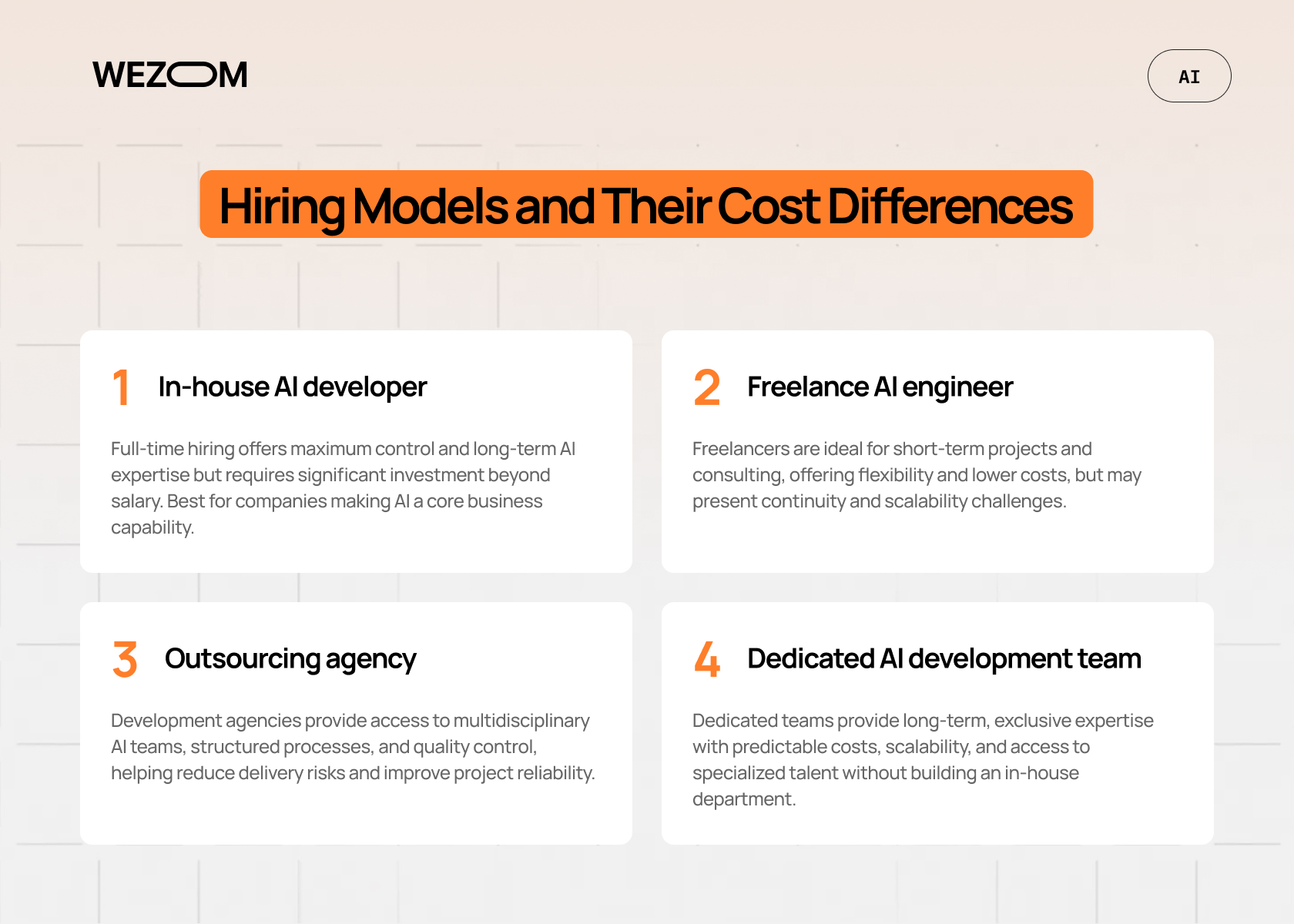
The cost of hiring AI developer talent is influenced not only by technical expertise but also by the hiring model a company chooses. Two organizations may work with professionals of similar skill levels yet end up with significantly different budgets due to differences in recruitment, management overhead, infrastructure costs, and project scope.
There is no universal hiring approach that works for every business. Startups often prioritize flexibility and speed, while enterprises may focus on long-term scalability, knowledge retention, and operational control. Understanding the advantages and limitations of each model helps companies select the most cost-effective strategy for their specific goals.
The most common hiring models include:
- In-house AI developer. Hiring a full-time employee provides maximum control over development processes and creates long-term expertise within the organization. However, the total investment extends beyond salary and includes recruitment costs, onboarding, employee benefits, equipment, training, and retention efforts. This model is typically most effective for businesses that plan to make artificial intelligence a core part of their operations.
- Freelance AI engineer. Freelancers are often a cost-efficient option for short-term projects,proofs-of-concepts, audits, or specialized consulting tasks. Companies gain flexibility and avoid long-term commitments, but they may face challenges related to availability, project continuity, and scaling resources as requirements grow.
- Outsourcing agency. Working with an external development company provides access to a broader pool of expertise, including AI engineers, machine learning specialists, DevOps professionals, QA engineers, and project managers. While hourly rates may sometimes appear higher than freelance options, agencies often reduce delivery risks through established processes, quality control, and structured project management.
- Dedicated AI development team. This model gives organizations access to a long-term team that works exclusively on their product while remaining employed by an outsourcing provider. It combines many benefits of in-house hiring and outsourcing, offering predictable costs, scalability, and access to specialized talent without the burden of building an internal department from scratch.
When evaluating these options, businesses should consider not only the immediate AI developer cost but also factors such as delivery speed, project complexity, management effort, and long-term maintenance requirements. In many cases, the lowest hourly rate does not necessarily translate into the lowest total project cost. The most effective hiring model is usually the one that balances technical expertise, operational efficiency, and business objectives.
Cost Breakdown by Region
One of the biggest factors affecting AI developer cost is geographic location. While AI skills are in high demand worldwide, salaries and hourly rates vary significantly depending on the region. Companies looking to hire AI developer talent should evaluate not only pricing but also factors such as technical expertise, communication efficiency, and experience with international projects.
Regional differences can have a major impact on the overall budget, especially for long-term initiatives or dedicated development teams.
| Region | Typical Hourly Rate | Typical Monthly Cost | Key Characteristics |
|---|---|---|---|
| United States & Canada | $120–$250+ | $18,000–$35,000+ | Premium AI talent, highest rates |
| Western Europe | $90–$180 | $12,000–$25,000 | Strong expertise, mature tech market |
| Eastern Europe (Ukraine, Poland, Romania) | $40–$100 | $6,000–$15,000 | High quality-to-cost ratio |
| India & Southeast Asia | $25–$80 | $4,000–$12,000 | Large talent pool, competitive pricing |
North America remains the most expensive market for AI engineering. High demand from technology companies, startups, and enterprises continues to drive salaries upward, particularly for specialists in machine learning, NLP, computer vision, and LLM development.
Western Europe offers comparable technical expertise with slightly lower costs. Countries such as Germany, the UK, and the Netherlands have strong AI ecosystems, but labor expenses remain relatively high compared to other outsourcing destinations.
Eastern Europe has become a preferred region for many companies seeking a balance between quality and budget. Countries like Ukraine and Poland offer experienced AI engineers, strong technical education, and extensive experience working with international clients, making the region attractive for both startups and enterprises.
India and Southeast Asia typically provide the lowest development costs. These markets can be an effective choice for businesses seeking scalable teams and budget-conscious development, although project success often depends on effective communication and well-defined requirements.
For many organizations, the ideal choice is not necessarily the cheapest region but the one that delivers the best combination of expertise, reliability, and long-term value.
Real Project Cost Examples
The cost of hiring AI developer talent varies depending on project complexity, infrastructure requirements, and business goals. While every solution is unique, several common AI project types tend to fall within predictable budget ranges:
- AI chatbot development ($20,000–$100,000+) – Includes NLP functionality, business system integrations, and conversational workflows. Costs increase when using advanced LLM capabilities.
- Predictive analytics system ($30,000–$150,000+) – Covers data preparation, model training, analytics dashboards, and deployment.
- Computer vision application ($40,000–$250,000+) – Typically involves image processing, object detection, or video analytics, with budgets influenced by model complexity and data volume.
- LLM-based SaaS product ($75,000–$300,000+) – Requires significant investment in development, infrastructure, security, and scalability, making it one of the most expensive AI solution categories.
These figures represent general market estimates. The final AI developer cost depends on project scope, customization requirements, team size, and the technologies involved.
Hidden Costs of Hiring AI Developers
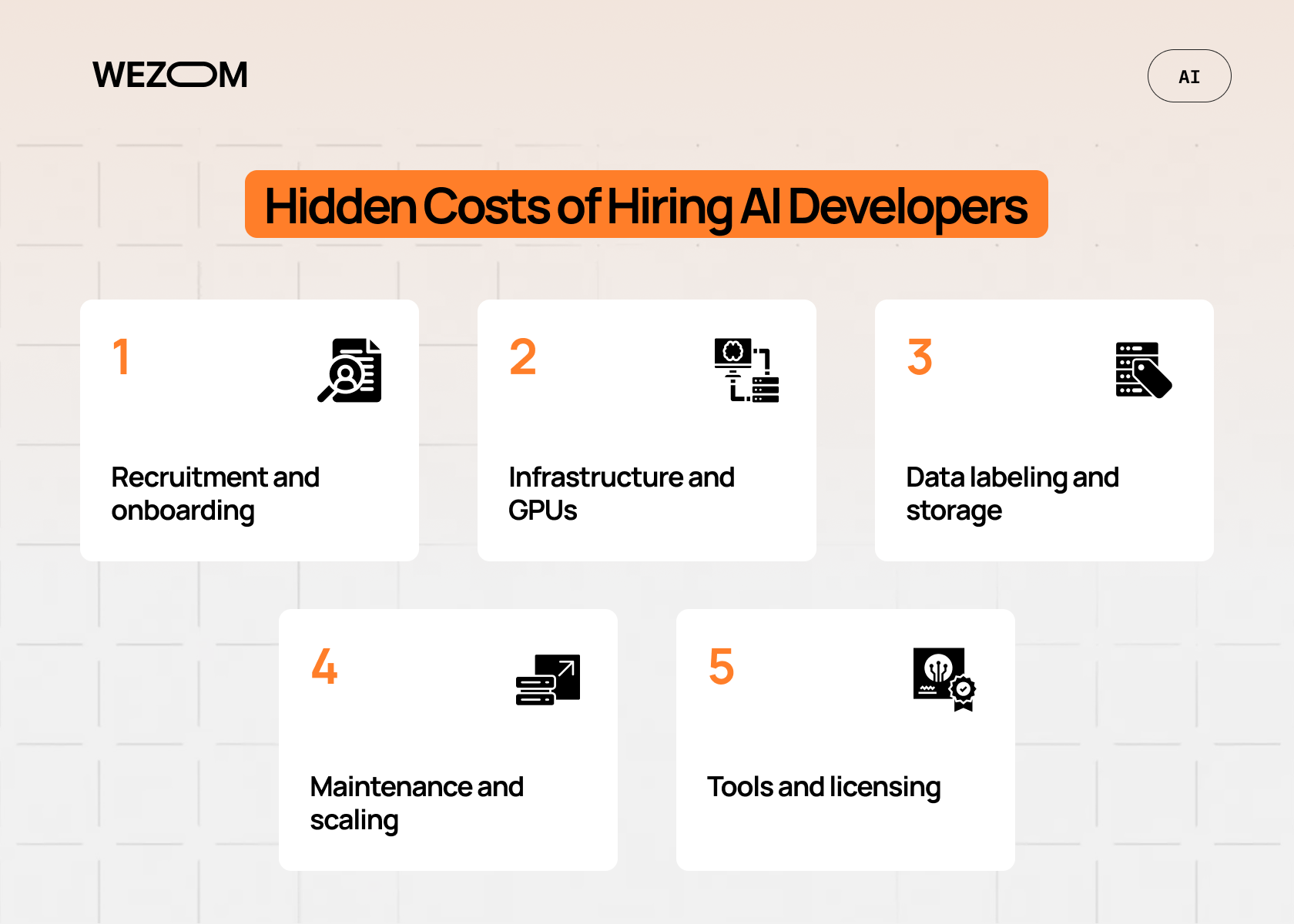
When estimating the cost of hiring AI developer talent, companies often focus on salaries or hourly rates while overlooking additional expenses that can significantly affect the total budget. AI projects frequently require ongoing investments beyond development itself.
Common hidden costs include:
- Recruitment and onboarding – Time and resources spent sourcing, interviewing, and integrating new specialists.
- Infrastructure and GPUs – Cloud computing, model training, and inference workloads can generate substantial expenses.
- Data labeling and storage – High-quality datasets often require preparation, annotation, and secure storage.
- Maintenance and scaling – AI models need monitoring, updates, retraining, and performance optimization.
- Tools and licensing – Development platforms, monitoring solutions, APIs, and enterprise software may involve recurring fees.
Factoring these costs into planning helps create more realistic AI project budgets and reduces the risk of unexpected expenses later.
How to Optimize AI Development Costs
Reducing costs does not necessarily mean reducing quality. Successful organizations focus on maximizing business value while minimizing unnecessary development effort.
An MVP-first approach helps validate assumptions before major investments. By developing only core functionality initially, teams can gather user feedback and reduce project risk.
An outsourcing strategy can improve access to specialized talent while controlling recruitment costs. Many companies leverage external partners for implementation while maintaining internal product ownership.
Hybrid team models combine internal stakeholders with external engineering resources. This structure often balances cost efficiency, domain knowledge, and development speed.
Using pre-trained models rather than building custom models from scratch can dramatically reduce budgets. Modern AI ecosystems provide powerful frameworks and pre-trained capabilities that accelerate delivery while lowering infrastructure requirements.
When Hiring an AI Developer Is Worth the Investment
Hiring AI talent becomes strategically valuable when organizations can directly connect technology initiatives to measurable business outcomes.
Common use cases include process automation, customer support enhancement, predictive analytics, intelligent search, fraud detection, recommendation engines, and operational optimization. In these scenarios, AI can improve efficiency, reduce manual workloads, and create new revenue opportunities.
ROI evaluation should consider both direct and indirect benefits. While implementation costs may appear substantial initially, long-term gains often emerge through increased productivity, faster decision-making, improved customer experiences, and operational scalability.
Organizations that approach AI as a business transformation initiative rather than a technology experiment typically achieve stronger outcomes. Whether hiring internally, working with freelancers, or partnering with an outsourcing provider, success depends on aligning AI investments with clearly defined business objectives and measurable performance indicators.

FAQ
How much does it cost to hire an AI developer per hour?
Hourly rates typically range from $25–$50 for junior developers, $50–$120 for mid-level specialists, and $120–$250+ for senior AI engineers. Actual pricing depends on expertise, geographic location, technology stack, and project complexity.
What is the average salary of an AI engineer in 2026?
In 2026, full-time AI engineers commonly earn between $4,000 and $35,000+ per month, depending on experience level, specialization, and region. Senior professionals working with LLMs, NLP, and enterprise AI systems often command premium compensation.
Is it cheaper to hire a freelance AI developer or an agency?
Freelancers usually have lower short-term costs, making them attractive for small projects and consulting engagements. Agencies often provide broader expertise, project management support, quality assurance, and scalability, which can reduce overall project risk and improve delivery outcomes.
What skills affect AI developer pricing the most?
Pricing is heavily influenced by expertise in machine learning, LLM development, NLP, computer vision, cloud infrastructure, MLOps, TensorFlow, PyTorch, and enterprise AI deployment. Specialists in high-demand areas generally command higher rates.
How much does a senior AI engineer cost per month?
A senior AI engineer typically costs between $16,000 and $35,000+ per month, depending on location, specialization, and hiring model. Highly experienced experts working on advanced AI products may exceed these ranges.
