
Organizing resource-efficient last-mile delivery using unmanned aerial vehicles is no longer a novelty. Today, it’s a generally accepted high-tech solution for many logistics companies. However, due to the lack of end-to-end automation, these companies can quickly lose control over their flight planning, which ultimately leads to extended UAV downtime and fines for violating BVLOS regulations. Fortunately, all these issues can be addressed using a specialized software stack, which we'll discuss below.
Why Software Is the Foundation of Last-Mile Drone Delivery
Drone hardware and firmware alone are incapable of autonomously performing commercial missions. Here, businesses need a more sophisticated software framework that can integrate with internal systems and ensure automation of drone-based operations. This framework will handle the orchestration of drone fleet piloting tasks, as well as the timely detection of battery degradation and weather anomalies, all with the ability to view the location of each drone in real time on an interactive map.
Also, unlike software that runs autonomously on each individual device, such platforms ensure compliance with airspace regulations by considering restrictions and geofencing zones when planning flight missions.
Main Software Components of a Drone-Based Delivery System
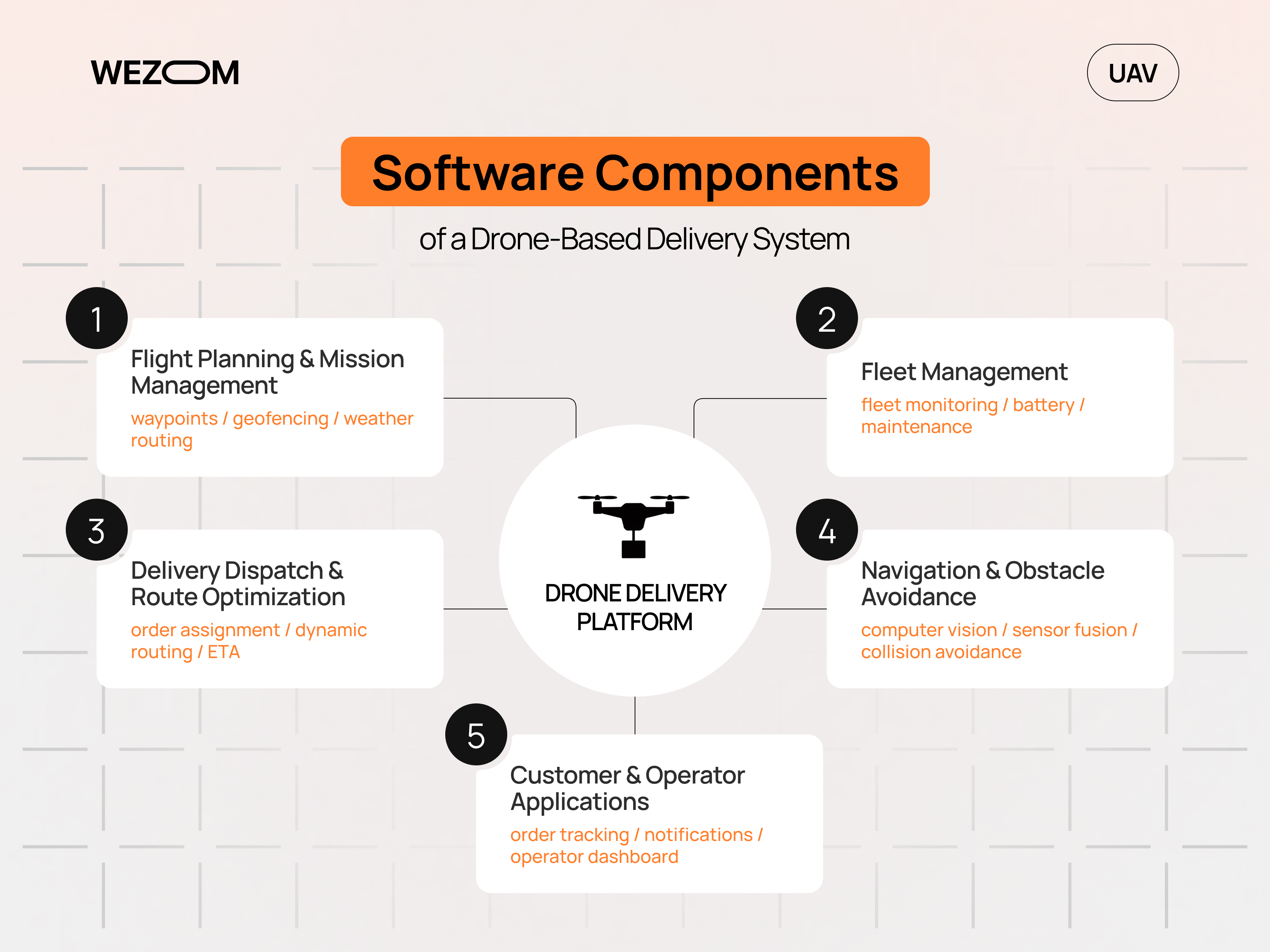
Below, we’ll consider the main components of software for centralized control of the last mile delivery drone fleet.
Flight Planning and Mission Management
This is a flight mission planning module that handles mathematical modeling and air corridor control. Specifically, its main features include:
- Waypoint generation, with automatic building of 3D flight paths taking into account terrain and delivery point coordinates;
- Geofencing, with identification and subsequent consideration of protective perimeters and restricted areas during flight mission planning to prevent unauthorized UAV incursions into the airspace of protected facilities;
- Weather-aware routing, with dynamic restructuring of flight missions (to ensure their safety for the UAV fleet) based on real-time meteorological data;
- Automated mission creation, taking into account incoming logistics data without the need for manual coordinate input;
- Emergency landing logic, with a description of drone behavior in the event of its malfunction.
Fleet Management Platform
A drone freight delivery platform must consolidate all telemetry data to ensure the constant technical availability of each device and minimize downtime. These features include:
- Fleet monitoring, with real-time tracking of each aircraft's status (displaying coordinates and speed) on a single control panel;
- Battery tracking, taking into account charge/discharge cycles, capacity degradation, internal resistance, thermal conditions, and more, essentially everything needed to ensure timely battery replacement;
- Maintenance scheduling, taking into account flight hours/mileage and takeoff/landing cycles;
- Remote diagnostics, with accompanying analysis of onboard computer logs, error dumps, telemetry, and other data, sufficient to assess the device's condition without the need for physical disassembly;
- Firmware management in a centralized format, enabling updates on all drones in the fleet;
- Utilization analytics, carried out after collecting and processing data on the workload of each drone – it helps optimize the fleet maintenance budget and predict the wear and tear of individual units.
Delivery Dispatch and Route Optimization
This module automates the distribution of airspace between drones, coordinating hundreds of simultaneous missions thanks to the following features:
- Order assignment, which uses algorithms to automatically distribute incoming delivery requests among available drones based on their technological specifications;
- Dynamic routing, which is activated when traffic conditions change and unexpected obstacles appear;
- Delivery prioritization, which ranks delivery queues based on order urgency and customer time windows;
- Multiple drone coordination, which prevents drones from colliding in common airspace;
- ETA calculations, which predict precise delivery times taking into account weather, wind speed, intermediate maneuvers, and more;
- Real-time optimization, which maximizes the efficiency of the entire drone fleet.
Navigation and Obstacle Avoidance Software
This module ensures the drone's safe navigation without human intervention, thanks to:
- Onboard computer vision, with accompanying real-time analysis of video feeds from optical cameras and object classification;
- Sensor fusion, with multiple, diverse onboard sensors, to create a precise map of the surrounding environment;
- Collision avoidance, which takes into account suddenly appearing dynamic and static obstacles and then instantly reconfigures the drone's flight path;
- Landing precision, used in the final phase of a flight mission to land at a target with an accuracy of up to several centimeters;
- Autonomous navigation, with onboard decision-making, which is useful in the absence of a GPS/GNSS signal;
- Fail-safe behaviors, with automatic switching to backup navigation sources or safe landings in the event of primary sensor failure.
Customer and Operator Applications
These are interface applications that provide end customers and operators with process transparency. They provide:
- Order tracking, with order statuses updated in real time;
- Live delivery status, with estimated arrival times;
- Notifications, which are sent automatically and describe order fulfillment milestones;
- Proof of delivery, with photo confirmation of successful completion and barcode scanning;
- Operator dashboards, displaying an overview of the drone fleet and their KPIs;
- Mobile control interfaces, designed for field engineers and mobile teams to perform aircraft diagnostics from tablets.
Compliance Requirements Every Drone Delivery Platform Must Support
The US Federal Aviation Administration, the European Aviation Safety Agency, and other local regulators impose strict requirements on software that takes on last mile delivery using drones to eliminate human error.
Specifically, the platform you choose must ensure legal transparency of flights at any distance, including when the drone is out of visual contact with the operator. It must also transmit drone identification data in real time via radio frequency channels and network protocols, as this is necessary to inform ground crews of the presence of a device performing a mission in airspace. Incidentally, to achieve this, the software must also maintain immutable electronic logs for each flight, recording telemetry, origin/destination coordinates, drone identifiers, and operator data/user sessions (in the event of an audit, all this data must be provided upon request). These logs subsequently form the basis for a complete package of permits/operational documentation for each flight in accordance with local aviation legislation.
Another important task assigned to such software is integration with government databases of restricted areas (as unauthorized routes must be automatically rebuilt by the system). To achieve this, the platform must be able to automatically create virtual boundaries around dense residential areas or infrastructure so that the drone avoids these restricted areas.
Now, a few words about pilot permissions: modern solutions are often based on a multi-level, role-based access model, which verifies the operator or any other user's valid licenses and qualifications during the authorization process. Based on the user's role, the platform must be able to send alerts about any abnormal situations and route deviations.
Ultimately, all these features guarantee end-to-end safety monitoring, meaning that the longer the platform operates in a particular company, the faster and more accurately risks and potential system failures are identified.
Essential Integrations for Enterprise Drone Delivery
No drone last mile delivery platform operates in full autonomy – it must have a number of open APIs and connectors for integration with the company's business systems, which typically include:
- ERP, which is necessary for synchronizing financial flows, inventory, and personnel, for subsequent resource planning;
- WMS, for automatically notifying responsible employees about the readiness of parcels for shipment and their transfer to takeoff points;
- TMS, for integrating the drone fleet with ground courier services (this is necessary for building multimodal supply chains);
- OMS, for centralized receipt of customer requests and subsequent order prioritization, with instant launch of the flight mission building process;
- CRM, for seamless access to customer databases and their order history;
- GIS, for terrain mapping and real-time obstacle analysis;
- Warehouse automation system, for seamless connection to conveyor lines and automated cargo delivery stations at drone ports without human intervention;
- Mapping services, which provide vector maps and satellite images needed to visualize aircraft movements on dispatch dashboards;
- Weather APIs, for optimizing flight windows based on weather conditions;
- UTM platform, for coordinating traffic in shared air corridors;
- Payment system, for instant transaction processing and digital receipt processing;
- Customer portal, for real-time transfer of order status data to end customers.
Cybersecurity and Data Protection Requirements
Given the specific nature of air cargo transportation and the presence of confidential information about end customers on board, drone delivery platforms must comply with information security standards to minimize the risks of cyberattacks and control hijacking. This is typically achieved by protecting data transmission channels between the ground station, the cloud, and the drone's onboard computer using encryption such as TLS 1.3/AES-256. Multi-factor authentication is also mandatory, as it ensures that access to platform functionality is limited to authenticated users (whether they are operators, dispatchers, or anyone else) and registered devices (drones). Access rights must also be defined to ensure that employees have access only to the functions and data necessary to perform their work tasks.
As for protecting integration interfaces from cyberattacks, developers of such platforms typically use tokenization and security gateways. Telemetry data also requires protection – here, advanced cryptographic protocols come to the rescue to prevent spoofing and electronic interception.
The list of vulnerabilities doesn't end there: if the platform is deployed in the cloud, it must comply with ISO/IEC 27001 standards and provide the ability to isolate tenants. It's also important that algorithms (for example, computer vision and obstacle avoidance) must be implemented directly on the drone's onboard computer so they can operate even if the connection to the cloud is lost. Finally, to enable you to objectively assess the platform's security, it must maintain immutable security logs that record all unauthorized access attempts and suspicious activity.
Now, a few words about fault tolerance: regardless of the platform vendor you choose, your IT department must implement backups of customer databases, flight missions, system configurations, and other data used/produced by the platform. Finally, you should provide protocols for quickly restoring the entire ecosystem in the event of a failure.
AI Capabilities That Improve Drone Delivery Operations
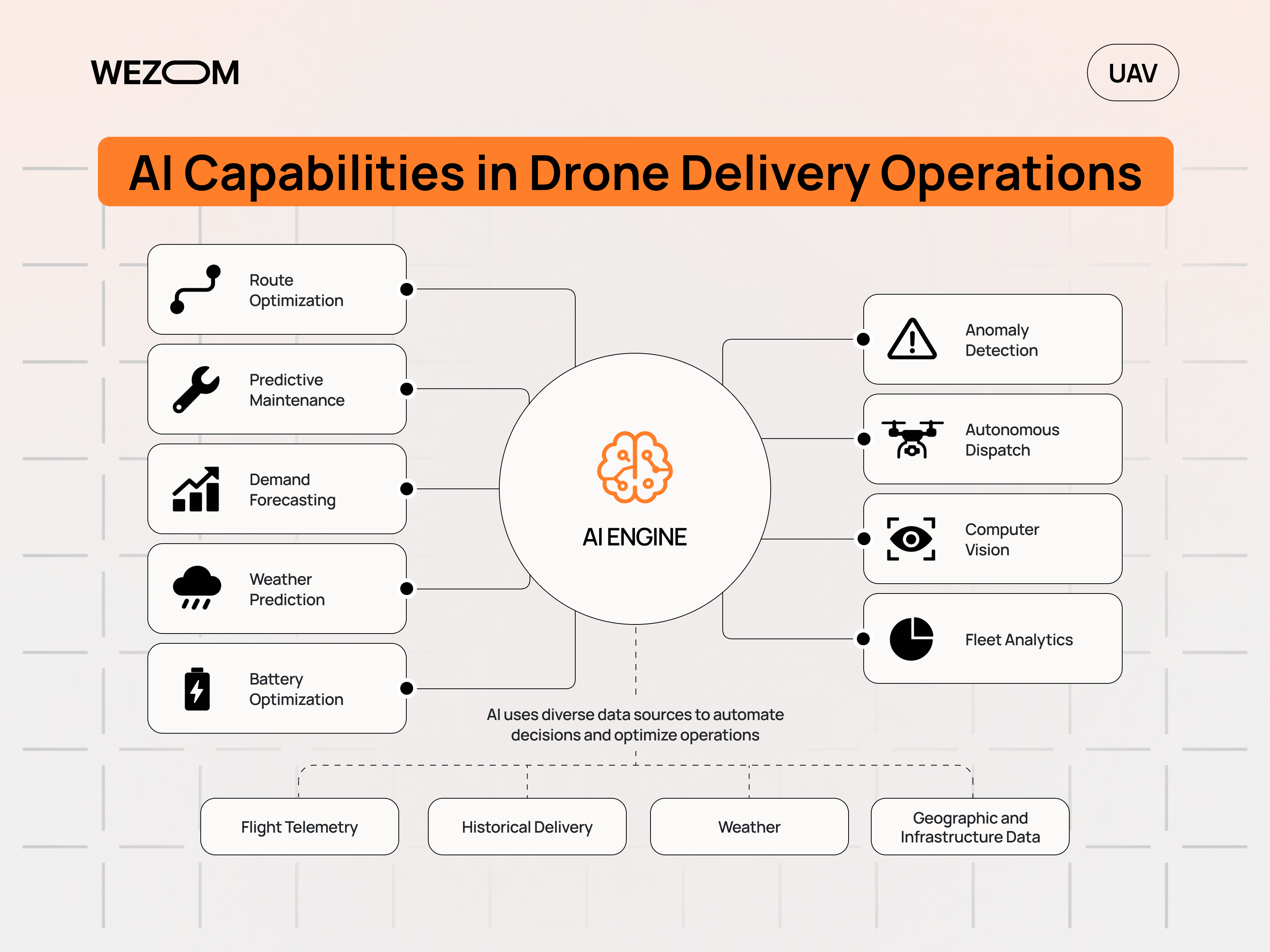
Artificial intelligence makes unmanned fleet management adaptive: using previously collected data, the system self-learns over time and becomes capable of proactively responding to highly dynamic environments with constantly changing external factors. Here are the tasks AI can perform:
- Real-time route optimization, based on processed geographic/meteorological/infrastructure data, which is useful for constructing energy-efficient and safe trajectories;
- Predictive maintenance, implemented through continuous analysis of onboard system telemetry data and flight history, which enables early detection of component wear and tear and the planning of drone maintenance;
- Demand forecasting, with order history analysis and seasonal pattern detection, which helps reserve available aircraft at nearby stations in advance;
- Weather prediction (implemented through the integration of local AI-based meteorological models), which enables platforms to accurately predict climate change and thereby plan routes that protect drones from accidents;
- Battery optimization, taking into account payload weight and onboard system operation intensity, which is necessary for subsequent optimization of drone energy consumption at each stage of the mission;
- Anomaly detection, for identifying subtle deviations in sensor operation or, for example, unusual behavior of the onboard computer, with the subsequent triggering of emergency scenarios;
- Autonomous dispatch between available drones without human intervention, taking into account network load, delivery priorities, battery status, infrastructure geography, and other factors to reduce mission execution time;
- Computer vision, which is necessary for classifying moving objects and precise navigation when landing at terminals or customer sites;
- Fleet analytics, to maximize the efficiency of the entire drone fleet and identify inefficient routes, with optional generation of recommendations for better infrastructure scalability.
Challenges Companies Face When Building Compliant Drone Delivery Software
Developing a custom platform for last-mile drone delivery presents a number of challenges, so an initial lack of understanding of the industry's specifics often leads to losses and, just as importantly, the inability to legally launch the delivery service. Here's what newcomers to the field often overlook:
- Changing regulations. The problem is that aviation regulations for drone use are still in the process of being gradually established in all regions. This means that regulators are constantly changing requirements for BVLOS flights, as well as for the drones themselves and their safety protocols, which, in turn, forces developers to build flexibility into platform architectures.
- Software complexity. The integration of real-time systems and AI algorithms (all in compliance with requirements) determines the high level of technical complexity of the project.
- Interoperability. This implies the need to ensure seamless interaction between hundreds of third-party systems, some of which are public sector and have their own integration requirements.
- Fleet scaling. Another challenge is the frequently encountered architectural limitations when transitioning from a test run of 4-5 drones to centralized control of thousands of autonomous UAVs.
- Latency. This refers to the fact that drone flight safety depends on network latency. In particular, any delay in transmitting commands or telemetry can lead to a crash, so minimizing this parameter should be a priority for developers.
- Connectivity. 4G/5G cellular network coverage issues are common worldwide and require the implementation of hybrid communication protocols with the ability to switch to satellite channels or fully autonomous operation.
- Cybersecurity. The platform must be reliably protected from cyberattacks, including telemetry interception, spoofing, unauthorized access to onboard computers, etc.
- Integration costs. Specialized software for centralized drone control can be extremely difficult to integrate with systems that companies have been using for years (as they are often legacy).
- Testing. Another challenge is the impossibility of fully testing the software in real-world conditions without the risk of damaging the drones for last mile delivery and violating airspace laws.
- Certification. As practice shows, obtaining certification is a lengthy and bureaucratic process that requires close cooperation with aviation authorities.
- Operational reliability. The system must be 99.999% fault-tolerant, since any failure in its operation could result in drones falling over urban areas and people's heads.
Best Practices for Developing a Scalable Drone Last-Mile Delivery Platform
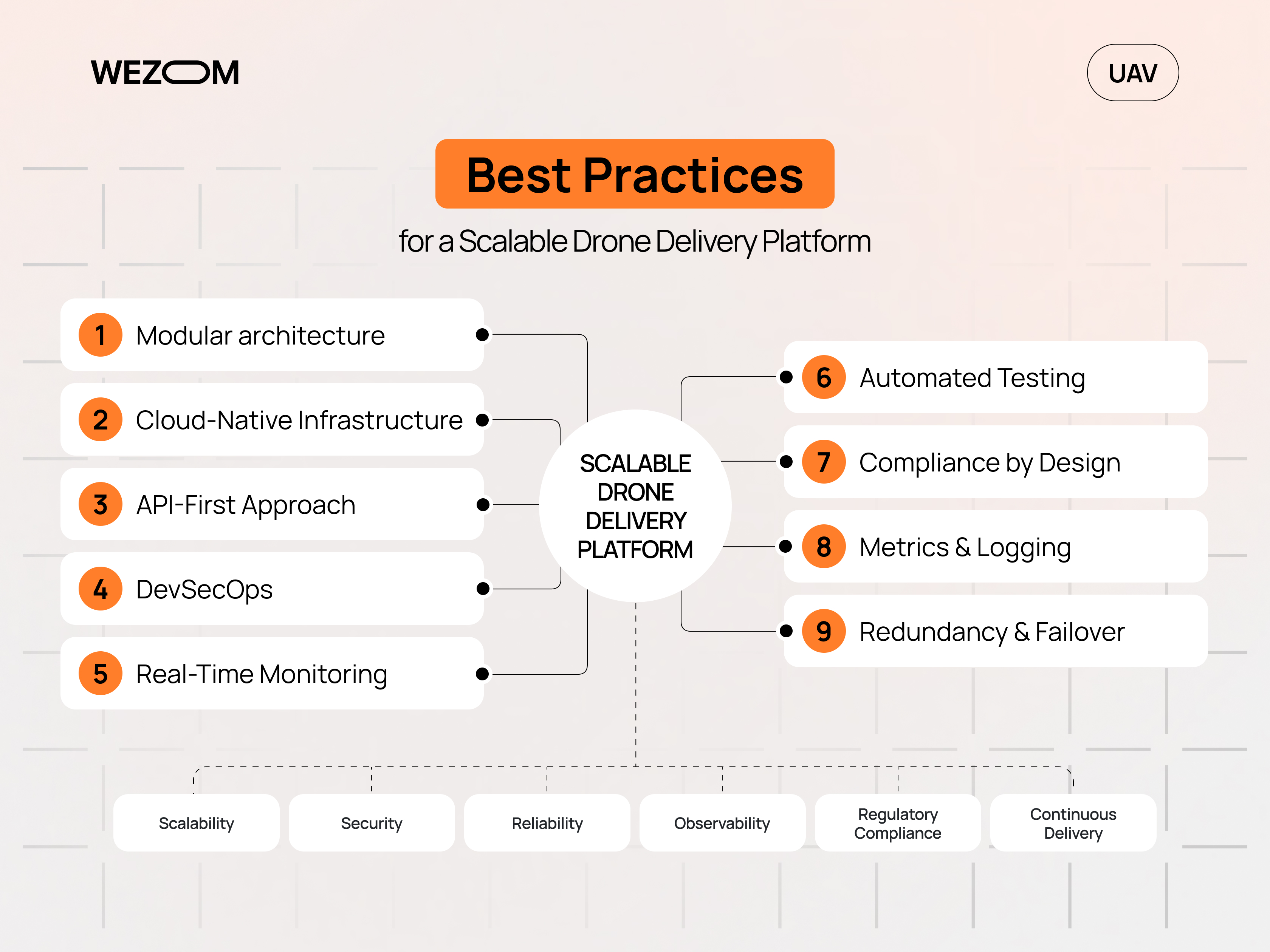
To minimize the risks described above, developers should rely on proven practices (particularly those developed by our team) for designing last mile drone delivery systems. Here they are, in brief:
- Ensure modularity of the architecture from the outset, by dividing the project into independent/loosely dependent domain modules (e.g., through microservices), like those described at the beginning of the article – this will allow you to isolate errors and simplify subsequent updates.
- Build a cloud-native platform, which implies the use of containerization and orchestration systems (they ensure elasticity of computing resources during peak loads);
- Follow an API-first approach, meaning that interactions between interfaces should be implemented through well-documented, standardized APIs such as REST or WebSockets;
- Implement DevSecOps practices at every stage of the CI/CD pipeline (usually this includes automated code scanning for vulnerabilities, container validation, static security analysis, etc.);
- Deploy end-to-end infrastructure and real-time business metrics monitoring systems (tools like Prometheus and Grafana are helpful here) to quickly respond to performance degradation;
- Automate testing (especially for critical algorithms such as trajectory planning and telemetry parsing) using flight simulators before deploying to production;
- Integrate regulatory standards and auditing requirements into the architecture itself during coding, rather than as add-ons after development is complete;
- Ensure transparency of the state of all distributed components through metrics and logs to quickly isolate the cause of failures;
- Create redundant communication channels by duplicating server nodes and implementing failover mechanisms so that the fleet can continue to be managed even if the primary data center fails.
Conclusion
As we can see, software for cargo delivery using unmanned aerial vehicles (UAVs) is currently at the pinnacle of engineering vision, as they often combine advanced AI algorithms with cloud technologies to ensure drone-based operations comply with aviation requirements. In particular, their ability to ensure safe BVLOS flights and automate dispatching of thousands of aircraft with integration into corporate ecosystems brings significant cost reductions to last-mile delivery businesses within the first few months of implementation.

FAQ
What software is required for last-mile drone delivery?
Drone last-mile delivery typically utilizes a multi-layer stack, including ground control stations, cloud-based fleet orchestration platforms (such as DroneDeploy or DJI FlightHub 2), automated route planning modules, and optionally, specialized software for integration with autonomous drone ports.
How does a drone-based delivery system work?
Drone based delivery systems use autonomous algorithms. After receiving an order via an API, they calculate the optimal trajectory, taking into account the remaining battery charge and weather conditions. The drone takes off automatically and then flies using AI navigation and obstacle avoidance systems. Once the route is completed, the drone, still autonomously, performs a precision landing or drops the cargo at the destination.
What regulations apply to commercial drone delivery?
Commercial delivery is regulated by aviation authorities such as the FAA/EASA, which implies certification and licensing for commercial flights. Liability insurance and compliance with drone air traffic management system standards are also required.
What is BVLOS and why is it important for drone logistics?
These are flights beyond the operator's line of sight. They utilize a technology stack that allows drones to cover long distances autonomously, maximizing the cost-effectiveness of cargo delivery between remote locations due to the elimination of the need for constant visual monitoring.
How does geofencing improve drone delivery safety?
This technology involves creating virtual perimeters on digital maps around restricted areas (e.g., airports, military installations, etc.), automatically blocking flights or returning the drone to its base if it attempts to cross the perimeter.
