
The modern financial sector is undergoing a large-scale transformation – physical branches are giving way to digital ecosystems. In this context, high-quality mobile app development has become a main tool for retaining existing clients and attracting new ones. Actually, a professional, well-thought-out approach to mobile banking app development enables financial institutions to create scalable digital products that provide seamless access to banking services. This guide uncovers in detail all the main aspects related to mobile banking application development in our company.
What Is Mobile Banking App Development?
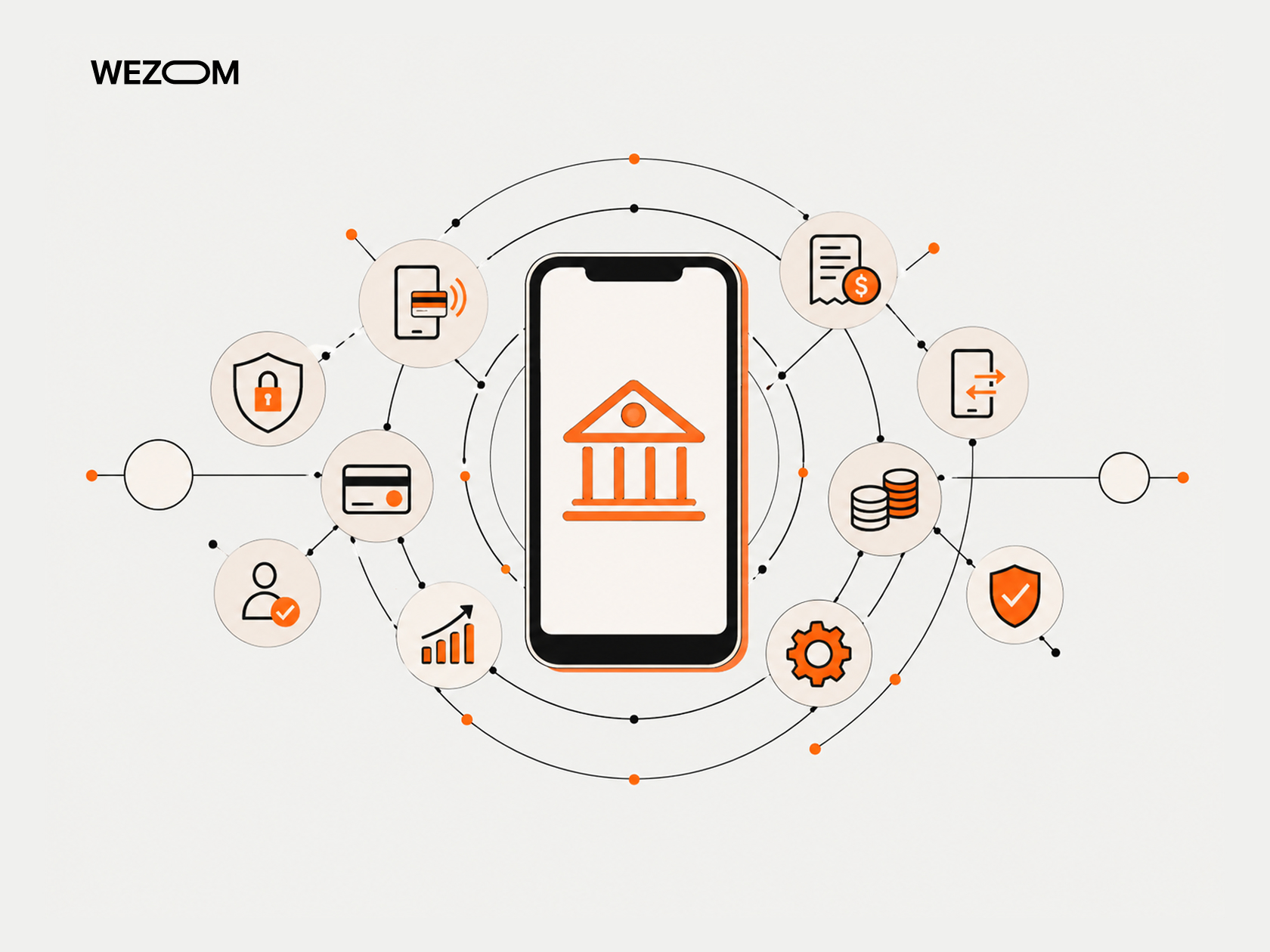
Creating a mobile financial service is a complex engineering and analytical process. The field of mobile banking development covers both the design of client interfaces and building fault-tolerant server-side logic.
How a Mobile Banking Application Works
A full-featured mobile banking app functions as a front-end layer that interacts with the bank’s infrastructure via secure communication channels. Upon launch, the client undergoes authorization; the mobile banking back end then processes requests and interfaces with databases and transaction processing centers. Every transaction is validated by anti-fraud systems, recorded in the relevant ledgers (all thanks to the seamless payment processing integration), and is displayed on the account balance.
Mobile Banking Apps vs Digital Banking Platforms
A mobile app serves as the endpoint for user interaction with a financial institution via a smartphone. A digital banking platform, by contrast, is a broader concept that implies channel orchestration and integration services. It acts as the primary interface, powered by the organization’s entire digital banking application infrastructure.
Who Needs Custom Banking Application Development?
Custom banking application development is essential for organizations that are rapidly transforming their operational models. This category of clients includes:
- Traditional banks (organizations undergoing extensive modernization of legacy systems and expanding their digital presence);
- Neobanks and fintech startups (companies building innovative services from the ground up, unconstrained by legacy infrastructure);
- Credit unions and microfinance organizations (financial institutions working to increase the accessibility of their products to the general public);
- Investment and brokerage firms (providers that integrate banking accounts with trading instruments).
Categories of Mobile Banking Apps: Traditional Banks, Neobanks, Fintech, and Cryptocurrency Banks
Mobile banking applications fall under different categories, each with its own characteristics. Traditional banks focus on reliability and converting manual services into digital ones. On the contrary, neobanks app development emphasizes speed. Finally, as for crypto banking app development, it involves integrating traditional and cryptocurrency transactions.
Basic Characteristics of a Mobile Banking App
The success of a product in the market is determined by its functional scope. Modern mobile banking app features must meet both the requirements of the users and offer advanced analytical tools.
Digital Onboarding, Registration, and KYC Verification
The customer acquisition process begins with remote registration. An integrated digital onboarding module allows users to open an account in minutes, without needing to visit a physical branch. Automated KYC verification is used to confirm identity by cross-referencing biometric data with official documents.
Account Dashboard and Real-Time Balance Management
The main screen of the application gives a detailed insight into the financial state of the specific user. In account management, the information is collected from various bank cards and accounts so that the balances of all accounts are updated instantly – right after each new transaction has been done.
Money Transfers and P2P Payments
Fund transfers form the core of user activity. A robust money transfer solution supports transfers via phone number or account details, as well as instant P2P payments, both within the system and to external banks.
Bill Payments and Scheduled Transactions
Bill payment functionality enables users to pay for utilities and subscription services. Features such as payment templates and automated payments ensure that recurring transactions are executed on time, eliminating the need for repeated manual data entry.
Card Management and Virtual Cards
The card management section gives users full control over their payment instruments. Customers can instantly issue virtual cards and update their PINs.
Transaction History, Search, and Statements
People can manage their expenditures based on the date or category in a dynamic transaction history, as well as obtain official bank statements within seconds.
Push Notifications and Instant Transaction Alerts.
Real-time notifications boost the level of security; also, they improve the engagement of each individual user, too. Actually, customizable push notifications come to the rescue here, as they inform instantaneously of upcoming debits or deposits.
Personal Finance Management and Spending Analytics
Built-in personal finance management modules help clients keep track of their budgets. The system automatically categorizes expenses and provides visual representations of spending patterns.
Customer Support, Chatbots, and In-App Messaging
High-quality service requires 24/7 support. Integrating chatbots and text-based support directly into the app allows for the prompt resolution of common customer issues, while also reducing the workload on call centers.
Advanced Features: AI Assistants, Personalization, and Predictive Analytics
Advanced banking systems typically use artificial intelligence to monitor users’ behavior. Intelligent assistants can predict expenses and tailor advice based on the received data.
Security Requirements for Mobile Banking App Development
Security is the must-have when building financial systems. Banking app security must ensure the absolute protection of users' funds and personal data against all types of attacks.
Multi-Factor and Biometric Authentication
Account access protection must be built on a layered approach. Here, multi-factor authentication is mandatory, as it combines passwords with one-time codes, while biometric authentication provides a fast and secure login method.
Data Encryption at Rest and in Transit
All data, whether in transit or at rest, must be subjected to advanced cryptographic protection. Data in transit is usually secured via TLS protocols, while financial data encryption on devices and servers prevents the leakage of sensitive information.
Secure API Design and Authentication
Server-side interfaces act as a bridge between the application and its databases. A secure API design incorporates the mandatory use of OAuth 2.0 tokens and the validation of all incoming parameters.
Device Binding, Session Management, and Token Security
Binding an account to a specific smartphone’s hardware prevents unauthorized access from other devices. Automatic session termination during periods of inactivity, combined with short-lived JWT tokens, minimizes the risk of session hijacking.
Fraud Detection and Real-Time Transaction Monitoring
An intelligent fraud detection system analyzes every transaction in real time. If a transaction deviates from a client’s typical behavior, the built-in transaction monitoring system temporarily blocks the transfer pending further verification.
Root, Jailbreak, and Mobile Threat Detection
Using an application on rooted or jailbroken devices carries significant risk. Built-in mobile application security algorithms automatically detect the presence of a root or jailbreak and restrict app functionality to safeguard data.
Secure Data Storage and Sensitive Information Protection
Sensitive data must never be stored on a device in an unencrypted format. Hardware-based smartphone storage, such as iOS Keychain and Android KeyStore, is the best choice for the secure storage of keys/tokens.
Penetration Testing and Vulnerability Management
Before being released into production, any secure banking application undergoes end-to-end testing. Regular pentesting helps identify potential vulnerabilities in the code and architecture before they can be exploited by malicious actors.
Audit Logging and Security Monitoring
All actions taken by users and system components must be recorded in immutable audit logs. 24/7 monitoring of security events enables an immediate response to anomalies and attempts at unauthorized access.
Compliance Requirements for Banking Application Development
The development of banking software is strictly governed by national and international regulations. Failure to comply can lead to the revocation of licenses and the imposition of multi-million-dollar fines.
KYC and AML Compliance
Financial applications are required to combat money laundering. Implementing AML compliance involves screening clients against sanctions lists and monitoring suspicious financial flows.
PCI DSS for Payment and Card Data
When handling payment processing and card data, PCI DSS compliance is mandatory. This standard dictates the rules for the transmission and storage of payment card information.
GDPR and Personal Data Protection
Processing data belonging to citizens of the European Union requires full adherence to GDPR compliance. Users must be able to manage their consent for data processing and request the complete deletion of their personal data.
PSD2, Open Banking, and Strong Customer Authentication
The European PSD2 directive mandates that banks provide third-party fintech services with access to accounts via open banking APIs. A main component of this regulatory framework is PSD2 compliance, which requires the implementation of Strong Customer Authentication for all electronic payments.
Regional Banking Regulations and Data Residency Requirements
Each jurisdiction establishes its own rules regarding the storage of citizens' data. Developers must account for local regulatory requirements concerning the localization of servers and personal information.
Building Compliance into the Development Lifecycle
Regulatory compliance should not be treated as a formality at the final stage of a project. Instead, its requirements must be integrated into the system architecture from the earliest project phases.
Mobile Banking App Architecture and Core Integrations
A scalable banking app architecture is built on a modular principle, ensuring high-speed request processing and overall system fault tolerance.
Frontend, Backend, and Banking Infrastructure
The frontend is responsible for rendering the user interface and performing initial input validation. The backend consists of a layer of microservices that handle business logic and coordinate requests to the core banking system.
Core Banking System Integration
The core banking system serves as the central component of the infrastructure. Seamless core banking integration ensures that data regarding balances and accounts remains synchronized.
Payment Gateway and Payment Network Integration
Payment gateway integration is used to process external transfers and merchant acquiring. This service connects the application to international payment networks and national clearing centers.
KYC and Identity Verification Services
Automating document verification requires integration with external providers. Specialized identity verification infrastructure enables automated passport scanning and facial recognition.
Open Banking API Integration
The use of standardized protocols allows for the aggregation of accounts from various financial institutions. An integrated mobile banking API enables clients to manage all their assets from a single application.
Fraud Protection and Anti-Money Laundering Tools
With the use of extraordinary fraud detection and prevention systems, a constant risk assessment must be performed. This is achieved by analyzing the features of devices used and differentiating the amounts of money checked from different locations.
Loan And Credit Rating Systems
For automation of the process involved in issuing loans, linking the system to the scoring and credit rating systems is essential. In this way, decisions related to applications are made very quickly.
Customer Relationship Management, Analytical Tools And Customer Positioning Tools
The systems communicate to track customers. Here, data analysis is used for continuous improvement of customer experience.
Designing a Scalable Banking API Layer
The API gateway serves as a single entry point for all requests from mobile devices. It handles load balancing and protects internal services from DDoS attacks, ensuring high banking app scalability.
Choosing a Technology Stack for Mobile Banking Development
A wisely chosen banking app technology stack determines its performance and security for years to come.
Native iOS and Android Development
Native development using Swift/Kotlin ensures maximum performance and the highest level of security. This is the ideal choice for large banks that require full access to a smartphone’s hardware features and the ability to handle high workloads.
Use of Flutter or React Native for Cross-Platform Development
Cross-platform development can save a lot of time and money, due to one codebase. Latest technologies provide a high level of performance, which is necessary for most fintech applications.
Backend Technologies for Banking Software
The backend of banking systems is built on high-performance technology stacks. In the context of banking software development, Java and Go are the most popular choices, as they are capable of processing thousands of transactions in parallel.
SQL, NoSQL, and Transactional Data Storage
Databases must guarantee absolute operational reliability. For example, relational databases can be used for handling transactions, while NoSQL solutions are utilized for caching.
Cloud Infrastructure vs. On-Premises Deployment
The choice between a cloud environment and on-premises servers depends on regulatory requirements. A hybrid approach allows personal data to be stored within an isolated segment of a cloud banking infrastructure, while high-load computing tasks can be offloaded to the cloud.
Microservices vs. Monolithic Banking Architecture
Modern financial software development favors a microservices architecture. Using banking microservices enables the independent scaling and updating of individual system modules without the risk of bringing down the entire application.
How Technology Choices Affect Security, Scalability, and Cost
Choosing native technology will increase the costs of development but still reduces the chances of experiencing performance problems in the future. Development with the help of a cross-platform tech stack saves a lot of time needed for bringing products to the market, but it also requires a closer inspection of security aspects.
Mobile Banking Application Development Process
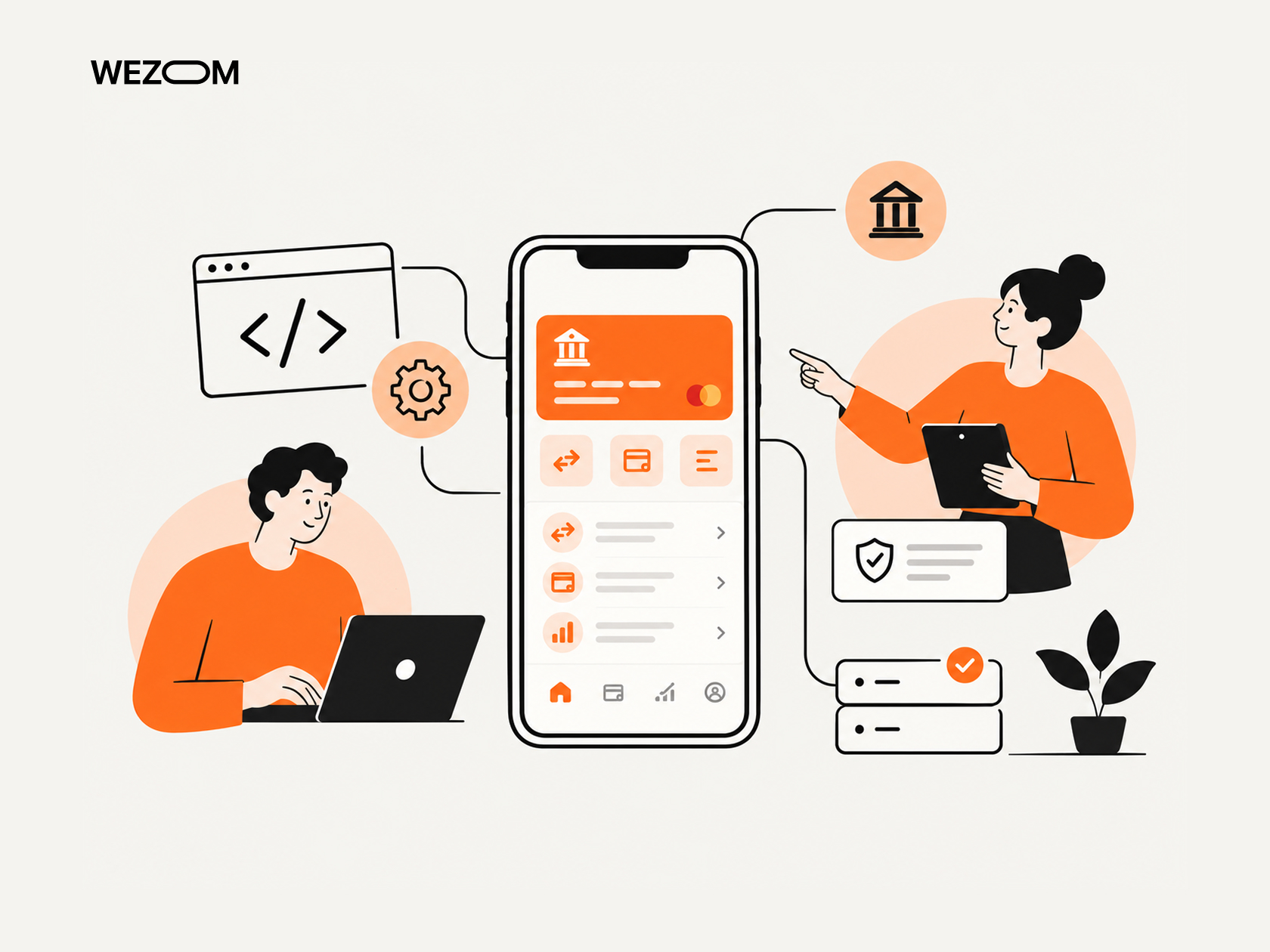
Creating a complex financial product requires discipline and strict adherence to development stages. A smooth banking app development process ensures predictable timelines and a high-quality final solution.
Step 1 – Product Discovery and Requirements Analysis
At the initial stage, the team conducts market analysis and defines the technical specifications. This results in a clear project roadmap, outlining the features and architecture.
Step 2 – Regulatory and Security Assessment
Legal and information security experts compile a list of regulatory requirements for the target regions. They establish the necessary level of protection and the protocols for handling personal data.
Step 3 – UX Research and Customer Journey Design
Researchers map out user interaction scenarios. High-quality banking UX design minimizes the number of clicks required to perform core operations, ensuring an intuitive interface.
Step 4 – Banking Architecture and Integration Planning
Architects design the interaction structure between modules and select the technology stack for data exchange between the application and external services.
Step 5 – UI/UX Design and Prototyping
Designers establish the application’s visual style and develop clickable prototypes to test hypotheses and ensure ease of navigation.
Step 6 – MVP and Backend Development
The development team begins writing the backend code and building the primary screens of the mobile application, laying the foundation for the future product.
Step 7 – Core Banking and Third-Party Integrations
At this stage, the application is connected to the core banking system and processing centers to enable full-scale financial services.
Step 8 – Security and Compliance Testing
At this stage, a comprehensive security audit of the code is conducted, along with verification of compliance with standards such as PCI DSS/GDPR.
Step 9 – Performance, Load, and Reliability Testing
QA engineers perform load testing, simulating peak user and transaction volumes to verify the resilience of the infrastructure.
Step 10 – App Store Release and Production Deployment
Once all checks are complete, the application is published on the App Store and/or Google Play. This process includes setting up monitoring systems and analytics collection.
Step 11 – Monitoring, Maintenance, and Continuous Improvement
After the release of the banking app, the maintenance phase is initiated, and the team performs periodic updates to improve performance.
MVP vs Full-Stack Mobile Banking Software Development
Typically, the first step while launching any financial product is creating a minimum viable product, which allows early testing of the idea and feedback from users. In the first version of a banking app MVP, the app must be able to complete basic operations:
- Secure registration (authorization and remote verification of the user’s identity);
- Viewing of balances (showing account balance and transaction history);
- Simple transfer (transaction by card number or account data).
What Can Be Delayed Until Later?
Difficult features like automated loan processing or investment instruments can be moved to later stages of development.
MVP for a traditional bank vs. MVP for a new fintech product
For a conventional bank, MVP is a way to test a new hypothetical service aimed at a specific limited audience. For a fintech startup, MVP is the only way to show a working product to investors and create a customer base.
What Should You Do to Keep Your MVP Out of Technical and Security Debt?
Even in the lite version of a banking app, there should be absolutely no compromise on security. The architecture has to be designed taking into consideration scalability from day 1 in order not to find oneself having to rewrite the code completely later.
Crypto Banking App Development
With the digital asset sector growing in popularity, hybrid solutions are beginning to emerge that are the perfect mix of the classical banking system and cryptocurrencies.
How Crypto Banking Apps Differ from Traditional Banking Applications
Crypto banking app development differs from building a standard banking application due to the need for blockchain network integration and specific requirements for secure key storage.
Fiat and Cryptocurrency Account Management
Users can manage both fiat accounts and digital assets within a single interface, enabling instant transactions between them.
Crypto Wallet and Custody Integration
From an architecture point of view, the realization of this application involves the use of custodial and non-custodial applications. Efficient digital and crypto wallet integration guarantees private key protection and ongoing access to the assets.
Fiat-to-Crypto and Crypto-to-Fiat Transactions
The inbuilt exchange modules allow users to buy cryptocurrency by means of bank cards and turn their funds into fiat currency with little to no fees.
Blockchain Transaction Monitoring and AML Controls
Working with digital assets necessitates specialized AML analysis. The system verifies the legitimacy of cryptocurrency addresses and transactions, preventing any interaction with illicit services.
Security Challenges in Crypto Banking App Development
The primary risk factors include the irreversible nature of blockchain transactions and the threat of attacks targeting private keys. Addressing these risks requires the implementation of multi-signature wallets and hardware security modules.
How Much Does Mobile Banking App Development Cost?
Determining a project budget is one of the main challenges for any business. The final cost of a mobile banking app is shaped by various factors, such as the scope of features and the expertise of the development team.
Typical Cost Ranges by Product Complexity
The budget depends directly on the scale of the solution. There are several primary price categories:
- Simple MVP ($60,000-$100,000, with a development timeline of 3-5 months);
- Mid-sized application ($120,000-$250,000, with a development timeline of 6-9 months);
- Enterprise-grade platform ($250,000-$600.000+, with a development timeline of 9 months or more).
Mobile Banking MVP Development Cost
Creating a basic initial version featuring core security measures and support for a single native platform typically falls at the lower end of the budget spectrum.
Cost of a Mid-Size Banking Application
An application with a broader range of features and support for two platforms requires a mid-level investment.
Enterprise and Digital Banking Platform Costs
Developing a large-scale digital platform, complete with a custom core banking system and complex security algorithms, requires the significant budget.
Development Cost by Feature and Integration Complexity
Each integration with an external service adds a significant amount to the budget, driven by the complexity involved in debugging and testing.
How Security and Compliance Affect the Budget
Security audits and PCI DSS certification can account for as much as 20-30% of the total project budget.
Native vs. Cross-Platform Development Cost
Building two separate native applications is approximately 30-40% more expensive than developing a single cross-platform service.
Development Team Location and Hourly Rates
The geographic location of the development team significantly influences hourly rates, which, in turn, affects the final banking app development cost.
Infrastructure, Licensing, and Third-Party Service Costs
In addition to development fees, the bank must account for monthly costs related to cloud infrastructure and software licenses.
Maintenance and Post-Launch Costs
Annual expenses for application support and vulnerability remediation typically amount to 15-20% of the initial development cost.
What Factors Affect Banking App Development Cost the Most?
Understanding cost drivers enables effective budget planning and helps avoid unplanned expenses during the development process.
Number and Complexity of Banking Features
The more non-standard scenarios a product contains, the higher the costs for developers and testers.
Core Banking and Legacy System Integrations
The complexity of working with legacy core banking systems stems from a lack of documentation and the absence of modern APIs. Legacy banking system integration requires the involvement of highly specialized, top-tier experts.
Security Architecture and Fraud Prevention
Building a multi-layered security system that incorporates machine learning and biometrics significantly increases the cost of the project's backend.
Regulatory Scope and Target Markets
Launching an application in multiple international markets simultaneously necessitates compliance with the requirements of various regulatory bodies, which adds complexity to both legal and technical aspects.
Number of Platforms and Devices
The need to support smartwatches and less common smartphone models expands the scope of work required for interface adaptation and testing.
Custom UI/UX Requirements
Creating unique animations and complex graphics demands more time from designers and front-end developers.
Scalability and High-Availability Requirements
Designing an infrastructure capable of handling millions of active users per day requires additional investment in server architecture and DevOps.
Third-Party APIs and Fintech Services
Paid access to third-party services, like those for document verification or messaging, creates ongoing operational expenses.
How Long Does It Take to Develop a Mobile Banking App?
The timeline for building a financial service depends on the readiness of requirements, the complexity of the architecture, and the efficiency of team collaboration.
Discovery and Architecture Timeline
The discovery and interface design phase typically takes 4 to 8 weeks.
Design and Prototype Timeline
Creating a complete set of screens and a design system requires about 6-10 weeks of work.
MVP Development Timeline
The coding phase for the first version of the application, featuring a basic set of functions, lasts from 3 to 5 months.
Integration and Testing Timeline
Connecting to banking infrastructure and conducting security audits takes 8 to 12 weeks.
What Can Delay a Banking Application Launch?
Release delays most often arise from difficulties in passing security audits and lengthy approval processes for accounts in app stores.
Testing a Mobile Banking Application Before Launch
Thorough banking application testing eliminates the risk of critical errors in a production environment, where any failure can lead to financial and reputational losses.
Functional and Regression Testing
Testers make sure that all the scenarios of using the program are consistent with the requirements of the specifications. Regression tests are conducted to ensure that implementation of new code would not lead to breaking existing functionality.
Mobile Security and Penetration Testing
Security experts implement a full-scope audit of the system that includes imitating attempts to perform brute-force attacks and injection of malicious code.
API and Integration Testing
It checks the correctness of information exchange between the application and the server, focusing on problems related to network failures and timeouts.
Transaction Integrity and Payment Testing
All the possible ways of carrying out payments are tested in the situation of poor internet connection. The program has to manage completing/rolling back transactions without losing users' money.
Performance and Load Testing
The infrastructure of the server is subjected to artificial loads to check the limits of its capabilities and identify other bottlenecks.
Device Compatibility Testing
The software is tested on a significant number of devices with different operating systems and screen sizes.
Disaster Recovery and Failure Scenario Testing
Server outages and database failures are simulated to verify the effectiveness of backup and rapid recovery mechanisms.
Common Mobile Banking Development Challenges
Building modern banking systems always involves overcoming a range of technical and organizational challenges.
Integrating with Legacy Core Banking Systems
Legacy banking systems are often not aimed at real-time operation. Therefore, developers must create intermediate caching layers and gateways to bridge the gap in data processing speeds.
Balancing Security with User Experience
An excessive number of security checks frustrates users, while overly simple access increases the risk of a breach. The challenge for designers is to strike a balance between robust security and ease of use.
Preventing Fraud Without Creating Excessive Friction
Anti-fraud algorithms should operate transparently for legitimate users, requesting additional verification only when transactions appear genuinely suspicious.
Meeting Different Regulatory Requirements Across Markets
When operating in multiple markets, developers must build a flexible configuration system that allows features to be enabled or disabled based on the user's country.
Maintaining Transaction Consistency and Availability
In a distributed microservices architecture, ensuring data integrity is critical. The use of specific patterns guarantees account consistency even if individual services fail.
Scaling Infrastructure As the User Base Grows
Infrastructure must be prepared for significant increases in load. Leveraging cloud technologies and auto-scaling helps manage surges in user activity without service interruptions.
Managing Third-Party Fintech Dependencies
Relying on external services introduces risks in the event of their failure. Applications should incorporate backup providers for key operations.
How to Choose Mobile Banking App Developers
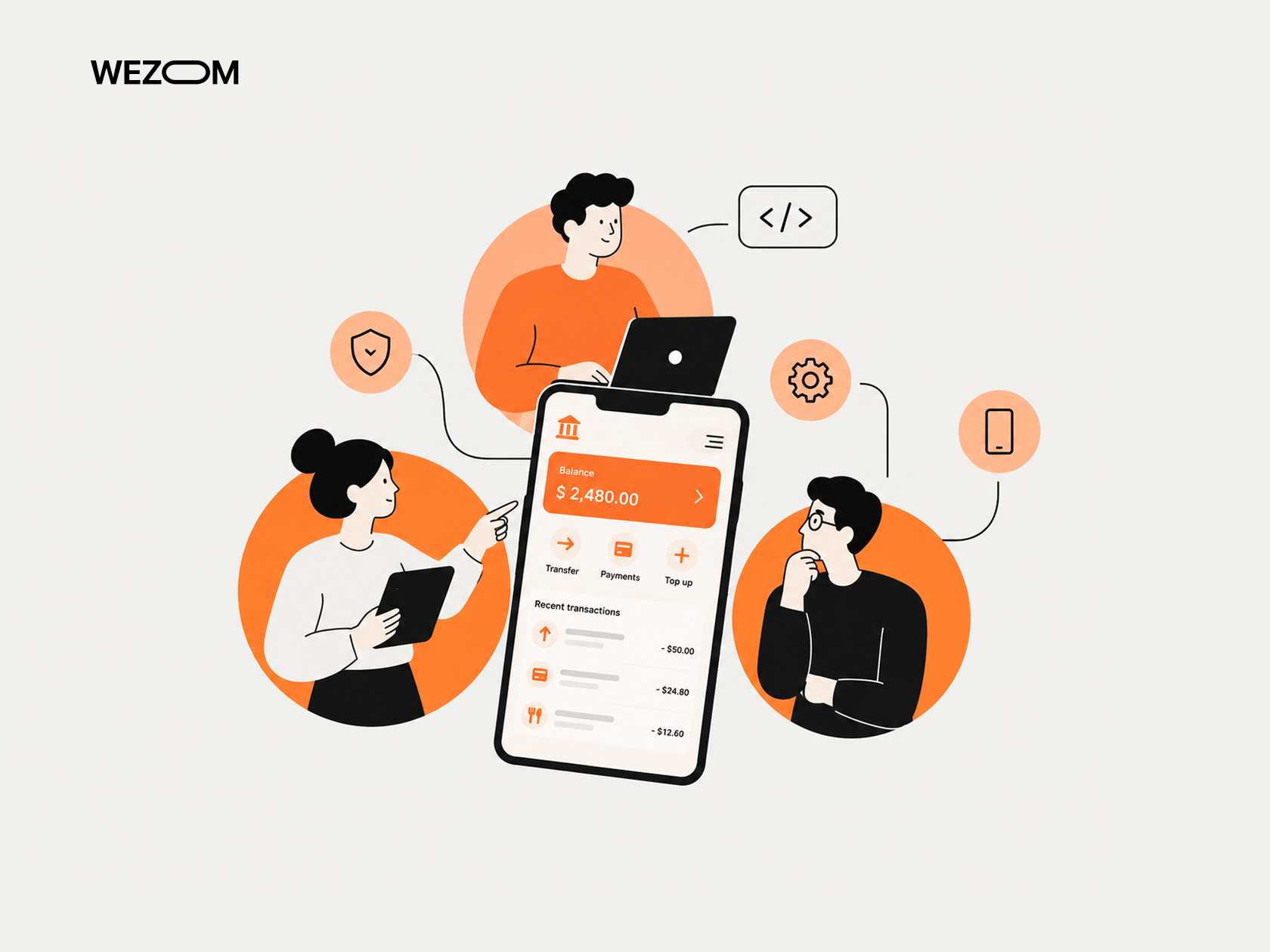
The success of a project largely depends on the qualifications of the team involved. Experienced mobile banking app developers can navigate common pitfalls and help save the client’s budget.
Banking and Fintech Domain Experience
The team should have an extensive portfolio of completed projects in the fintech app development sector. A solid grasp of the domain accelerates development and minimizes architectural errors.
Security and Compliance Expertise
The service provider must demonstrate proficiency in developing secure systems and possess a proven track record of successfully passing PCI DSS/GDPR audits.
Core Banking Integration Experience
Practical experience in connecting to popular core banking systems helps avoid delays during the service integration phase.
Mobile and Backend Engineering Capabilities
Developers should possess in-depth knowledge of modern frameworks and design patterns for distributed systems.
Development Process and Quality Assurance
Transparent project management processes and a robust QA culture ensure that deadlines are met and code quality remains high.
Post-Launch Support and Security Maintenance
A reliable partner offers long-term service-level agreements that provide 24/7 support and prompt issue resolution.
Questions to Ask a Mobile Banking Development Company
Before signing a contract, it is advisable to ask potential partners about their relevant fintech experience and their methods for ensuring security.
Mobile Banking Development Trends to Consider
The financial sector is driving the development of dynamic technologies. By accounting for current trends, it is possible to create products that remain relevant for years to come.
AI-Powered Fraud Detection and Behavioral Analytics
Behavioral analytics can analyze typing patterns and the pressure applied to a screen. This enables AI-based fraud detection systems to instantly identify unauthorized access to an account.
AI Banking Assistants and Hyper-Personalization
Artificial intelligence is transforming customer interaction by offering deep interface personalization and highly accurate, predictive financial product recommendations.
Passwordless Authentication and Passkeys
Shifting toward passwordless login methods enhances both convenience and security. Utilizing these modern technologies effectively eliminates the risks associated with phishing.
Open Banking and Embedded Finance
The concept of embedded finance allows banking services to be integrated into third-party platforms, such as online marketplaces or ride-hailing services.
Real-Time Payments
Users expect funds to be credited instantly. Supporting real-time payment systems has become an essential standard for any modern application.
Banking Super Apps
Major fintech companies are evolving their applications into “super apps”, combining core banking services with features like ticket purchasing and food delivery.
Cloud-Native and API-First Banking Architecture
An API-first approach ensures system flexibility, allowing for the rapid integration of new sales channels and third-party fintech services without requiring a complete overhaul of the core system.
FAQ
Can a mobile banking app work with several core banking systems?
Yes, an app can work with multiple core banking systems simultaneously. This is achieved at the server level using an API gateway that aggregates data from the various systems.
Is it better to build a mobile banking app from scratch or use a white-label platform?
Building from scratch offers complete flexibility and a unique UX, which is ideal for large banks. White-label platforms allow for a faster launch but significantly limit scalability.
Can an existing banking application be modernized without replacing its backend?
Yes, the interface and mobile front-end can be updated independently by creating an intermediary API layer. This improves performance without the need for a costly replacement of the core banking system.
How do banks protect mobile apps from account takeover attacks?
Protection is provided through multi-factor authentication, biometrics, and the automatic termination of inactive sessions. Additionally, built-in algorithms analyze suspicious login attempts and geolocation data.
What APIs are typically required for a mobile banking application?
The application requires integrations with core banking systems, payment gateways, and identity verification services. It also connects to push notification providers and transaction processing centers.
Can a banking app support multiple countries and currencies?
Yes; the architecture is designed to support multiple currencies and language locales. The backend automatically adjusts fees based on the regulations of specific regions.
How often should a mobile banking application undergo security testing?
A comprehensive security audit and penetration testing should be conducted at least once a year. Code scanning for vulnerabilities is performed with every update.
What should banks own internally when outsourcing mobile banking app development?
The bank must have full ownership of the source code, intellectual property, and access keys. All administrative accounts and servers must also be registered in the client’s name.
