
The global TMS market is constantly growing, as clearly demonstrated by analytics claiming its CAGR will remain at a record 17.8% until 2033. At the same time, logistics is becoming increasingly complex, so solutions that were relevant just five years ago are no longer sufficient to achieve end-to-end automation. Due to this, many carriers tend to invest in custom TMS software development. However, is it the optimal solution from an ROI perspective, given the hundreds of ready-made SaaS systems available? Let's find out below, as well as answer the question: “How much does TMS software cost?”
How Much Does TMS Software Cost?
Let's look at the average cost of ownership for one of the most popular SaaS solutions on the international market, Oracle Transportation Management. According to SelectHub, each module costs approximately $450 per month. If we add to that the fee for each booked freight shipment, which ranges from $1 to $4, and the cost per truck from $50 per month, it becomes clear that with a fleet of 10 trucks with one trip per day for each (and only one module, which is usually not enough), such a system would cost a company at least $1,250 per month, not including staff training, integrations with third-party services, and customization.
Actually, the last expense item, customization, is often one of the most expensive, as its cost directly correlates with the volume of data processed and the complexity of business operations. For example, for a small fleet of 10-15 vehicles, implementing a basic cloud solution can range from $1,000 to $5,000 per setup, while the enterprise segment will most likely face bills from $100,000.
Ultimately, when assessing TCO, you should consider the required depth of integration with ERP, WMS, GPS trackers, and other solutions, the number of active users, and the expected volume of requests/trips. Once this is understood, you’ll be able to come to a simple conclusion: the larger the company, the more complex its workflows, and the faster it scales, the more expensive it will be to implement a subscription-based system. Consequently, developing a custom alternative looks more promising.
Understanding TMS Pricing Models
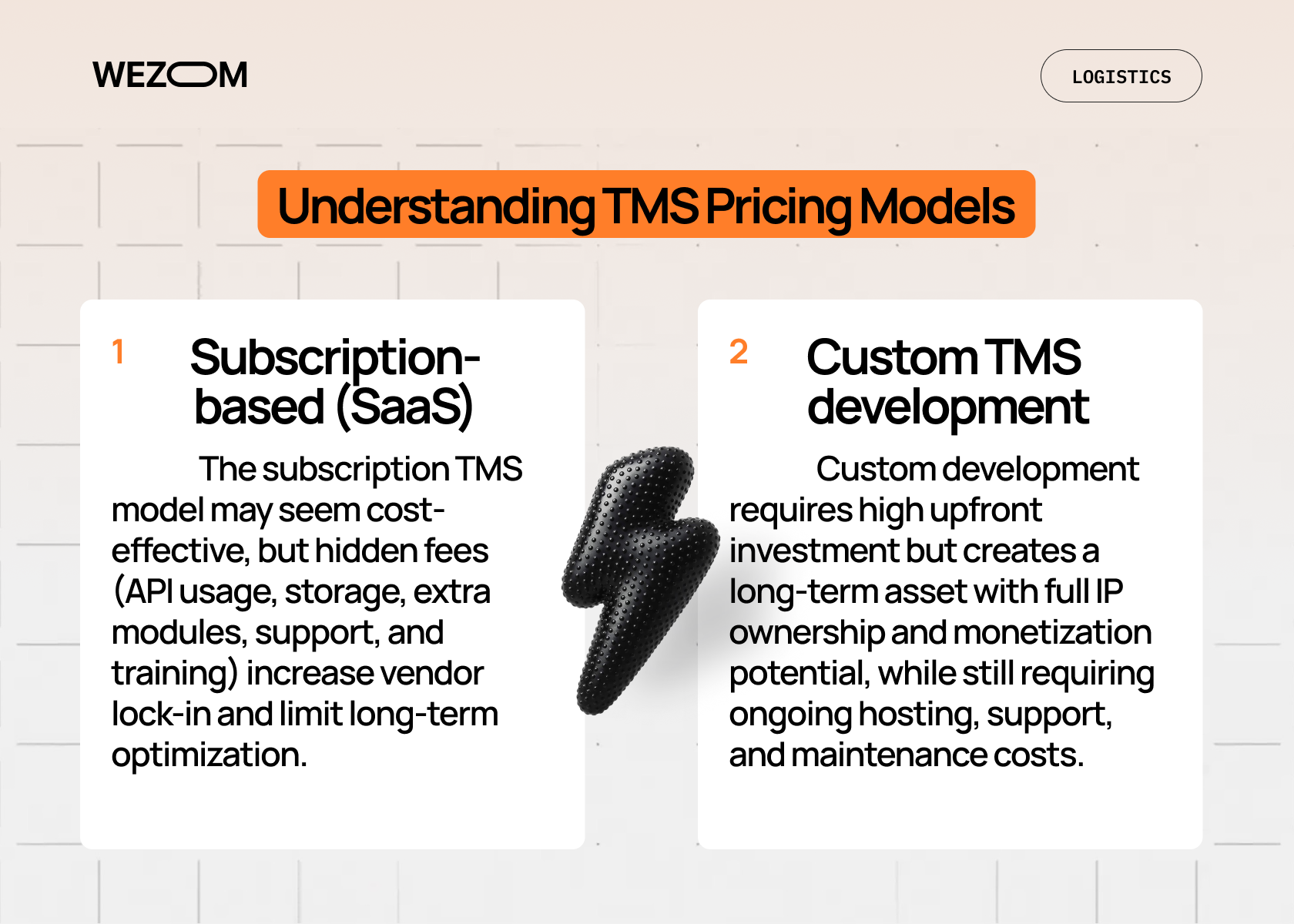
Now, let's dig deeper into TMS pricing models.
Subscription-based (SaaS)
The vast majority of vendors use either per-user pricing or performance/volume-based tiers. In this context, the subscription TMS software pricing model looks attractive because it doesn't require significant upfront investment, but it also comes with hidden fees for growth. Specifically, hidden costs include fees for additional API requests, document archive storage beyond the limit, and the purchase of modules (usually analytics) that aren't included in the basic package. Ultimately, a seemingly low TMS software price with additional fees for 24/7 support and staff training creates a tight vendor lock-in with no room for optimization over the long term.
Custom TMS development
Custom development always requires a significant capital investment at the start, which, over time, becomes a full-fledged company asset. Specifically, the main budget goes towards architecture design, coding, and integration with an existing IT infrastructure. However, unlike a subscription, you receive intellectual property that is solely yours (by the way, it can be monetized if desired by selling subscriptions to other companies). At the same time, you should understand that owning your own software requires costs for servers and/or cloud storage, as well as regular technical support and maintenance.
3-Year Cost Comparison: Subscription vs Custom Build
So, how much does a TMS system cost? Let’s compare a typical enterprise-level SaaS platform with the development of a custom system of average complexity. As we can see, the SaaS transportation management system cost is consistently high or growing, while custom solutions experience the biggest budget hit in the first year.
| Expense item | TMS on demand pricing (year 1) | TMS on demand pricing (year 2) | TMS on demand pricing (year 3) | Custom TMS (year 1) | Custom TMS (year 2) | Custom TMS (year 3) |
|---|---|---|---|---|---|---|
| Subscription (average) | $24,000 | $26,500 | $30,000 | $0 | $0 | $0 |
| Development and implementation (average) | $5,000 | $0 | $0 | $80,000 | $0 | $0 |
| Integrations (average) | $3,000 | $1,500 | $1,500 | $15,000 | $2,000 | $2,000 |
| Support and hosting | Included | Included | Included | $2,000 | $10,000 | $10,000 |
| Scaling | $2,000 | $4,500 | $7,000 | $0 | $5,000 | $3,000 |
| Total for the year (average) | $34,000 | $32,500 | $38,500 | $97,000 | $17,000 | $15,000 |
Total Cost of Ownership (TCO) in Logistics Software
The concept of TCO, which we've already used above, always extends far beyond the developer's invoice. This means that licensing fees (as in SaaS) or coding (as in custom development) are just the tip of the iceberg – so, you’ll have to add indirect costs such as staff training, adapting business processes to software limitations, and, most critically, the consequences of vendor lock-in (which imposes scalability limitations or may require middleware development for seamless integration with third-party systems) as well.
It's also worth noting that in the SaaS model, you don't own the code, so if the provider raises prices several times or discontinues support for a critical module, you'll have to go through data migration, which can cost tens of thousands of dollars due to the complexity of transferring trip history and settlements. In turn, with a custom solution, you manage the update cycle yourself and don't have to pay for features you don't need but that are included by default in the package you purchase.
Why Subscription Models Become Expensive at Scale
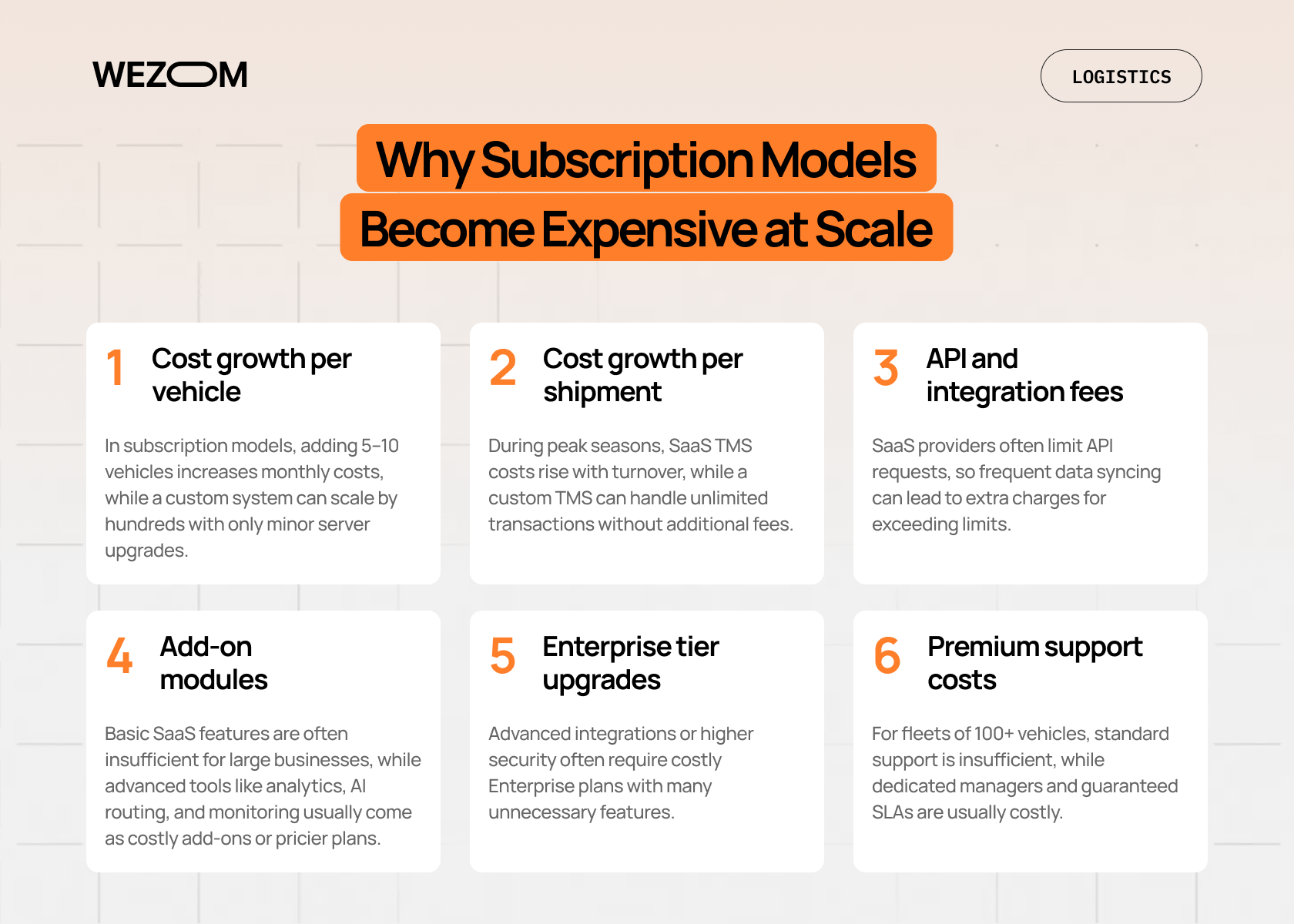
For companies with a fleet of 100+ vehicles, a subscription inevitably becomes a kind of success tax. This means the more you grow, the more you pay, even though the software's value to your business remains the same. Here's why:
- Cost growth per vehicle. In most subscription models, increasing your fleet by even 5-10 vehicles increases the monthly payment, while in a custom system, adding even 500 new vehicles requires only a minor increase in server capacity.
- Cost growth per shipment. When business reaches peak seasons, the SaaS transportation management system software cost increases in sync with turnover. A custom TMS, on the other hand, allows you to process an unlimited number of transactions.
- API and integration fees. SaaS providers often impose strict limits on the number of API requests. If your system needs to sync data with a marketplace or customs terminal 100 times per hour, you'll need to pay for each request over the limit.
- Add-on modules. Basic SaaS functionality often proves insufficient for large businesses. Smart analytics and forecasting modules, AI-powered route planners, temperature monitoring systems, and much more are often offered either as separate, expensive options or as part of a package that significantly increases the overall subscription price.
- Enterprise tier upgrades. As soon as you require specific integrations or a higher level of security, you'll have to upgrade to the Enterprise tier, where the cost per user is 3-5 times higher than the basic version and includes 50-70% of the new features you don't need.
- Premium support costs. When your fleet consists of 100+ vehicles, a standard support ticket with a 24-hour response is no longer sufficient. At the same time, dedicated managers and guaranteed SLAs are typically very expensive.
As a result, over 3-5 years, for companies with large fleets, a subscription creates budget uncertainty and deprives them of control over operating expenses.
When Does Custom TMS Become Financially Justified
Choosing custom development is usually most cost-effective in the following scenarios:
- Large fleets with 100+ vehicles – their subscription costs typically exceed $30,000-$40,000 per year, so a custom approach becomes cheaper after the third year;
- Too sophisticated workflows – if your dispatchers spend a third or more of their time manually transferring data, you're wasting money on inefficiencies;
- Integrations – if you need seamless integrations with your custom systems and, for example, hundreds of IoT sensors in real time, paying for supporting API integrations in SaaS becomes extremely unprofitable;
- Long-term growth plans – if you plan to double your revenue in a couple of years, you risk also doubling your SaaS subscription costs.
Overall, the cost of the transportation management system in the custom format pays for itself through subscription cancellations and dispatcher staff reductions through automation. On average, the breakeven point occurs between 18 and 24 months of operation.
Which TMS Pricing Model Is More Cost-Efficient?
For startups and small businesses, it's best to first consider a subscription-based transportation management system pricing model, as it offers the lowest entry threshold and doesn't require expanding an in-house IT department. If we're talking about medium-sized businesses with 30-80 vehicles, they can look for SaaS with flexible integrations, but simultaneously begin a process audit to prepare for custom development. Finally, for larger companies with 100+ vehicles, only a custom TMS deployment will help control TCO and eliminate vendor lock-in.
If you're looking for a reliable custom TMS developer with an extensive portfolio in this niche, feel free to contact us.

FAQ
How much does TMS software cost on average?
If we answer the question: “How much does TMS cost?” briefly, it ranges from $50 to $500 per user per month, while custom development typically starts from $30,000 to $80,000 for an MVP.
What is the typical transportation management system pricing model?
SaaS models are typically based on the number of users, transactions, or trips.
Is SaaS TMS cheaper than custom development?
In the short term, yes, it is, but over a 3-5 year period, the custom TMS software cost is 30-50% lower (for large companies).
What affects the cost of transportation management system software?
These include the number of integrations, the complexity of automated planning algorithms, the availability of a mobile app for drivers, and the depth of analytical reporting.
When does custom TMS become cost-effective?
Typically, the breakeven point occurs when the fleet size exceeds 50-70 units or when the cost of customizing a ready-made solution to your needs exceeds 50% of the cost of creating your own system.
