
Agentic AI has become one of the most important trends in enterprise technology, moving beyond traditional chatbots and content generation tools toward systems capable of planning, reasoning, and executing complex tasks autonomously. Modern AI agents can interact with APIs, retrieve information, use external tools, maintain context, and coordinate workflows with minimal human involvement.
As adoption accelerates, interest in the top AI agent frameworks 2026 continues to grow. These frameworks provide the infrastructure required to build scalable agentic systems, handling orchestration, memory management, tool integration, and multi-agent collaboration. Instead of developing these capabilities from scratch, organizations can leverage mature platforms that significantly reduce development complexity and deployment risks.
The rapid evolution of large language models has also expanded the capabilities of modern agents. Businesses are now using AI-powered assistants for workflow automation, data analysis, customer support, software development, and internal operations. However, the success of these solutions often depends on the framework that powers them.
When evaluating the best AI agent frameworks 2026, organizations typically focus on scalability, orchestration capabilities, memory handling, tool integration, and support for multi-agent architectures. Understanding the strengths of today's leading platforms is essential for selecting the right foundation for future AI initiatives and long-term business growth.
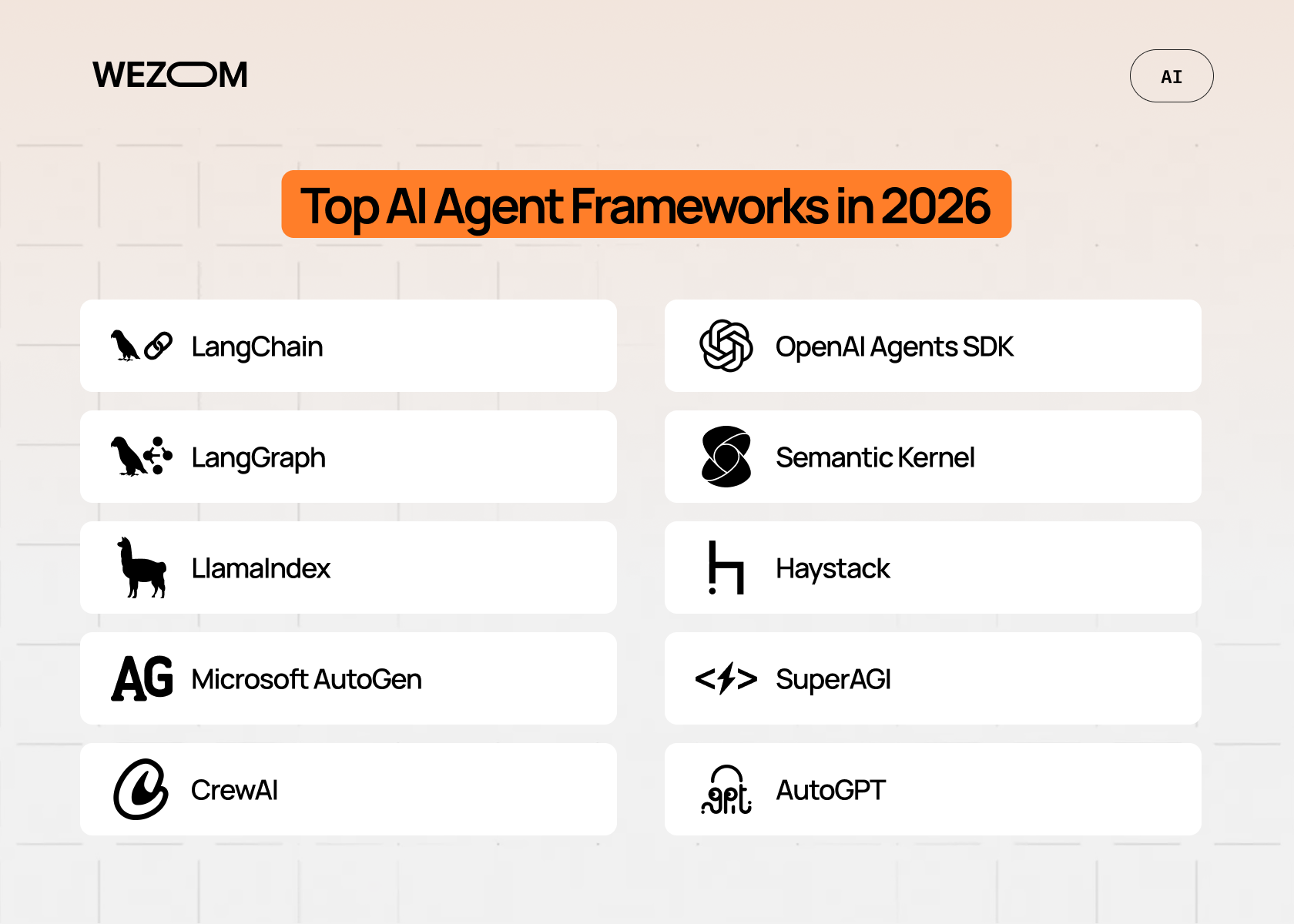
Top AI Agent Frameworks in 2026
1. LangChain
LangChain remains one of the most influential platforms among the top AI agent frameworks platforms 2026. Its ecosystem maturity, extensive documentation, and broad community support have made it a popular choice for both startups and enterprise development teams.
The framework provides comprehensive tooling for agent creation, prompt orchestration, memory management, retrieval systems, and external integrations. Developers can connect agents to databases, APIs, cloud services, search engines, analytics systems, and enterprise software using standardized components.
One of LangChain's primary strengths lies in its flexibility. Organizations can create simple assistants, advanced workflow engines, or fully autonomous systems without being locked into a specific model provider. This architecture allows businesses to adapt quickly as LLM capabilities evolve.
Enterprise adoption has expanded significantly because LangChain supports production-grade deployment patterns, observability tools, and integration with modern infrastructure stacks.
2. LangGraph
LangGraph has become one of the most influential additions to the ecosystem of top AI agent frameworks 2026 thanks to its focus on stateful orchestration and complex workflow management. Built by the LangChain team, it enables developers to design AI agents as interconnected graphs where each node represents a specific action, reasoning step, or decision point. This approach provides greater control over execution flow and makes it easier to build reliable, production-ready agent systems.
One of LangGraph's key advantages is its ability to maintain state across long-running processes, allowing agents to preserve context, revisit previous decisions, and handle complex multi-step tasks more effectively. The framework is particularly valuable for enterprise applications involving workflow automation, customer support operations, research assistants, and multi-agent collaboration. Its transparent architecture also improves observability and debugging, helping development teams better understand how agents reason and execute tasks in real-world environments.
3. LlamaIndex
LlamaIndex has established itself as one of the leading platforms for data-centric agent development and is widely recognized among the top AI agent frameworks platforms 2026. Unlike frameworks that primarily focus on workflow orchestration, LlamaIndex specializes in connecting AI agents with structured and unstructured data sources, enabling more accurate and context-aware decision-making. The platform provides powerful retrieval capabilities through vector databases, embeddings, indexing pipelines, and advanced search mechanisms.
Its strong support for retrieval-augmented generation (RAG) allows agents to access relevant information in real time rather than relying solely on model knowledge. This makes LlamaIndex particularly valuable for enterprise knowledge management systems, research assistants, analytics platforms, and document-heavy environments. Organizations that need AI agents to work with large volumes of internal data often choose LlamaIndex because of its ability to improve accuracy, reduce hallucinations, and enhance contextual reasoning.
4. Microsoft AutoGen
Microsoft AutoGen introduced a highly effective framework for building collaborative multi-agent systems. Instead of relying on a single AI agent to perform all tasks, AutoGen enables multiple specialized agents to communicate, exchange information, and work together toward a common objective. This approach supports more advanced reasoning processes and allows organizations to design sophisticated workflows involving planning, execution, validation, and analysis.
The framework has gained popularity in both research and enterprise environments due to its flexibility and support for dynamic agent interactions. Development teams can create ecosystems where different agents contribute specialized expertise while coordinating through structured communication channels. AutoGen is particularly useful for software development automation, complex data analysis, business process optimization, and scenarios requiring iterative problem-solving. Its architecture reflects the growing trend toward multiagent systems as organizations seek more scalable and intelligent automation solutions.
5. CrewAI
CrewAI focuses on role-based multi-agent collaboration, providing a framework that closely mirrors how human teams operate within organizations. Developers can define specific agent roles, responsibilities, objectives, and communication patterns, allowing each agent to contribute specialized expertise to a larger workflow. This structure makes CrewAI particularly intuitive for business-focused applications where tasks naturally involve coordination among multiple participants.
One of the framework's key strengths is its task delegation architecture. Agents can function as researchers, analysts, planners, reviewers, or executors, working together to complete complex objectives efficiently. This approach simplifies the design of multi-step workflows and helps organizations model real-world operational processes. As a result, CrewAI has become one of the top AI agent development frameworks for companies looking to automate business functions that require collaboration, coordination, and distributed decision-making across multiple roles.
6. OpenAI Agents SDK
The OpenAI Agents SDK has quickly emerged as one of the most important additions to the ecosystem of top AI agent development frameworks 2026. Built specifically for the OpenAI platform, it provides native support for agent orchestration, reasoning loops, tool calling, memory management, and workflow execution. By integrating these capabilities into a unified development environment, the SDK significantly reduces the complexity associated with building production-ready AI agents.
A major advantage of the framework is its tight integration with OpenAI models and services, enabling developers to rapidly deploy agents that can interact with external tools, retrieve information, and perform autonomous actions. The SDK also simplifies implementation by providing standardized mechanisms for context management and task execution. For organizations already leveraging OpenAI technologies, it offers a streamlined path from prototype development to enterprise-scale deployment while minimizing infrastructure overhead.
7. Semantic Kernel
Semantic Kernel has evolved into a robust enterprise orchestration framework designed to bridge AI capabilities with existing business systems. Developed by Microsoft, it focuses on structured integration, enabling organizations to connect intelligent agents with applications, databases, services, and workflows already operating within their technology ecosystem. This makes it particularly attractive for enterprises pursuing large-scale AI adoption initiatives.
The framework's plugin-based architecture allows developers to expose business functionality directly to AI agents through reusable components. These plugins can connect to CRM platforms, ERP systems, analytics tools, cloud services, and proprietary applications, creating a unified environment for intelligent automation. Beyond technical integration, Semantic Kernel places strong emphasis on governance, security, compliance, and operational control, making it one of the most enterprise-ready solutions among the top agentic AI frameworks available today.
8. Haystack
Haystack remains a powerful platform for building intelligent search systems, question-answering applications, retrieval pipelines, and AI-powered assistants. While originally focused on natural language processing use cases, the framework has expanded significantly to support modern agentic architectures that combine retrieval, reasoning, and workflow execution capabilities.
Its strength lies in connecting AI agents with large knowledge repositories and enabling efficient access to relevant information through retrieval and contextual search. Organizations often use Haystack to develop enterprise assistants, internal knowledge platforms, customer support solutions, and analytics applications where information accuracy is critical. The framework also benefits from a mature deployment ecosystem and production-focused architecture, making it suitable for organizations that require scalable, reliable AI systems capable of operating in demanding business environments.
9. SuperAGI
SuperAGI was created as an open-source framework specifically focused on autonomous agent development and lifecycle management. Rather than concentrating solely on agent creation, the platform provides tools for deployment, monitoring, optimization, and operational oversight. This broader approach helps organizations manage autonomous systems throughout their entire lifecycle, from experimentation to production deployment.
The framework includes centralized management capabilities that allow developers to track agent performance, monitor execution outcomes, analyze behavior, and continuously improve workflows. Its open-source nature also provides extensive customization opportunities for organizations with unique technical requirements. Businesses that prioritize transparency, flexibility, and operational visibility often consider SuperAGI a compelling option for building and managing autonomous AI systems at scale.
10. AutoGPT (Modernized 2026 Version)
AutoGPT remains one of the most recognizable projects in the autonomous AI ecosystem and continues to influence the evolution of agentic systems. While early versions were primarily experimental and focused on demonstrating autonomous task execution, the modernized 2026 iteration introduces more structured workflow management, improved reasoning capabilities, and stronger memory persistence mechanisms.
The platform enables agents to break down objectives into smaller tasks, execute actions, evaluate results, and adjust their strategies dynamically. Although it is still generally considered more experimental than enterprise-focused frameworks such as Semantic Kernel or LangGraph, AutoGPT remains valuable for research, prototyping, and innovation initiatives. Many organizations use it to explore emerging autonomous workflows and test advanced concepts before implementing them within more structured production environments.
Top AI Agent Frameworks Comparison 2026
Choosing among the top AI agent frameworks comparison 2026 requires more than simply reviewing feature lists. Organizations must evaluate architectural approaches, deployment requirements, governance needs, integration capabilities, and long-term maintainability. A framework that performs exceptionally well for a research prototype may not be suitable for a regulated enterprise environment, while a highly structured enterprise platform may introduce unnecessary complexity for smaller teams.
One of the most important distinctions between modern frameworks is how they handle orchestration. Some platforms focus primarily on agent workflows and tool execution, while others emphasize state management, retrieval, multi-agent coordination, or enterprise integration. The right choice often depends on the complexity of the workflow being automated and the number of systems involved.
Memory handling has also become a major differentiator among the top AI agent frameworks platforms. Simple conversational memory may be sufficient for customer support assistants, but enterprise systems increasingly require long-term context retention, retrieval capabilities, knowledge grounding, and cross-session continuity. Frameworks that provide flexible memory architectures often deliver better performance in complex operational environments.
Another critical consideration is tool integration. Modern AI agents rarely operate in isolation. They interact with CRM platforms, databases, APIs, analytics systems, cloud services, productivity tools, and proprietary business applications. Frameworks that simplify integration can dramatically reduce development time while improving reliability and maintainability.
Enterprise readiness extends beyond technical capabilities. Organizations must consider observability, monitoring, deployment flexibility, governance controls, scalability, security requirements, and operational support. Many businesses initially prioritize experimentation but later discover that production deployment introduces an entirely different set of requirements.
The following comparison highlights how the leading frameworks approach these challenges.
| Framework | Architecture Type | Multi-Agent Support | Memory Capabilities | Tool Integration | Enterprise Readiness |
|---|---|---|---|---|---|
| LangChain | Modular orchestration | Moderate | Strong | Extensive | High |
| LangGraph | State-based workflows | Moderate | Strong | Extensive | High |
| LlamaIndex | Data-centric architecture | Limited | Excellent | Strong | High |
| AutoGen | Agent communication model | Excellent | Good | Strong | Medium-High |
| CrewAI | Role-based agents | Excellent | Good | Moderate | Medium |
| OpenAI Agents SDK | Native agent platform | Moderate | Strong | Excellent | High |
| Semantic Kernel | Enterprise orchestration | Moderate | Strong | Excellent | Excellent |
| Haystack | Retrieval pipelines | Limited | Strong | Good | High |
| SuperAGI | Autonomous agent management | Strong | Moderate | Moderate | Medium |
| AutoGPT | Autonomous execution | Strong | Moderate | Moderate | Medium |
From an enterprise perspective, Semantic Kernel, LangChain, LangGraph, and OpenAI Agents SDK currently offer some of the strongest production capabilities. Organizations prioritizing retrieval-heavy applications often gravitate toward LlamaIndex or Haystack, while businesses exploring sophisticated multiagent architectures frequently evaluate AutoGen and CrewAI.
The top AI agent frameworks 2026 comparison ultimately demonstrates that no single platform dominates every category. The best choice depends on organizational goals, technical requirements, infrastructure strategy, and the desired level of agent autonomy.
Benefits of Agentic AI Frameworks
The growing popularity of agentic AI is driven by its ability to move beyond simple task automation and support more sophisticated business processes. Modern organizations increasingly require AI systems that can reason, access data, interact with software tools, and coordinate multiple actions to achieve a specific goal. Building such capabilities from scratch is both time-consuming and technically complex, which is why businesses are turning to the top AI agent frameworks for business 2026.
These frameworks provide a structured foundation for creating intelligent systems that combine large language models with memory, orchestration, retrieval, and tool integration capabilities. As a result, development teams can focus on solving business problems rather than building underlying infrastructure. This accelerates deployment, reduces engineering effort, and helps organizations move AI initiatives from proof-of-concept to production more efficiently.
Beyond development speed, agentic frameworks improve operational flexibility. AI agents can dynamically adapt to changing conditions, access contextual information, communicate with external systems, and execute multi-step workflows without requiring predefined rules for every possible scenario. This makes them particularly valuable for enterprise environments where processes often involve multiple systems, departments, and decision points.
The main advantages of modern agentic AI frameworks include:
- Increased automation of complex workflows that involve multiple steps, approvals, and external systems.
- Multi-agent collaboration, allowing specialized agents to handle planning, analysis, execution, and validation tasks.
- Improved decision-making through access to contextual data, enterprise knowledge bases, and external tools.
- Seamless integration with APIs, databases, cloud services, CRM platforms, and other business applications.
- Better scalability for enterprise deployments that require large volumes of interactions and workflow execution.
- Faster development of AI-powered products and assistants through reusable components and orchestration tools.
- Enhanced personalization and context awareness through memory systems and long-term information retention.
As agentic AI continues to mature, these frameworks are becoming a critical part of enterprise technology stacks. Rather than serving as standalone development tools, they increasingly act as orchestration layers that connect models, data, workflows, and business applications into unified intelligent systems capable of delivering measurable operational value.
How to Choose the Right AI Agent Framework
Selecting the right framework begins with understanding the business problem rather than evaluating technology in isolation. Many organizations make the mistake of choosing a platform based on popularity or feature lists without considering long-term operational requirements.
For retrieval-heavy applications involving large document repositories, enterprise knowledge bases, and analytics workflows, LlamaIndex and Haystack often provide strong advantages. Their focus on retrieval, embeddings, vector search, and contextual reasoning supports data-intensive use cases effectively.
Organizations building workflow-centric applications may benefit more from LangGraph or LangChain. These frameworks provide extensive orchestration capabilities that support complex execution pipelines, tool coordination, and structured decision-making processes.
Businesses pursuing multiagent architectures should evaluate CrewAI and AutoGen carefully. Their specialized support for agent collaboration can significantly simplify implementation when multiple agents need to coordinate responsibilities and exchange information.
Enterprise environments introduce additional considerations. Security requirements, governance policies, compliance standards, monitoring capabilities, and deployment flexibility often influence framework selection as much as technical functionality. Semantic Kernel and OpenAI Agents SDK frequently perform well in these scenarios because they emphasize enterprise integration and operational control.
Cost-versus-complexity tradeoffs must also be considered. Some frameworks offer powerful capabilities but require substantial engineering expertise. Others simplify development but may introduce platform dependencies or limitations that affect long-term flexibility.
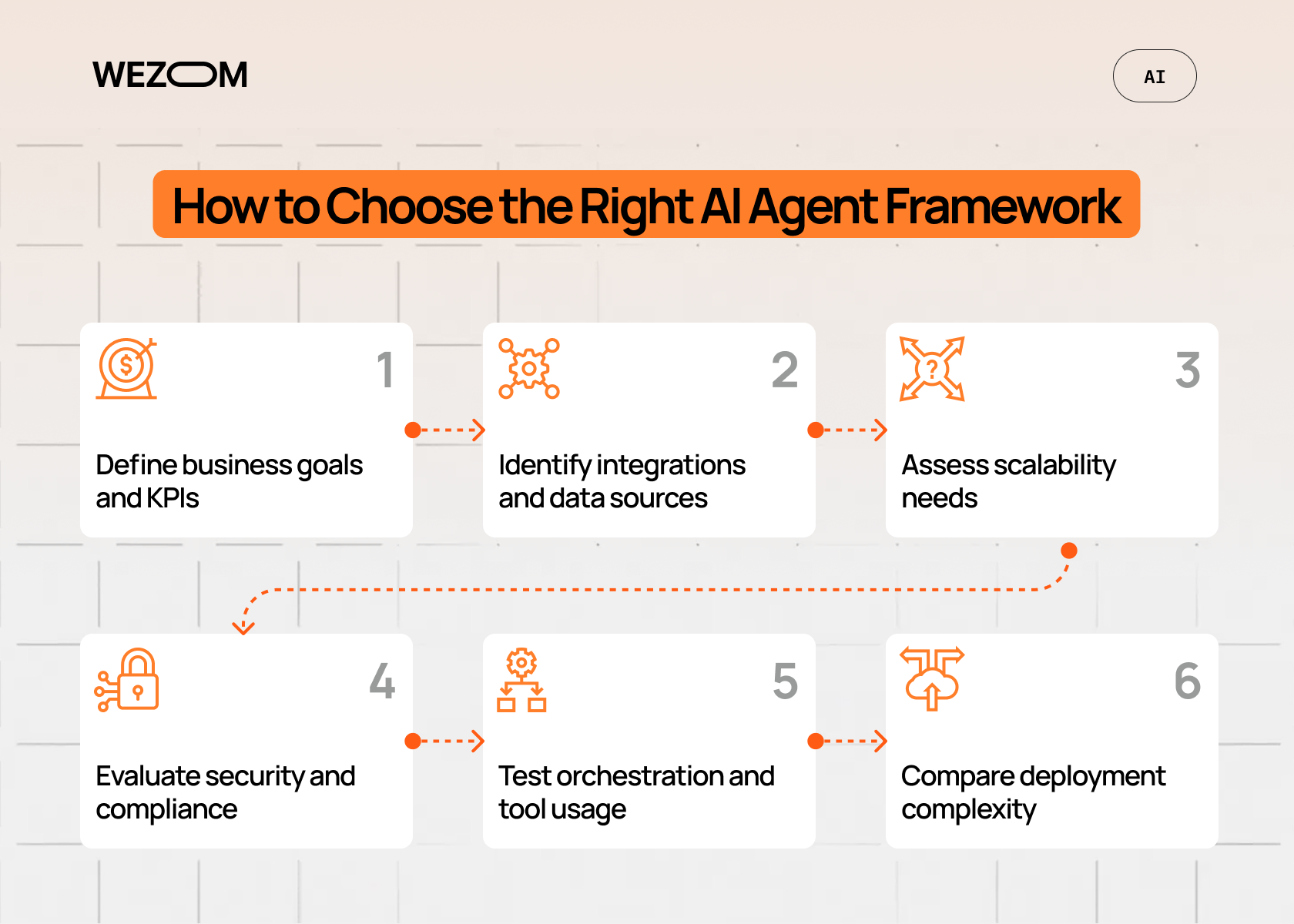
A practical evaluation process typically includes:
- Defining primary business objectives and success metrics.
- Identifying required integrations and data sources.
- Assessing scalability requirements and expected workload growth.
- Evaluating governance, security, and compliance needs.
- Testing orchestration, memory, and tool execution capabilities.
- Comparing operational overhead and deployment complexity.
Organizations should also recognize that the agent ecosystem continues evolving rapidly. Flexibility and adaptability are becoming increasingly important selection criteria. Frameworks that support multiple models, cloud providers, and integration approaches often provide greater long-term value than highly specialized alternatives.
Conclusion
The rise of agentic AI represents a significant shift in how organizations approach automation, decision-making, and software development. Rather than functioning as isolated conversational interfaces, modern agents are becoming active participants in business workflows, capable of reasoning, planning, executing actions, and collaborating with both humans and other agents.
The ecosystem of top AI agent frameworks 2026 has matured considerably, offering solutions tailored to different architectural approaches and business requirements. LangChain and LangGraph continue to lead workflow orchestration, LlamaIndex dominates data-centric applications, AutoGen and CrewAI excel in multi-agent collaboration, while Semantic Kernel and OpenAI Agents SDK provide increasingly compelling enterprise capabilities.
The best agentic AI frameworks are not necessarily those with the largest feature sets. Success depends on alignment between business objectives, technical architecture, operational requirements, and long-term scalability goals. Organizations that carefully evaluate these factors will be better positioned to build reliable, production-ready AI systems capable of delivering measurable business value.

FAQ
What are the best AI agent frameworks in 2026?
The best AI agent frameworks 2026 include LangChain, LangGraph, LlamaIndex, Microsoft AutoGen, CrewAI, OpenAI Agents SDK, Semantic Kernel, Haystack, SuperAGI, and AutoGPT. The ideal choice depends on the use case. Enterprises often prioritize Semantic Kernel, LangChain, and OpenAI Agents SDK, while organizations focused on multi-agent collaboration frequently evaluate AutoGen and CrewAI.
How do AI agent frameworks work?
AI agent frameworks provide the infrastructure required to build autonomous systems that combine large language models with memory, orchestration, tool execution, retrieval, planning, and workflow management capabilities. They coordinate interactions between models, APIs, databases, business systems, and users, allowing agents to perform complex tasks rather than generating standalone responses.
Which AI agent framework is best for beginners?
LangChain is often considered the most accessible starting point because of its extensive documentation, large community, and mature ecosystem. Developers can quickly build functional agents while gradually expanding into advanced orchestration, retrieval, and automation scenarios. OpenAI Agents SDK is also becoming increasingly attractive for teams already using OpenAI technologies.
Which AI agent framework is best for enterprises?
Enterprise requirements typically emphasize scalability, governance, security, observability, and integration. Semantic Kernel, LangGraph, LangChain, and OpenAI Agents SDK are among the strongest enterprise-oriented options. The final selection should depend on infrastructure strategy, compliance requirements, deployment model, and integration complexity.
What is the most scalable AI agent framework?
Scalability depends on architecture and deployment design, but LangGraph, LangChain, Semantic Kernel, and OpenAI Agents SDK currently provide some of the strongest foundations for large-scale enterprise deployment. These frameworks support advanced orchestration, distributed workflows, cloud-native deployment patterns, and integration with enterprise infrastructure, making them suitable for high-volume production environments.
