
A fraud model scoring card transactions, a chatbot answering delivery questions, and a vision system rejecting cracked bottles on a packing line are all called "AI," yet they are built differently, fail differently, and cost different amounts to run. This guide explains the main types of artificial intelligence through the classification schemes researchers and vendors actually use, then covers industry examples, comparisons, and selection criteria.
What Are the Different Types of Artificial Intelligence?
How artificial intelligence is classified
There is no single official AI classification. The same system can be described along several independent axes. Capability classification asks how broad the intelligence is, from narrow task performance to hypothetical human-level reasoning. Functionality classification asks how the system uses memory. Technology classification groups systems by the technique doing the work, such as machine learning or computer vision, while learning-approach classification describes how a model is trained. Business categories such as generative, predictive, or agentic AI describe what the system produces.
A support assistant built on a large language model is narrow AI by capability, limited memory AI by functionality, NLP by technology, self-supervised and fine-tuned by learning approach, and conversational AI by business category.
Why different AI classifications matter for businesses
Each axis informs a different decision. Capability classification sets expectations: no commercial product reasons across domains the way a person does, so a proposal assuming general intelligence misjudges the technology. Technology classification determines skills and infrastructure, because a computer vision project needs labeled images and GPU inference capacity, while a rule-based system needs documented domain logic. Learning approach shapes the budget, since labeling is often the largest hidden cost of a supervised project.
The difference between AI types, technologies, and applications
Vendor materials often mix three layers. An AI type is a conceptual category (narrow AI, reactive machines, generative AI). A technology is the method that implements it (gradient-boosted trees, convolutional networks, transformers). An application is the business use (invoice extraction, demand forecasting, visual inspection). One application usually combines several technologies, so the useful question behind any "AI-powered" claim is which model, trained on what data, produces which output.
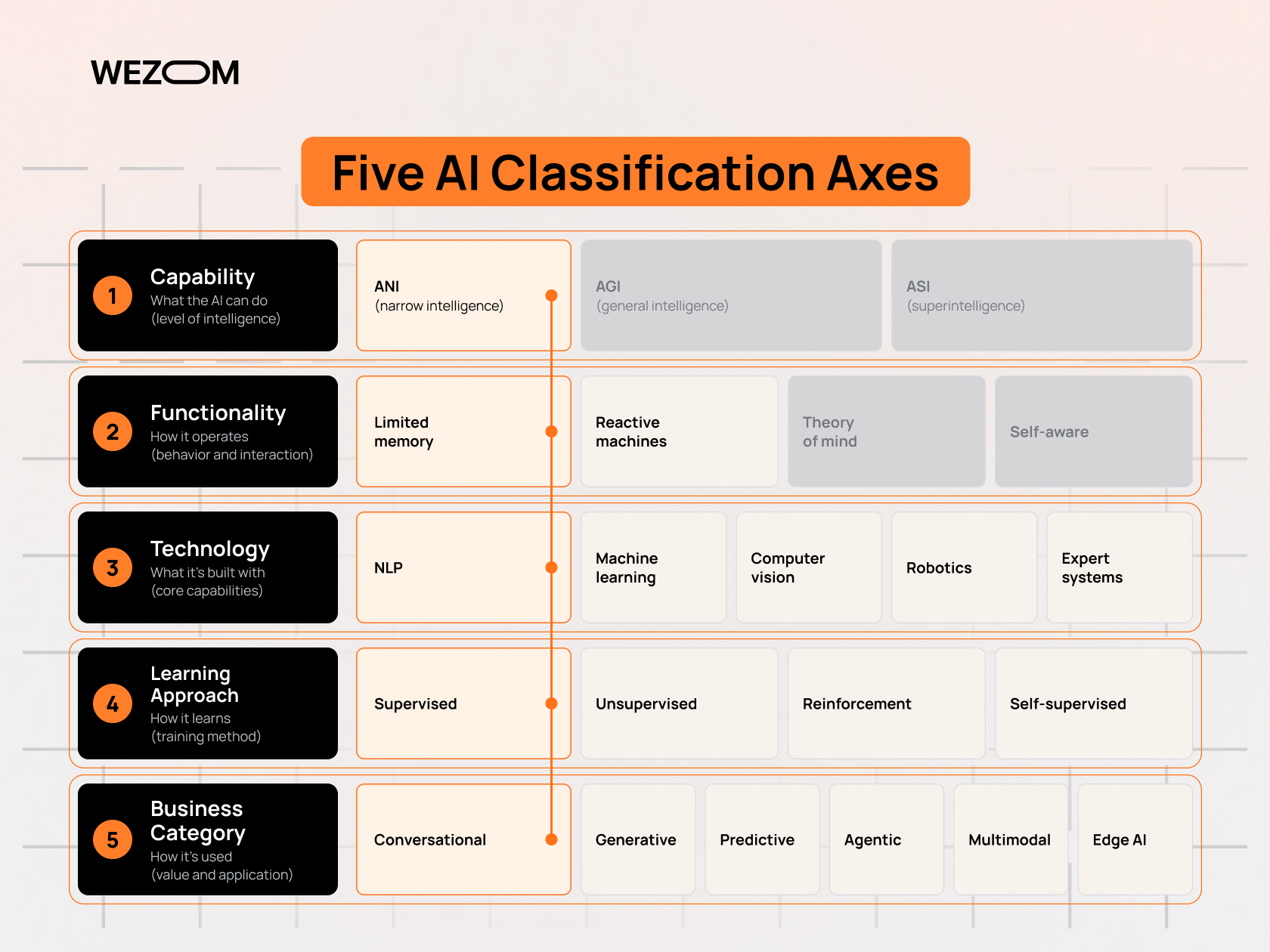
Types of Artificial Intelligence Based on Capabilities
Artificial Narrow Intelligence (ANI): AI built for specific tasks
Narrow AI (ANI), often called weak AI, performs a defined task or bounded set of tasks. Credit scoring models, speech recognizers, recommendation engines, and image classifiers are all narrow systems. They may outperform people within their scope but do not transfer that competence to unrelated problems without retraining: a model that detects defects in welded seams knows nothing about painted surfaces.
Large language models stretch the intuitive meaning of "narrow" because they handle drafting, translation, and code across many subjects. They remain narrow in the technical sense: they work within the patterns of their training data, cannot reliably verify their own outputs, and do not form goals or learn continuously in deployment.
Artificial General Intelligence (AGI): The concept of human-level AI
Artificial general intelligence (AGI) describes a system that learns and reasons across domains at human level, transferring knowledge between situations without task-specific engineering. AGI does not exist. For business planning, AGI is a research question rather than a procurement option.
Artificial Superintelligence (ASI): AI beyond human capabilities
Artificial superintelligence (ASI) refers to hypothetical systems exceeding human intelligence across virtually all cognitive work. It matters mainly in safety research and policy debate, where alignment and control are studied before such systems could exist, and has no role in current product selection.
Narrow AI vs. General AI vs. Super AI: Key differences
Narrow AI handles one domain, needs retraining for new tasks, and is deployed everywhere. General AI would handle any intellectual task a person can and is theoretical. Superintelligence would surpass human performance across domains and is speculative. The weak AI vs strong AI distinction maps onto this split: weak AI is task-bounded, while strong AI means general intelligence comparable to a human mind.
Which capability-based AI types are available today?
Only narrow AI. Every commercial system, including the most capable LLMs, agent frameworks, and autonomous vehicles, belongs here. Project plans should assume a system that performs well inside its tested scope and unpredictably outside it.
Four Types of Artificial Intelligence Based on Functionality
Reactive machines: AI systems without memory
Reactive machines respond to current input with fixed logic or a fixed model, without storing past interactions. IBM's Deep Blue, which defeated Garry Kasparov in 1997, is the standard example: it evaluated chess positions in depth but remembered no previous games. Many production systems behave reactively at inference time. A deployed spam filter scoring each email independently is reactive even though it was trained on historical data.
Limited memory AI: Learning from historical and recent data
Limited memory AI combines historical training data with recent observations. Nearly all modern machine learning falls here. An autonomous vehicle pairs a trained perception model with a short buffer of sensor readings to track nearby objects, and a chatbot keeps the current conversation in its context window. Learning usually happens through retraining cycles, where engineers collect new data and release a new model version, rather than through continuous self-modification.
Theory of mind AI: Understanding human emotions and intentions
Theory of mind AI would model the beliefs, intentions, and emotions of the people it interacts with. Current systems detect sentiment and generate empathetic-sounding replies, but this is pattern recognition, not an internal model of another mind. Sentiment analysis that routes an angry customer to a senior agent is useful without being theory of mind AI.
Self-aware AI: The hypothetical future of artificial intelligence
Self-aware artificial intelligence would possess consciousness and awareness of its own internal states. It exists only in theory and fiction, and there is no agreed scientific test for machine consciousness.
How these four forms of AI compare in business applications
Of the four forms of AI in this scheme, only two are deployable. Reactive designs suit tasks where consistency and auditability outweigh adaptation, such as fixed-model quality scoring. Limited memory AI covers most business value: forecasting, recommendations, document processing, assistants, and vision systems. In practice the functional choice is between static behavior and models periodically retrained on new data.
What Are the 5 Main Types of Artificial Intelligence?
Why some AI classifications identify five main types
Lists of the 5 main types of artificial intelligence usually follow a technology-based grouping rather than a formal standard: machine learning, natural language processing, computer vision, robotics, and expert systems. The grouping is practical because each maps to a distinct engineering discipline with its own data, tooling, and specialists.
Machine learning AI: Systems that identify patterns in data
Machine learning (ML) builds models that learn statistical relationships from examples instead of hand-written rules. A churn model learns which combinations of usage drop-off, support tickets, and contract terms preceded past cancellations, then scores current customers. On structured business data such as transactions and CRM records, classical methods like gradient boosting remain competitive with deep networks and are cheaper to run and easier to explain.
Natural language processing AI: Understanding and generating language
Natural language processing (NLP) covers systems that classify, extract from, translate, and generate human language, from routing support emails by intent to extracting clauses from contracts and fields from invoices. Large language models (LLMs) have absorbed many tasks that once needed separate NLP pipelines, though smaller dedicated models still make sense where cost per document, latency, or data residency rules out a large model.
Computer vision AI: Interpreting images and video
Computer vision handles classification, object detection, segmentation, and tracking in images and video. Applications include defect inspection, shelf monitoring, document capture, medical imaging, and drone-based infrastructure inspection. A model trained under one lighting setup or camera angle can degrade sharply under another, so data collection usually takes more effort than model selection.
Robotics and autonomous AI: Connecting intelligence with physical actions
Robotics and automation combine perception, planning, and control to act physically. Warehouse robots navigating aisles and arms picking mixed items integrate vision, localization, motion planning, and safety logic. Because physical errors can injure people or damage goods, these systems carry safety layers, fallback behaviors, and certification requirements that pure software does not need.
Expert systems and rule-based AI: Automating knowledge-driven decisions
Expert systems encode specialist knowledge as explicit rules, decision tables, or knowledge graphs. Rule-based systems remain common in underwriting, tax calculation, eligibility checks, and compliance, where every decision must trace back to a documented rule. They need no training data and behave deterministically, but grow hard to maintain as rule sets expand and cannot handle cases their authors did not anticipate.
How these five AI technology categories overlap
The categories are ingredients more than products. An insurance claims platform may use NLP to read adjuster notes, computer vision to assess damage photos, an ML model to flag fraud risk, and an expert system to apply policy terms. Most enterprise AI solutions are compositions like this, so data flow between components often decides project success more than any single model.
Different Kinds of AI by Learning Approach
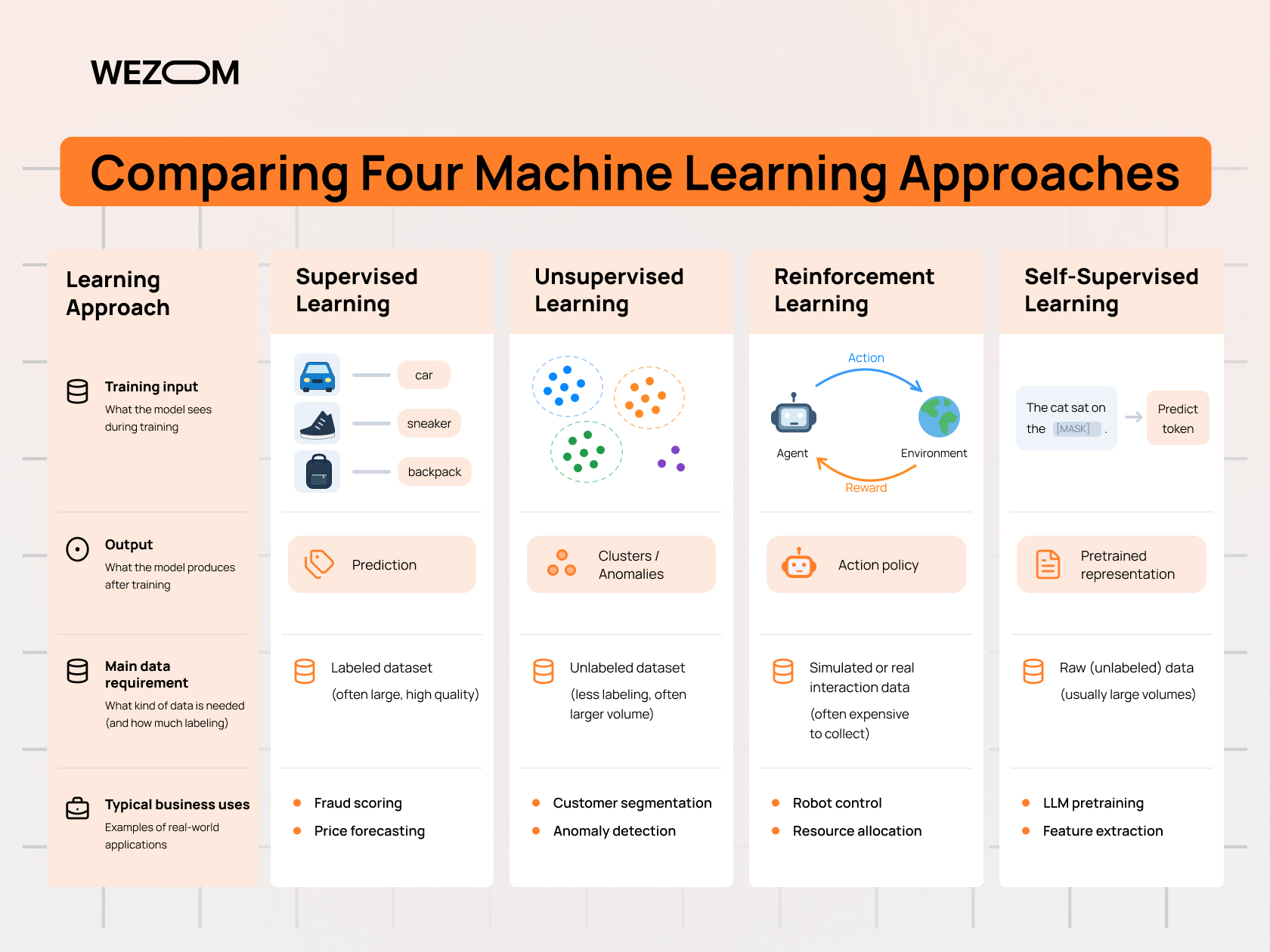
Grouping different kinds of AI by how they learn shows where the data and labeling effort sits, which often decides cost and timeline.
Supervised learning: Training AI with labeled data
Supervised learning trains a model on input–output pairs: transactions labeled fraudulent or legitimate, images labeled defective or acceptable. It dominates business use because results can be measured against held-out labeled data. Labels cost domain expertise, and inconsistent labeling caps achievable accuracy.
Unsupervised learning: Finding patterns without predefined labels
Unsupervised learning finds structure without labels. Clustering groups customers by purchasing behavior, and anomaly detection flags sensor readings that differ from normal operation. It suits exploratory analysis and failures too rare to label in volume, but output needs interpretation: a cluster is a statistical grouping until someone confirms it represents a meaningful segment.
Reinforcement learning: Learning through actions and rewards
Reinforcement learning trains an agent through actions and rewards. It has produced strong results in games and robotics control, and a variant using human feedback is widely applied to align LLM behavior. Business adoption is narrower because the agent needs a realistic simulator or a safe environment for trial and error, and few companies can let a pricing agent experiment on live operations.
Self-supervised learning: Using unlabeled data at scale
Self-supervised learning creates training signals from the data itself, for example by hiding a word and asking the model to predict it. It is how LLMs and other foundation models are pretrained on enormous unlabeled corpora. Businesses rarely run this pretraining themselves; they adapt pretrained models through fine-tuning or retrieval.
Deep learning vs. traditional machine learning
Deep learning uses artificial neural networks with many layers that learn features directly from pixels, audio, or text. Traditional machine learning relies on engineered features from structured data. Deep learning dominates unstructured data and needs more data and GPU compute, while traditional ML often matches it on tabular data, trains faster, and is easier to explain to auditors. The data type should drive the choice.
Modern Types of AI Technology Used in Business
These are the types of AI technology most often discussed in enterprise planning. They describe what a system produces or how it operates rather than the underlying algorithm.
Generative AI: Creating text, images, code, and content
Generative AI produces new text, images, code, audio, and synthetic data. Text and code generation runs mostly on transformer-based LLMs, image generation commonly on diffusion models. Business uses include drafting proposals, summarizing documents, generating code and tests, and answering questions over internal knowledge through retrieval-augmented generation (RAG), where the system retrieves passages from approved documents and instructs the model to answer from them, which reduces unsupported answers and allows citations.
Predictive AI: Forecasting outcomes and identifying risks
Predictive AI estimates future values or probabilities from historical data: demand, churn likelihood, default risk, equipment failure, delivery delays. Its outputs can be tested directly against what actually happened. Predictive models are usually cheaper per decision than generative ones and fit into ERP, CRM, and planning systems as scores or forecasts.
Conversational AI: Chatbots and virtual assistants
Conversational AI manages dialogue through text or voice. Earlier systems used intent classification and scripted flows; current ones typically combine an LLM with retrieval, business rules, and back-end APIs such as order lookup. The design work lies mostly in deciding what the assistant may do, which data it may access, and when it hands a conversation to a person.
Agentic AI: Systems that plan and execute multistep tasks
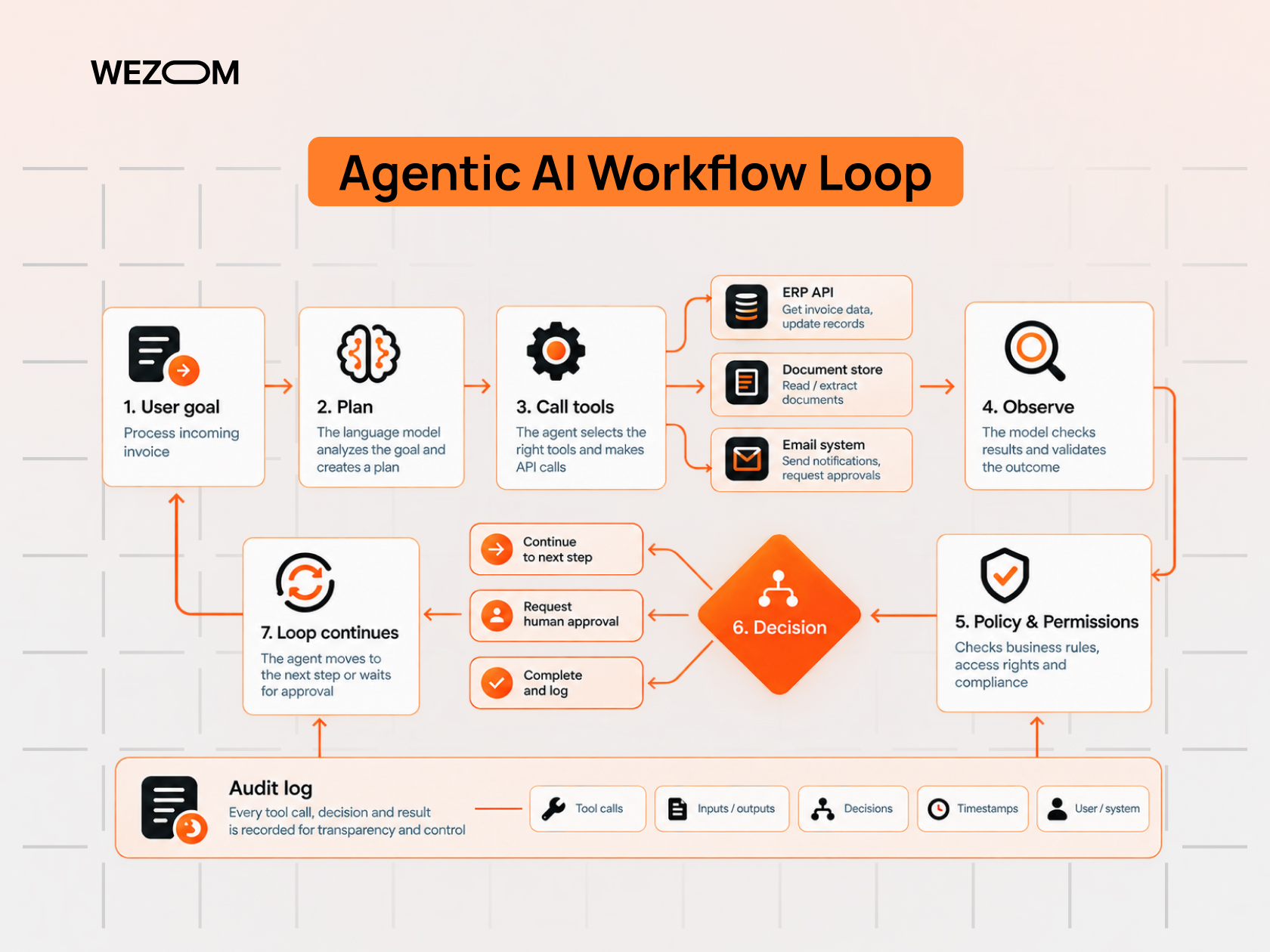
Agentic AI uses a model to break a goal into steps, call tools, inspect results, and continue until the task is complete or escalated. An accounts payable agent might read an invoice, match it to a purchase order in the ERP, check goods receipt, flag price discrepancies, and prepare a payment proposal for approval. Autonomous AI agents take actions in other systems, which makes permissions, audit logs, and approval checkpoints central design concerns. Errors compound across steps, so production agents usually run inside narrow workflows with defined tools.
Multimodal AI: Processing text, images, audio, and video
Multimodal AI relates several data types in one model: a photo of damaged goods with a written complaint, or a scanned form with handwriting and stamps. It removes the need to chain separate OCR, vision, and text models and allows cross-checks, such as whether damage visible in a photo matches the claim description.
Edge AI: Running intelligent systems directly on devices
Edge artificial intelligence runs inference on or near the device: cameras, industrial controllers, vehicles, drones. It is chosen when latency must be low, connectivity is unreliable, or data should not leave the site. Edge models are usually compressed or quantized to fit the device's memory and power budget, so teams decide explicitly which tasks run locally.
Real-World Examples of Artificial Intelligence Types Across Industries
Real-world AI examples rarely rely on one technology. The use cases by industry below show which artificial intelligence types typically combine in production.
AI in retail and ecommerce: Personalization and demand forecasting
Recommendation engines rank products using purchase history, browsing behavior, and learned item embeddings. Demand forecasting combines sales history, promotions, and seasonality to set replenishment per store and SKU. Accuracy depends on clean stock-out data, because a week with zero sales due to empty shelves otherwise reads as zero demand.
AI in healthcare: Medical imaging and clinical decision support
Vision models help read radiology images and pathology slides, often by prioritizing worklists so urgent cases reach a clinician first. Clinical decision support combines rules, such as drug interaction checks, with predictive models for risks like sepsis. These systems act as aids, and many fall under medical device regulation, which adds validation and documentation requirements.
AI in banking and fintech: Fraud detection and risk assessment
Fraud detection scores transactions in milliseconds using supervised models trained on confirmed cases, anomaly detection for new patterns, and rules for known schemes. Credit risk models estimate default probability, and because lenders must explain adverse decisions, interpretable models or explanation tooling are favored.
AI in manufacturing: Quality control and predictive maintenance
Vision inspection detects surface defects and assembly errors at line speed. Predictive maintenance analyzes vibration, temperature, and current draw to schedule service by condition rather than calendar. Because real failures are rare, teams often start with unsupervised anomaly detection and add supervised models as labeled failure history accumulates.
AI in logistics: Route optimization and fleet management
Route optimization pairs operations research solvers with ML predictions of travel and service times. Fleet management uses telematics to predict maintenance and analyze driving behavior. Warehouses apply vision for parcel dimensioning and robotics for transport, while generative and agentic AI increasingly draft carrier claims and delay notifications, writing results back into the TMS or WMS.
AI in customer service: Automated support and intelligent assistants
Assistants resolve routine requests such as order status by calling back-end systems, while agent-assist tools summarize history and draft replies for human agents. Containment rate alone misleads, because a conversation that ends without escalation is not necessarily resolved.
Comparing Different Types of Artificial Intelligence
AI types comparison table: Capabilities, technologies, and business use cases
The table compares the categories business teams most often evaluate by what each produces and depends on.
| Type of AI | Core technologies | Typical output | Data requirement | Example business use |
|---|---|---|---|---|
| Rule-based / expert systems | Decision rules, knowledge graphs | Deterministic decision | Documented domain logic | Eligibility checks, compliance validation |
| Predictive AI | Supervised ML, time-series models | Score, probability, forecast | Labeled historical data | Demand forecasting, fraud scoring |
| Computer vision | Convolutional networks, vision transformers | Detection, classification | Labeled images or video | Defect inspection, document capture |
| Conversational AI | NLP, LLMs, retrieval | Dialogue and API actions | Knowledge base, conversation logs | Customer support, internal help desk |
| Generative AI | LLMs, diffusion models | New text, code, images | Pretrained model plus company content | Drafting, summarization, code generation |
| Agentic AI | LLMs with tool calling | Completed multistep task | Tool access, process definitions | Invoice processing, research workflows |
Rule-based AI vs. machine learning vs. generative AI
Rule-based AI executes logic people write: transparent and stable, but unable to generalize. Machine learning learns decision boundaries from data, handling variation rules cannot express, at the cost of needing representative data and producing probabilistic outputs. Generative AI is flexible across tasks, but its outputs are harder to verify and can contain plausible errors. Reliable designs often layer them, with generative AI extracting and drafting, ML scoring risk, and rules enforcing hard limits such as approval thresholds.
Predictive AI vs. generative AI vs. agentic AI
Predictive AI estimates what is likely to happen, generative AI produces content, and agentic AI decides on steps and executes them. Predictive outputs are easy to evaluate against outcomes, generative outputs need review for accuracy, and agentic systems need the most control because they change records. In procurement, a predictive model flags a likely shortage, generative AI drafts a supplier request, and an agent submits the requisition for approval.
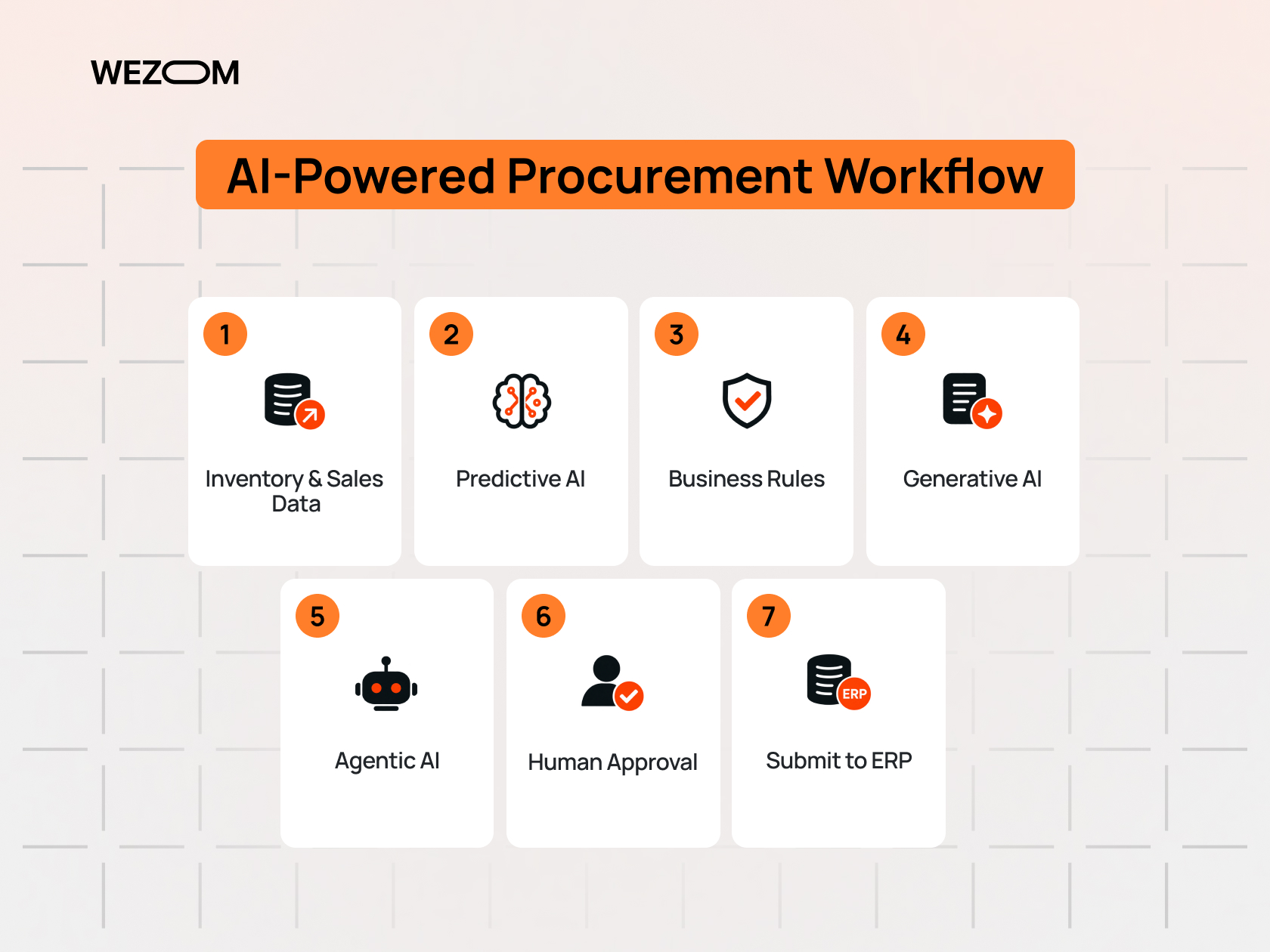
AI automation vs. traditional business process automation
Workflow engines and robotic process automation follow predefined paths and break when inputs deviate from the expected format. Intelligent automation adds AI where inputs vary: reading unstructured emails, classifying documents, extracting fields from differently formatted invoices. The combination works best when deterministic automation runs the stable process and confidence thresholds send uncertain AI results to people.
How to Choose the Right Type of AI for Your Business
Identify business problems that artificial intelligence can solve
An AI implementation strategy starts with a process problem rather than a technology. Good candidates have high volume, measurable outcomes, available data, and tolerance for errors that review can catch: manual document handling, spreadsheet forecasts, fatigue-prone inspection, repetitive support queues. Problems with very low volume or zero error tolerance usually justify rules or process changes first.
Match AI technologies to business goals and available data
Available data often decides the right type of AI more than the goal does. Structured records with known outcomes support predictive ML. Large document collections support generative AI with retrieval. Consistent image archives support computer vision once labeled. Stable policy logic suits rules. When data is sparse, rules plus a data collection plan are often more realistic than training a model immediately.
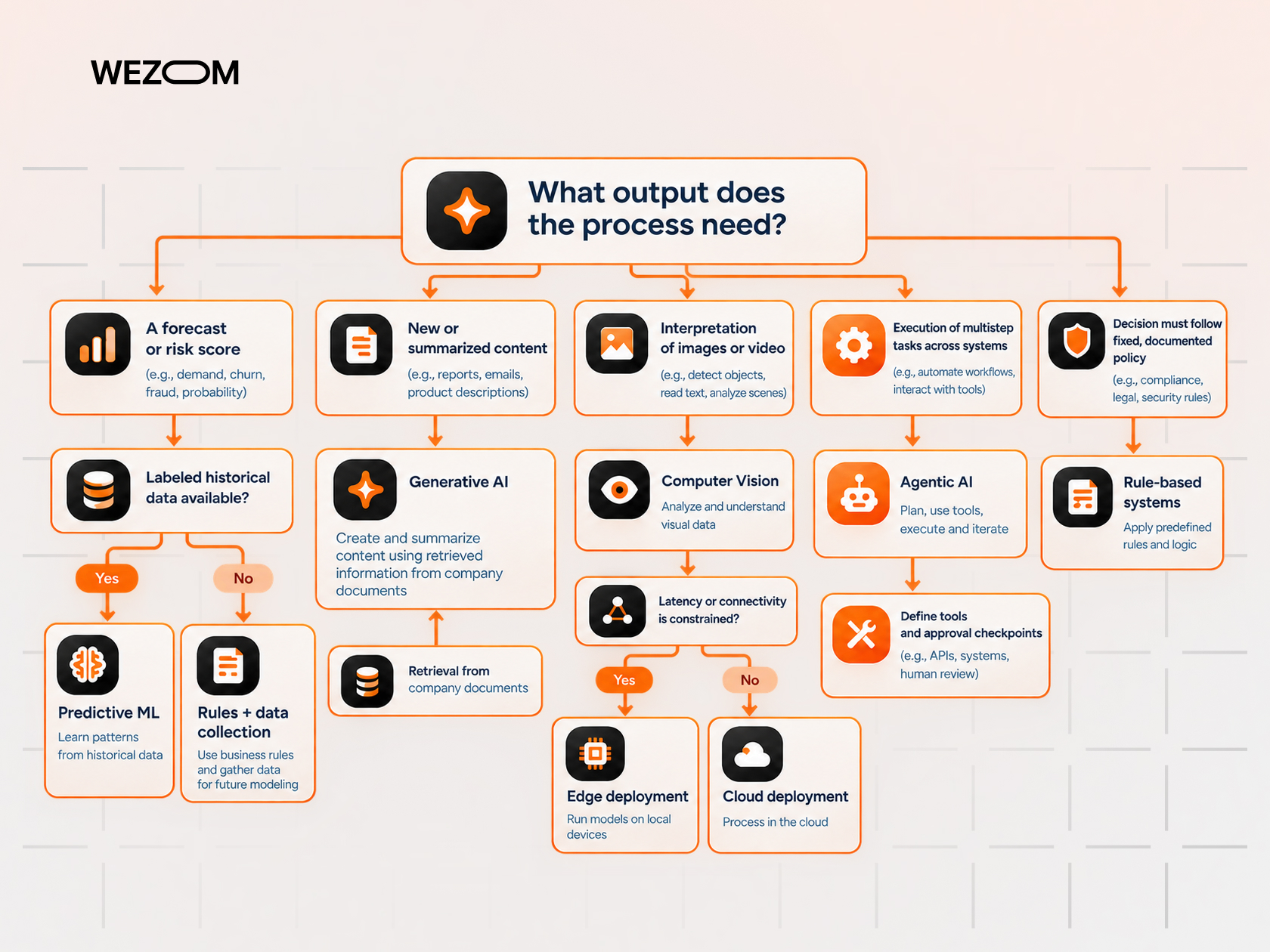
Evaluate implementation complexity, infrastructure, and integration requirements
The model is usually a small part of the work. AI integration needs data pipelines from source systems, APIs that deliver predictions into ERP, CRM, or WMS platforms, access control, logging, and review interfaces. AI model deployment options include managed cloud APIs, self-hosted GPU infrastructure, and edge devices, each with different latency, cost, and data residency implications.
Compare AI development costs and expected ROI
AI development costs span discovery, data preparation and labeling, AI model training or adaptation, integration, testing, and infrastructure, followed by ongoing inference, monitoring, and retraining. Generative and agentic systems add per-call costs that scale with usage, so a cheap prototype can become expensive at production volume. AI return on investment (ROI) should be estimated per process from measurable quantities, such as handling time per document or forecast error, and validated through a pilot against a baseline captured before launch.
Assess data privacy, security, compliance, and model reliability
Data privacy and AI security questions cover where data is processed, whether a vendor trains on customer data, and how prompts and outputs are logged. Generative systems add risks such as prompt injection through documents the model reads. GDPR, sector regulations, and the EU AI Act, whose obligations depend on the risk category of the use case, shape documentation and oversight. AI model accuracy should be measured on data from the real operating environment against thresholds agreed before deployment.
Decide between ready-made AI tools and custom AI development
Ready-made tools suit common tasks such as meeting summaries or standard OCR; they deploy quickly but limit control over data handling and integration depth. Custom AI development is justified when the task depends on proprietary data, deep integration with internal systems, domain-specific accuracy, or a controlled hosting environment. A frequent middle route builds custom retrieval, logic, and integrations around commercial foundation models accessed through APIs.
Common Challenges When Implementing Different AI Technologies
Poor data quality and insufficient training data
Models learn whatever the data contains, including duplicate records, inconsistent product codes, and labels applied differently by different teams. Rare events such as equipment failures create class imbalance that standard training handles poorly. Data profiling during discovery, written labeling guidelines, and in some cases synthetic data or anomaly detection approaches narrow these gaps, but none fully replace representative real data from the operating environment.
AI hallucinations, model bias, and explainability
AI hallucinations occur when generative models produce fluent but false statements, such as invented contract terms. Grounding answers in retrieved documents, requiring citations, and validating extracted values against source systems reduce the risk. Bias appears when training data encodes outdated or unfair patterns, for example in hiring or lending. Explainability, from interpretable models to post-hoc feature attribution, matters wherever decisions affect people or face audit.
Integration with legacy systems and existing workflows
A model that works in a notebook delivers nothing until its output reaches the system where work happens. Legacy ERP and warehouse platforms may need middleware, message queues, or scheduled exchange. A prediction shown in a separate dashboard nobody checks has no effect, while one that sets a priority field in the existing work queue changes behavior.
Model monitoring, maintenance, and operational costs
Models degrade as customer behavior, packaging, fraud patterns, or a vendor's underlying model change. Monitoring tracks input drift, prediction distributions, accuracy against confirmed outcomes, latency, and cost per call. Retraining, version control for models and prompts, and regression testing continue for the life of the system and belong in the original business case.
Human oversight and AI governance requirements
AI governance defines who owns each model, which use cases are approved, what testing precedes release, and how incidents are handled. The NIST AI Risk Management Framework and ISO/IEC 42001 give this work a structure. Responsible AI in operations means confidence thresholds for human review, audit trails of automated decisions, and a channel for users to report wrong outputs into evaluation.
The Future of Artificial Intelligence: Which AI Types Will Matter Most?
The evolution of generative and multimodal AI
Generative and multimodal models increasingly handle text, images, audio, and video together over longer contexts. Businesses will need fewer separate pipelines for documents and inspection reports, and more evaluation methods that check outputs against source data rather than fluency.
The growing role of autonomous AI agents
Agents are moving from demonstrations into bounded workflows such as invoice processing and IT ticket resolution. Adoption grows fastest where tasks are well defined, tools expose clean APIs, and each action can be reviewed or reversed.
Smaller specialized models and on-device intelligence
Smaller domain-tuned models cost less per call, run faster, and can be hosted privately or on devices. Edge deployment in vehicles, cameras, and industrial equipment keeps sensitive data local and removes the network round trip. Many architectures now route routine requests to a small model and escalate only complex ones to a larger model, which keeps inference costs proportional to task difficulty.
Progress toward AGI and the limits of current AI capabilities
Current systems perform well on many benchmarks yet still fail at reliable multistep reasoning and self-verification. Whether scaling will produce AGI remains disputed, so the future of AI technology should be judged by demonstrated capability on specific tasks.
What businesses should prioritize in their AI adoption strategies
A durable AI adoption roadmap invests in assets that stay valuable whichever models win: governed data, documented processes, integration layers that let models be swapped, and evaluation datasets from real operations. Starting with a few measurable high-volume processes keeps AI-powered decision-making tied to outcomes.
FAQ
How many types of artificial intelligence are there?
It depends on the classification: three by capability (narrow, general, superintelligent), four by functionality (reactive, limited memory, theory of mind, self-aware), and commonly five by technology (machine learning, NLP, computer vision, robotics, expert systems). Business categories such as generative, predictive, conversational, and agentic AI form another overlapping set.
What is the most common type of AI used today?
Narrow AI built with machine learning. Predictive models in recommendations, fraud detection, search ranking, and forecasting have run at scale for years. Generative AI has spread rapidly but is still narrow AI by capability.
Is ChatGPT narrow AI or general AI?
ChatGPT is narrow AI. Its breadth across language tasks makes it look general, but it works within patterns learned in training, can produce confident errors, and does not set its own goals or learn continuously. By business category it is generative and conversational AI.
Is generative AI a separate type of artificial intelligence?
It is a category defined by output, creating content rather than classifying or forecasting. It is not a separate capability level, since all current generative systems are narrow AI, and it is built on deep learning rather than a distinct technology family.
Can one AI system combine multiple AI technologies?
Yes, and most production systems do. A claims platform might combine computer vision for photos, NLP for notes, a fraud model, policy rules, and generative summaries. Each component adds its own failure modes and monitoring work.
What is the difference between weak AI and strong AI?
Weak AI performs specific tasks within a defined scope and describes every system in use today. Strong AI refers to general, human-level understanding that transfers across domains, and in some philosophical definitions includes consciousness. It remains theoretical.
Do small businesses need machine learning expertise to adopt AI?
Not for common uses. AI features embedded in accounting, CRM, ecommerce, and support platforms need configuration and process design rather than model training. ML expertise becomes necessary for custom predictions from proprietary data or deep integration, where an external development partner is often more practical than hiring a data science team.
Can AI systems make business decisions without human intervention?
Within limits, yes: fraud systems block transactions and routing engines assign deliveries automatically. Autonomy fits decisions that are high volume, low impact per instance, reversible, and monitored. Decisions with legal, financial, or safety consequences usually keep a human in the loop through confidence thresholds and approval steps, and some regulations require human review of certain automated decisions about individuals.
