
Online shopping is gradually moving beyond traditional search bars, filters, and product pages toward more conversational interactions. Instead of manually navigating a catalog, customers can describe what they need, ask questions, compare alternatives, and receive relevant recommendations through an AI-powered interface.
Voice commerce is part of this shift. It allows customers to use voice interfaces and conversational artificial intelligence to search for products, receive recommendations, manage purchases, reorder frequently bought items, or perform other shopping-related actions. A virtual shopping assistant can interpret natural-language queries and connect them with product catalogs, inventory, customer data, and eCommerce functionality.
This model makes digital shopping closer to a dialogue with a sales assistant. However, conversational retail is not simply about adding a chatbot or voice shop interface to an online store. Its effectiveness depends on accurate product data, reliable integrations, security, and clearly defined business logic. When these components work together, a digital shopping assistant can support customers throughout the purchasing journey while complementing existing eCommerce infrastructure.
How Voice Commerce and AI Shopping Assistants Are Changing eCommerce
Traditional eCommerce relies heavily on customers knowing how to navigate a website and formulate search queries. Conversational retail changes this interaction by focusing on intent. A shopper can describe a need in natural language, while the system interprets the request and connects it with relevant products, attributes, prices, and availability.
For example, instead of manually selecting several filters, a customer might ask for "a lightweight waterproof jacket for commuting under $150." The assistant can identify important requirements, search the catalog, recommend suitable products, and respond to follow-up questions such as "Which one is warmer?" or "Do you have a cheaper option?" The dialogue preserves context and makes product discovery more natural.
Voice shopping extends this experience to spoken interaction. Customers can search for products, compare alternatives, reorder previous purchases, check availability, manage carts, track orders, and potentially complete checkout using voice commands. This can be particularly convenient on mobile devices, smart speakers, connected vehicles, and other situations where conventional browsing is less practical.
An AI shopping assistant can therefore support several parts of the buying journey: natural-language search, conversational product discovery, personalized recommendations, product comparison, selection assistance, repeat purchases, checkout, and post-purchase support.
The main operational challenge is connecting the conversational layer with reliable commerce data. AI should interpret customer intent and manage dialogue, but prices, inventory, product specifications, delivery information, and transaction details should come from authoritative business systems. Integrations with eCommerce platforms, CRM, ERP, inventory, payment, and order management systems are therefore essential for turning conversational interfaces into functional retail tools.
Key Benefits of Conversational Commerce for Retailers
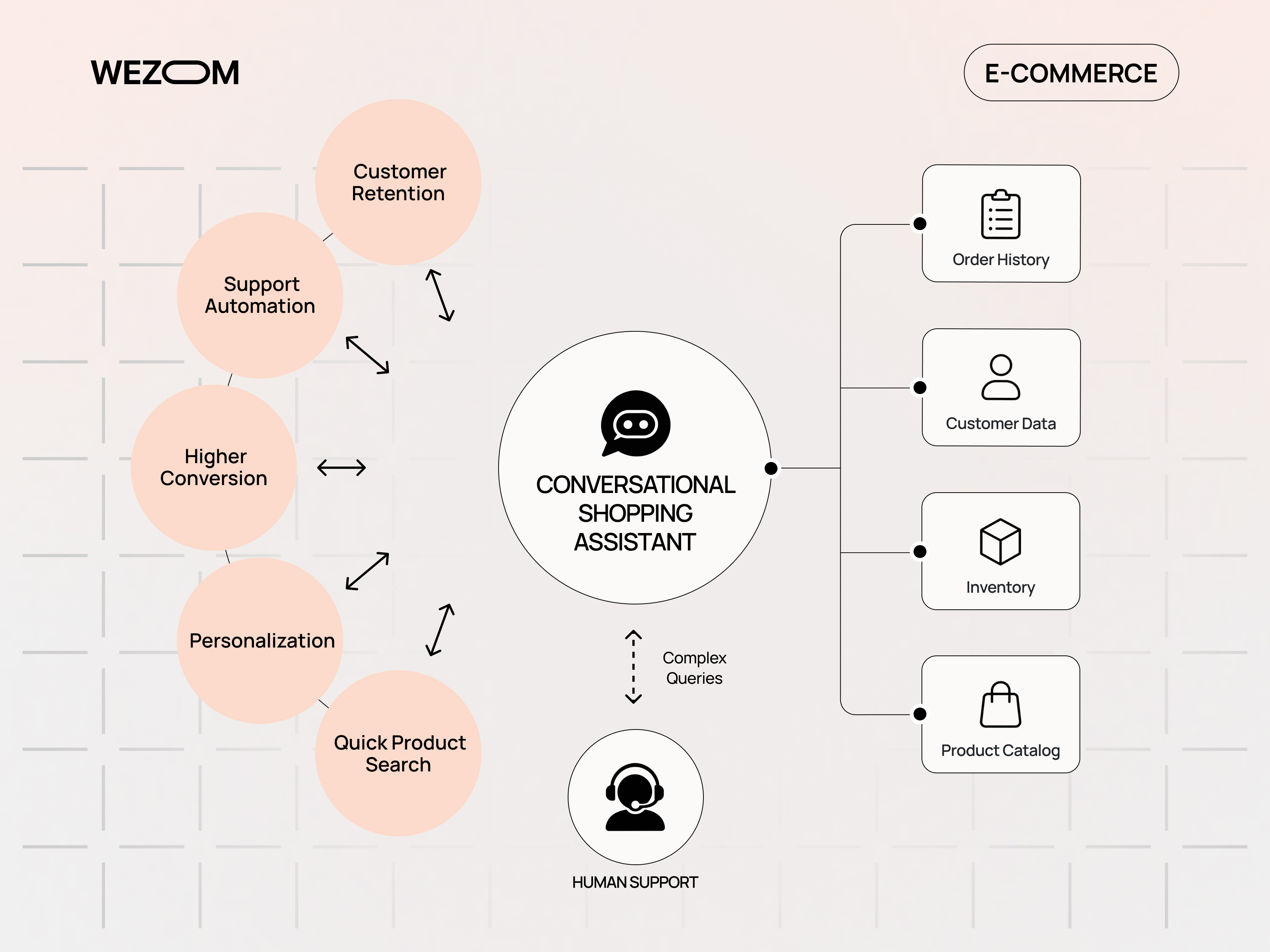
The benefits of conversational commerce go beyond providing another way to interact with an online store. Its business value comes from reducing friction in product discovery, supporting purchase decisions, and automating repetitive interactions throughout the customer journey. The strongest results usually appear when retailers introduce conversational functionality around specific customer problems rather than deploying a generic chatbot across the entire website.
Key benefits include:
- Faster and more convenient product discovery. Customers can describe what they need instead of navigating complex categories and filters. The assistant translates natural-language requests into product attributes and search parameters, which can be particularly valuable for retailers with large or technically complex catalogs.
- Personalized shopping experiences. A virtual shopping assistant can use information provided during the dialogue together with permitted customer data, previous purchases, preferences, and current inventory. Recommendations can therefore reflect the customer's budget, intended use, preferred features, or previous interactions rather than relying only on generic popularity rankings.
- Higher engagement and conversion opportunities. Customers often abandon shopping journeys when they cannot find sufficient information or confidently choose between alternatives. Conversational assistance can answer questions, compare products, explain specifications, and suggest relevant alternatives without forcing shoppers to leave the purchasing flow.
- Automated customer support. A digital shopping assistant can handle repetitive questions about products, availability, compatibility, delivery, order status, or return procedures. Complex disputes, unusual payment problems, and situations requiring judgment should still be transferred to human employees rather than forcing automation to resolve cases beyond its authority.
- Increased customer retention. Conversational interfaces can simplify repeat purchases by helping returning customers reorder products, find compatible accessories, check previous purchases, or manage replenishment. This can make recurring interactions significantly easier, especially when the assistant is connected to customer history and loyalty information.
These advantages depend heavily on data quality and integration. Incomplete catalog attributes can weaken recommendations, outdated inventory can produce frustrating interactions, and excessive personalization can create privacy concerns. Retailers therefore need to treat conversational commerce as part of the broader eCommerce architecture rather than as an isolated AI feature. The assistant should have controlled access to reliable data sources and clearly defined rules for when an interaction can be automated and when human support is required.
Use Cases for Virtual Shopping Assistants
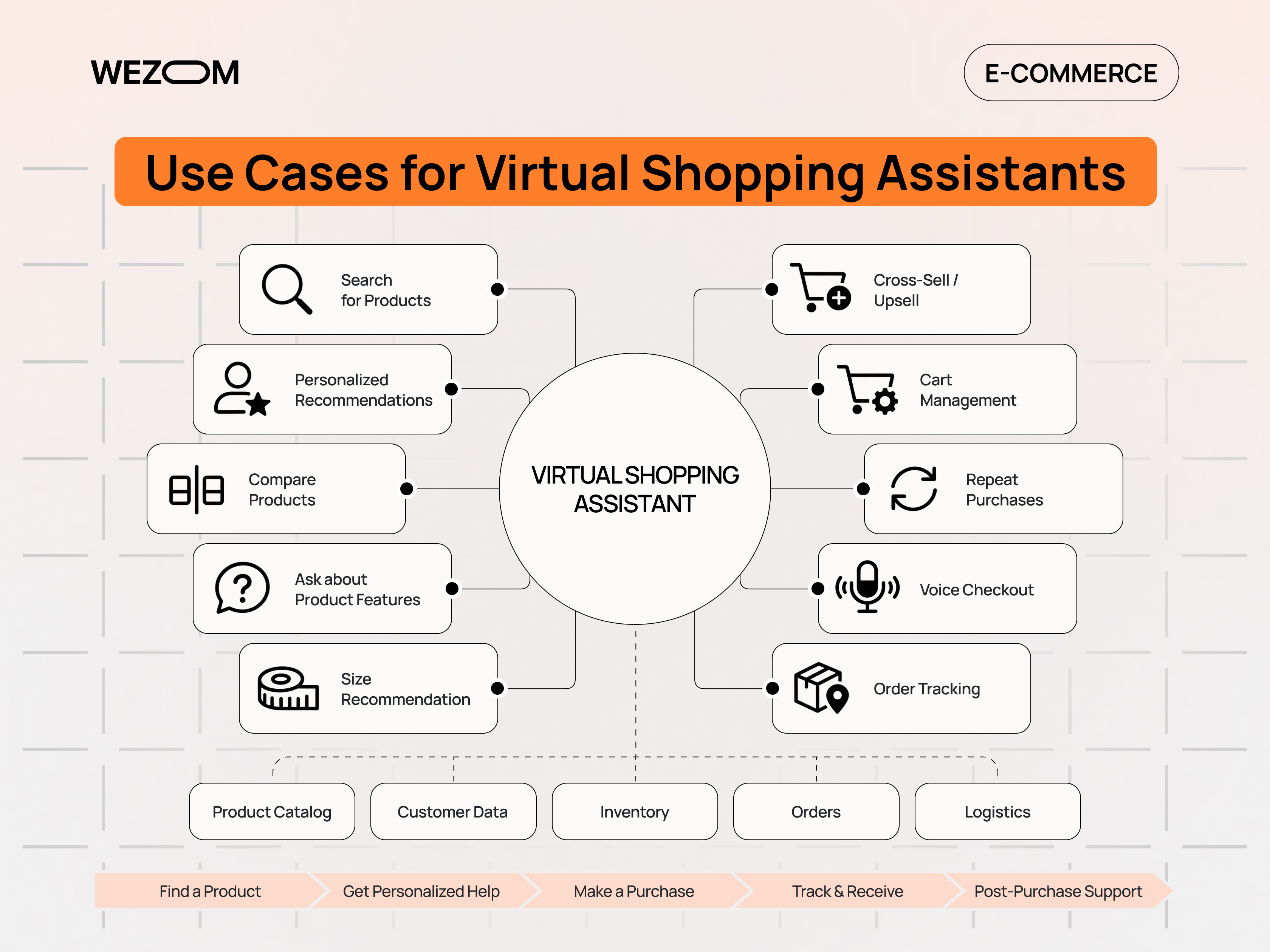
A virtual shopping assistant can support customers across the entire purchasing journey rather than functioning only as an alternative search interface. The most useful applications are typically those where shoppers need help narrowing a large catalog, understanding complex products, or completing repetitive actions. The exact functionality should therefore reflect the retailer's catalog, customer behavior, sales process, and existing digital infrastructure.
Common use cases include:
- Product search and discovery. Customers can describe their requirements conversationally instead of relying on exact product names or keywords. The assistant can interpret intent, identify relevant attributes, and narrow the catalog accordingly.
- Personalized recommendations. Recommendations can consider requirements expressed during the dialogue and, where appropriate, customer preferences, purchase history, and available inventory.
- Product comparison. An assistant can retrieve verified specifications and explain differences between several products in a format that is easier to understand than manually comparing multiple product pages.
- Product questions and specifications. Customers can ask about materials, dimensions, compatibility, functionality, or other catalog information without searching through long descriptions.
- Size and fit assistance. In categories such as apparel, an assistant can guide customers using available sizing information and brand-specific data. Recommendations should still acknowledge uncertainty where fit cannot be reliably predicted.
- Cross-selling and upselling. Relevant accessories, upgrades, or complementary products can be suggested based on the current purchase rather than through generic promotional blocks.
- Cart management. Customers can ask the assistant to add, remove, replace, or change the quantity of products while maintaining the context of the conversation.
- Repeat purchases and replenishment. Returning customers can quickly reorder frequently purchased products or find suitable replacements when an original item is unavailable.
- Voice-enabled checkout. Voice commands can support parts of checkout, although payments, address confirmation, and authentication require stricter security controls than ordinary product discovery.
- Order tracking and post-purchase support. Assistants can retrieve order status, provide delivery information, and answer standard post-purchase questions through integrations with order management and logistics systems.
Not every retailer needs all of these capabilities. For example, a store selling complex equipment may gain more value from product comparison and specification assistance, while a retailer selling frequently replenished goods may prioritize repeat purchases. Starting with a small number of high-value scenarios also makes it easier to measure whether the assistant improves customer behavior before expanding automation.
Voice Commerce vs. Conversational Commerce
Voice commerce and conversational commerce are related but distinct. Voice commerce focuses specifically on shopping through spoken commands, supporting activities such as product search, recommendations, purchases, and order tracking. Conversational commerce is broader and includes interactions through voice, text chat, messaging platforms, and AI assistants.
Voice interfaces work particularly well for simple tasks such as repeat purchases or order status checks. More complex product discovery often benefits from combining voice with visual or text interfaces. Modern shopping assistants increasingly use this hybrid approach, allowing customers to switch between voice, text, and visual interactions while maintaining the context of the shopping journey.
| Aspect | Voice Commerce | Conversational Commerce |
|---|---|---|
| Primary interaction | Spoken commands and queries | Voice, text, messaging, or combined interfaces |
| Typical scenarios | Search, reordering, status checks, simple purchases | Discovery, recommendations, comparison, support, purchasing |
| Interface dependency | Requires speech input | Can operate across multiple digital channels |
| Visual product discovery | Limited without a screen | Can combine dialogue with images and product interfaces |
| Strategic role | A specific commerce channel | A broader customer interaction model |
For retailers, this means a voice shop should rarely be considered in isolation. Voice functionality is generally more useful when it becomes one interaction method within an omnichannel conversational environment. Customers can then move between voice, text, and visual interfaces without restarting their shopping journey.
Technologies Behind AI Shopping Assistants
AI shopping assistants combine several technologies rather than relying on a single AI model. Speech recognition converts voice queries into text, while natural language processing and large language models interpret intent, maintain dialogue context, and generate responses. Text-to-speech enables the assistant to respond through voice when required.
Recommendation engines, product catalogs, and customer data support relevant product discovery and personalization. APIs connect the assistant with eCommerce platforms, inventory systems, CRM, and ERP solutions, allowing it to access current prices, availability, customer history, and order information.
Payment and authentication systems become essential when the assistant performs transactional actions. The AI can interpret requests and manage the conversation, but critical information and operations should remain controlled by authoritative business systems. This architecture reduces the risk of incorrect product information, unavailable items, or unintended purchases while allowing the assistant to operate as part of the existing eCommerce ecosystem.
Challenges of Implementing Voice Commerce
Implementing voice commerce requires more than connecting a language model to an online catalog. Retailers need to account for how customers speak, how accurately the system understands intent, where commerce data comes from, and which actions the assistant is authorized to perform. Errors that are relatively harmless during product discovery become much more serious when they affect pricing, payments, or orders.
Several challenges need to be addressed:
- Speech recognition and language variation. Background noise, accents, pronunciation, multilingual queries, and product names can reduce recognition accuracy. Retailers operating across multiple markets may need language-specific testing rather than assuming one model will perform equally well everywhere.
- Ambiguous requests. Customers often use incomplete phrases such as "order the same one" or "find something better." The assistant must recognize uncertainty and ask clarifying questions instead of making assumptions that could lead to an incorrect purchase.
- Product data quality. Inaccurate descriptions, missing attributes, inconsistent categories, or outdated inventory directly affect search and recommendations. Preparing catalog data is therefore often a significant part of implementation.
- AI hallucinations. A conversational model can generate plausible but incorrect product information. Responses should be grounded in approved data sources, with business rules preventing the model from inventing specifications, prices, discounts, or availability.
- Privacy and security. Personalization may involve customer profiles, purchase histories, addresses, or payment-related information. Access controls, consent management, data minimization, authentication, and secure integration are essential.
- Integration complexity. The assistant may need data from eCommerce, CRM, ERP, inventory, payment, and logistics systems. Legacy platforms and inconsistent APIs can significantly increase development effort.
- Customer trust and human escalation. Customers need predictable behavior, especially when money or personal data is involved. The system should clearly confirm important actions and transfer the interaction to human support when it cannot resolve an issue reliably.
These limitations make controlled implementation important. Retailers can initially restrict automation to low-risk scenarios such as search, recommendations, and order status before introducing transactional functionality. This allows teams to evaluate accuracy, customer behavior, and integration reliability before giving the assistant greater operational authority.
How to Implement an AI Shopping Assistant in eCommerce
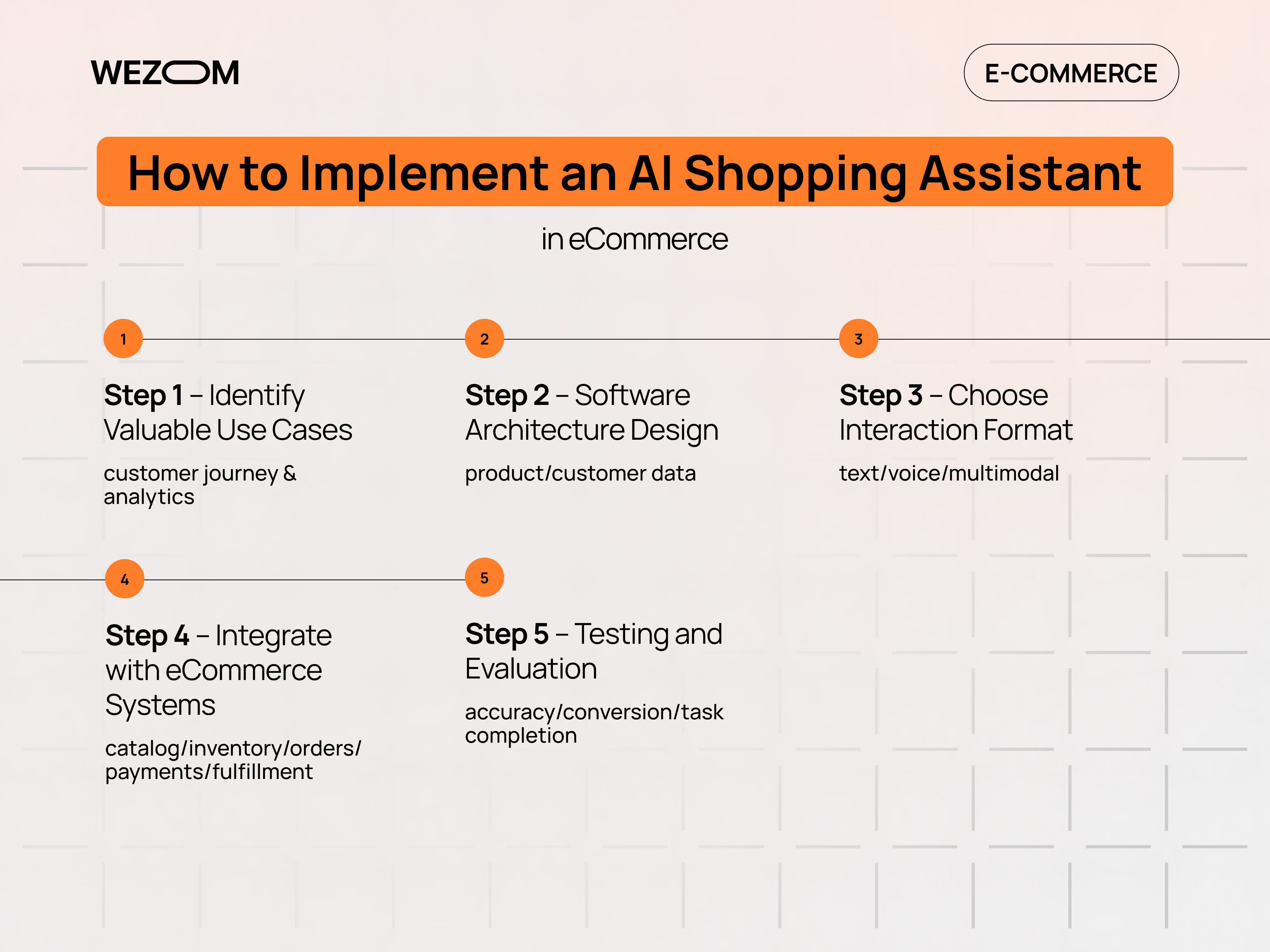
A successful implementation should begin with business processes rather than the choice of an AI model. The objective is to identify where conversational interaction can remove measurable friction and then design the technology, integrations, and controls around those scenarios.
- Identify High-Value Shopping Scenarios
The first step is to analyze the customer journey and determine where users experience difficulty. Search logs, support requests, abandoned journeys, repeat purchase patterns, and common product questions can reveal suitable opportunities.
Retailers should prioritize scenarios that are valuable but sufficiently predictable. Product discovery, comparison, repeat ordering, and order tracking are often easier starting points than allowing an assistant to autonomously manage complex purchases.
- Prepare Product and Customer Data
The assistant needs structured, accurate information to provide useful answers. Product names, categories, specifications, compatibility information, prices, and inventory should be reviewed before implementation.
Customer data requires additional governance. If purchase history or preferences are used for personalization, the retailer needs appropriate permissions, access controls, and rules defining which information the assistant can retrieve.
- Choose the Interaction Format
Not every shopping journey should be voice-first. Retailers should decide whether customers need voice, text, or a multimodal interface combining conversation with product images and conventional controls.
A digital shopping assistant for visually driven categories may work best as a conversational layer inside a website or mobile application. Voice can then complement the visual interface instead of replacing it.
- Integrate With the eCommerce Ecosystem
The assistant should connect with the systems responsible for catalog data, inventory, customer information, orders, payments, and fulfillment. APIs provide the controlled mechanisms through which conversational requests become business actions.
Integration design should also establish clear boundaries. The AI can interpret intent and generate dialogue, while transactional systems validate prices, availability, customer identity, and purchases.
- Test and Measure Performance
Testing should cover more than whether the chatbot produces fluent answers. Teams need to evaluate intent recognition, recommendation relevance, unsuccessful searches, escalation rates, response accuracy, conversion behavior, and task completion.
Testing should also include unusual wording, multilingual queries, incomplete requests, unavailable products, and integration failures. These cases reveal whether the assistant fails safely instead of providing incorrect information or performing unintended actions.
The Future of Conversational Retail
Conversational retail is moving toward multimodal experiences that combine voice, text, visual interfaces, and AI recommendations. Instead of replacing traditional eCommerce, AI shopping assistants will increasingly work across websites, mobile apps, messaging channels, and smart devices while maintaining the context of each customer interaction.
More advanced assistants will also handle multi-step shopping tasks, from understanding requirements and comparing products to creating carts and preparing orders for confirmation. Personalization may become more proactive, using previous purchases and customer preferences to support predictive replenishment and relevant recommendations.
At the same time, greater automation creates additional requirements for security and control. Payments, product substitutions, customer consent, and autonomous purchasing workflows need clear authorization rules. The development of conversational retail will therefore depend not only on more capable artificial intelligence, but also on reliable integrations, accurate data, secure transactions, and carefully defined boundaries for automated actions.

FAQ
What is voice commerce?
Voice commerce is the use of voice interfaces and conversational AI for shopping activities such as product search, recommendations, cart management, repeat purchases, checkout, and order tracking. It connects speech recognition with product catalogs and eCommerce systems, allowing customers to interact with an online store using natural spoken commands instead of traditional navigation.
Is voice commerce secure?
Voice commerce can be secure when supported by authentication, encryption, access controls, and reliable payment infrastructure. Sensitive actions such as purchases, address changes, or access to personal information may require additional verification. Retailers should not treat voice recognition alone as sufficient authentication and should apply the same security standards used across other eCommerce channels.
How can AI shopping assistants improve the customer experience?
AI shopping assistants simplify product discovery by allowing customers to describe their needs in natural language. They can answer product questions, compare alternatives, provide personalized recommendations, and support repeat purchases or order tracking. The experience is particularly useful for large or complex catalogs where traditional search and filters require significant effort from customers.
Can an AI shopping assistant recommend products?
Yes. A virtual shopping assistant can recommend products based on customer requirements, preferences, purchase history, catalog information, and available inventory. Recommendations should rely on verified product data and controlled recommendation logic. If no suitable product is available, the assistant should communicate this clearly rather than generating unsupported specifications, availability, or alternatives.
Can customers make purchases using voice commands?
Yes, provided the voice shopping system is integrated with the retailer's cart, inventory, customer accounts, payments, and order management infrastructure. Customers can potentially select products, specify quantities, and initiate checkout through voice commands. However, payment authorization and final order confirmation should include appropriate authentication to prevent accidental or unauthorized purchases.
How much does it cost to develop an AI shopping assistant?
Development costs depend on functionality, integrations, data quality, channels, and security requirements. A product search assistant is generally less complex than a solution supporting personalization, voice-enabled checkout, payments, and omnichannel interactions. Retailers should typically start with several high-value scenarios, validate their effectiveness, and then expand functionality based on customer adoption and business results.
