
Companies rarely bring in outside ecommerce help while things are going well. They do it when revenue flattens despite higher ad spend, when a platform upgrade stalls in internal debate, or when staff still retype web orders into the ERP. An ecommerce consultant earns their fee only if the engagement targets a specific problem and ends with decisions the business can execute. Below are the signals that justify hiring one, how to scope the work, and which results are realistic.
What Does an Ecommerce Consultant Do?
An ecommerce consultant diagnoses why an online business is underperforming or blocked, then recommends what to change, in what order, and with which tools. The output is decisions, requirements, and plans rather than code or campaigns.
Ecommerce consulting vs ecommerce development
Ecommerce consulting answers what should be built, changed, or abandoned, and why. Development executes that answer. A developer can rebuild a checkout, but a consultant first checks whether checkout is the real bottleneck or whether shipping costs revealed on the final step drive abandonment. Firms offering both services simplify handover but have an incentive to recommend work they will bill for, so separating assessment from build contractually keeps advice independent.
Strategic, technical, and operational roles of an ecommerce consultant
Strategic work covers channel mix, market priorities, and the digital commerce strategy that ties them to revenue targets. Technical work covers the ecommerce technology stack: platform fit, ecommerce architecture, integrations, and technical debt. Operational work examines how orders, inventory, and returns move between people and systems. Few individuals are strong in all three, so larger engagements pair a commerce strategist with a solution architect.
Ecommerce consultancy for B2C, DTC, and B2B businesses
B2C retailers usually focus on acquisition, merchandising, and conversion. DTC ecommerce brands carry heavy paid acquisition costs, so retention and customer lifetime value dominate. B2B ecommerce adds customer-specific price lists, quotes, approval chains, and deep ERP dependencies. An ecommerce consultancy that has only worked on retail storefronts can badly underestimate how much of a B2B project is back-office logic.
7 Signs Your Business Needs Ecommerce Consulting Services
No single sign proves external help is needed. When two or three appear together, the team usually lacks the time, data, or distance to diagnose the problem.
1. Ecommerce growth has stalled
Revenue stays flat while marketing spend rises, or growth comes only from discounting. Saturated channels, rising acquisition costs, assortment gaps, and falling repeat purchases each need a different response, so separating them with data should precede any new ecommerce growth strategy.
2. Traffic is growing but conversion rates remain low
When sessions rise and orders do not, the cause sits between landing page and confirmation: poorly targeted traffic, thin product content, weak site search, slow mobile pages, or surprise costs at checkout. Funnel analysis segmented by device and channel usually narrows it quickly.
3. Your ecommerce platform no longer supports business needs
Symptoms include workarounds for multiple currencies or tiered B2B pricing, conflicting extensions, and upgrades that require rewriting custom code. Choosing between optimization and replatforming is expensive to get wrong, which makes it a common reason to seek outside expertise.
4. Integrations and manual processes are slowing operations
Staff export orders to spreadsheets, re-enter them in the ERP, and adjust stock by hand. Overselling, delayed shipping notifications, and price mismatches follow, and they are often blamed on the team when the root cause is fragile ecommerce integrations. Fixing them is usually as much business process optimization as software work, because the manual steps exist to compensate for unclear data ownership.
5. Development costs and technical debt keep increasing
Each feature takes longer than the last, small changes cause regressions, and only one developer understands certain modules. An independent technology assessment shows which components create the friction and whether refactoring, replacement, or isolation behind an API is cheaper.
6. You are planning ecommerce expansion or entering new markets
New countries bring tax rules, currencies, local payment methods, and fulfillment constraints. New channels such as marketplaces or a B2B portal change catalog, pricing, and order-routing logic. Architecture choices made at this stage are hard to reverse.
7. Your team lacks specialized ecommerce expertise
A capable team may never have run a platform migration or implemented a PIM-driven catalog. Hiring permanent specialists for one decision is slow. An ecommerce business consultant brings that experience for the duration of the decision and transfers knowledge to internal staff.
When You May Not Need an Ecommerce Consultant
Consulting is a diagnostic service. When the diagnosis is already known, or nobody is ready to decide, it adds cost without changing the outcome.
Problems your internal ecommerce team can solve
Known issues with known fixes, such as a broken payment method, a missing analytics event, or slow image delivery, need no external analysis. If the team understands the cause and has capacity, an outside review only delays the fix.
When an agency, developer, or specialist is a better choice
If the problem is defined and the need is execution, hire the executor: a media agency for campaigns, a certified developer for a feature, a UX researcher for usability tests. Consultants add the most value while the question is still open.
Why unclear business goals can make consulting ineffective
Without agreed goals, an engagement drifts into documentation with no decisions attached. If leadership disagrees on whether the priority is margin, growth, or entering B2B, the recommendations will satisfy no one, so that disagreement must be resolved first.
What Ecommerce Consulting Services Can Include
Ecommerce consultant services are modular, and most engagements combine two to four of the following areas.
Ecommerce strategy and digital commerce roadmap
Ecommerce strategy consulting defines where the business sells, to whom, through which channels, and under what operating model. The result links commercial targets to required capabilities and sequences them into an ecommerce roadmap. For companies early in digital transformation, this stage also clarifies which capabilities to build internally and which to buy.
Ecommerce platform selection and technology assessment
Ecommerce platform selection starts from requirements: catalog complexity, B2B functionality, number of storefronts, integration load, and internal development capacity. SaaS, open-source, and composable options are compared on fit, total cost of ownership, upgrade path, and lock-in rather than feature checklists.
Ecommerce audit and performance analysis
An ecommerce audit reviews analytics setup, traffic sources, funnel performance, site speed, SEO health, and catalog data quality. Because ecommerce performance analysis is only as reliable as the tracking behind it, auditors validate revenue tracking before interpreting numbers.
Conversion rate optimization and customer journey analysis
Conversion rate optimization uses funnel data, session recordings, and usability testing to form hypotheses that are validated through controlled experiments. Customer journey optimization extends this to how buyers arrive, what they compare, and why they churn.
UX, navigation, site search, and checkout optimization
Ecommerce UX work targets findability and friction. Filters decide whether shoppers can narrow a large catalog, and site search matters most for buyers who know what they want, a common B2B pattern. Checkout optimization addresses guest checkout, payment options, and delivery cost transparency.
ERP, CRM, PIM, OMS, and third-party integration planning
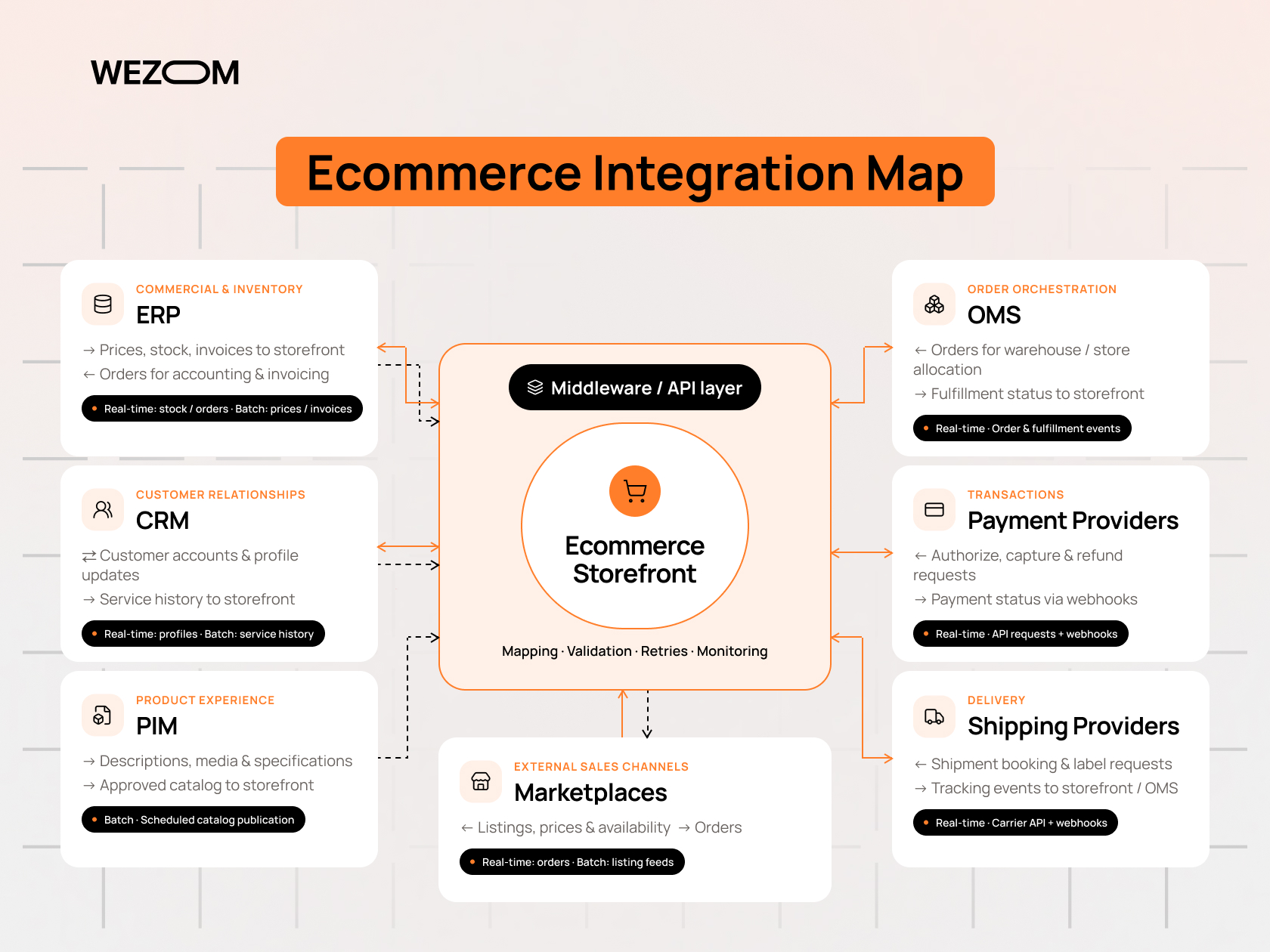
Integration planning defines which system owns each data domain. ERP integration typically covers prices, stock, orders, and invoices; CRM integration covers customer accounts; PIM integration supplies product content; and an order management system routes orders across warehouses and stores. The consultant specifies sync direction, real-time versus batch exchange, and error handling.
Ecommerce migration and replatforming strategy
Ecommerce replatforming risks lost organic traffic from broken URLs, corrupted order history, and disrupted integrations during cutover. A sound ecommerce migration strategy covers data mapping, redirects, phased versus single cutover, and rollback criteria.
Analytics, KPIs, and ecommerce performance measurement
Ecommerce analytics work closes tracking gaps, standardizes metric definitions, and reconciles storefront data with ERP records so revenue reflects returns. Defining ecommerce KPIs here gives every recommendation a measurable target.
Omnichannel and marketplace strategy
Omnichannel commerce raises questions about inventory visibility, click-and-collect, cross-channel returns, and consistent pricing. Marketplace strategy covers channel fit, product feed management, and avoiding undercutting the brand's own store.
Scalability, architecture, and technical modernization
This area tests whether the platform and integrations can absorb peak traffic or more storefronts. Recommendations may include CDN configuration, decoupling integrations through message queues, or retiring custom modules that block upgrades. Together they form an ecommerce technology strategy that sets which components to keep, replace, or phase out over the next few planning cycles.
How to Define the Scope of an Ecommerce Consultancy Project
A good scope fits on one page and states the problem, boundaries, outputs, and success measures.
Start with the business problem rather than a list of features
"Implement a new search engine" is a solution. "B2B buyers cannot find parts by manufacturer number" is a problem. Scoping around the problem lets the consultant test the cause and find cheaper fixes, such as better product attribute data.
Identify ecommerce goals, constraints, and priorities
Each goal needs constraints attached: budget, fixed dates like peak season or a contract renewal, and internal capacity. Priorities decide conflicts, for instance a faster launch versus full feature parity.
Determine which systems and business processes should be audited
List the systems in scope, such as storefront, ERP, PIM, OMS, and WMS, plus the processes crossing them, like order-to-cash and returns. Exclusions should be deliberate, because many problems sit at system boundaries.
Define deliverables and responsibilities
Each deliverable needs a format, an owner, and an acceptance condition. The client commits to system access, interview availability, and a named decision-maker.
Set measurable ecommerce KPIs before the engagement starts
Baselines captured upfront make evaluation possible. A few metrics tied to the problem, such as mobile checkout completion, beat a generic dashboard.
Common Ecommerce Consulting Engagement Models
The model depends on how much uncertainty exists and how much implementation the consultant should oversee.
One-time ecommerce audit
A fixed-scope review produces prioritized findings. It suits businesses wanting a second opinion before a large investment.
Strategy and roadmap engagement
This engagement defines the target state and sequencing over a planning horizon, often before annual budgeting or platform selection.
Project-based e commerce consulting
Project-based e commerce consulting attaches the consultant to one initiative, such as a B2B portal launch or ERP integration redesign, and ends when that phase is complete.
Consultant support during ecommerce implementation
The consultant reviews architecture, checks delivered work against requirements, and resolves scope disputes while an agency or internal team builds, which keeps recommendations from being diluted.
Ongoing ecommerce advisory and optimization
A retainer covers performance reviews, experiment planning, and advice on new initiatives. It suits companies without a senior ecommerce leader, as long as periodic checkpoints confirm that continuous ecommerce optimization still produces measurable gains.
What to Expect From the Ecommerce Consulting Process
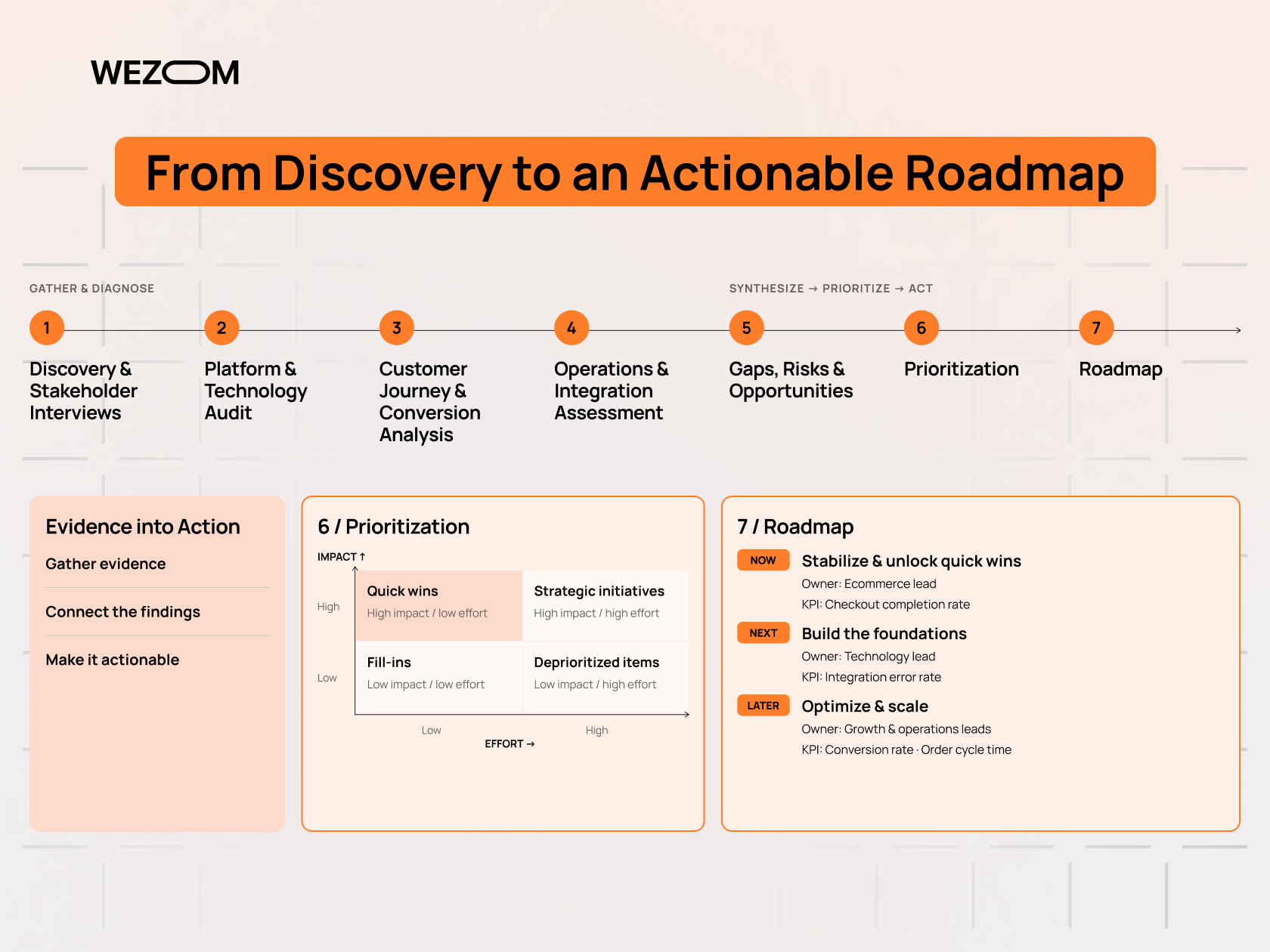
A structured engagement usually moves through these stages, with early findings deciding how deep later stages go.
Discovery and stakeholder interviews
Interviews with leadership, marketing, IT, finance, customer service, and warehouse staff show how each group sees the problem. Conflicting views are findings in themselves.
Ecommerce platform and technology audit
The audit reviews platform version, extensions, custom code, hosting, security, and upgrade path to identify what limits change.
Customer journey and conversion analysis
Funnel data and usability review show where buyers drop out and why, by device, channel, and customer type.
Operations and integration assessment
Tracing real orders through every system shows where data is re-entered, delayed, or lost. Failed sync logs often say more than architecture diagrams.
Identifying gaps, risks, and growth opportunities
Findings are grouped into capability gaps, risks such as single points of failure, and opportunities with estimated impact.
Prioritizing recommendations by impact and effort
Each recommendation is scored for impact, effort, and dependencies. Low-effort, high-impact items become quick wins.
Building an actionable ecommerce roadmap
The roadmap groups work into phases with owners, effort ranges, and target KPIs, detailed enough for a delivery team to estimate.
What Deliverables Should an Ecommerce Consultant Provide?
Deliverables should let someone who missed the meetings act on them.
Current-state ecommerce assessment
It documents systems, data flows, processes, performance baselines, and known issues.
Prioritized list of issues and opportunities
Findings are ranked by evidence, impact, and effort, not listed as generic best practices.
Technology and platform recommendations
Each recommendation states its reasoning and trade-offs, including rejected options and why.
Ecommerce architecture and integration recommendations
Target architecture, system-of-record assignments, and integration patterns are specified in enough detail for developers to estimate.
Implementation roadmap and priorities
A phased implementation roadmap shows dependencies, resourcing assumptions, and which items can run in parallel.
KPI framework for measuring progress
The framework sets metric definitions, baselines, targets, data sources, and owners.
Expected Results From Ecommerce Consulting
Outcomes depend on implementation, but well-scoped engagements typically deliver the following.
Better conversion and customer experience
Removing specific friction, such as late delivery costs or irrelevant search results, lifts conversion in affected segments. Customer experience optimization also cuts support contacts.
More efficient ecommerce operations
Automated order, inventory, and price synchronization removes manual re-entry, so staff handle genuine exceptions instead of correcting data.
Lower technical and operational risk
Unsupported extensions and knowledge held by one developer are addressed before they cause outages.
Clearer technology investment priorities
An agreed roadmap replaces competing departmental requests with a sequence based on impact and dependencies.
Improved scalability for future growth
Architecture work resolves platform scalability limits before peak traffic or new markets expose them.
Better alignment between ecommerce, marketing, IT, and operations
Shared KPIs reduce cases where marketing launches a promotion the ERP cannot price correctly.
How Long Does It Take to See Results From Ecommerce Consulting?
Quick wins vs long-term ecommerce improvements
Fixes to tracking, checkout friction, or failing integrations can show effect within weeks of implementation. Replatforming and new channels show results only after launch and stabilization.
Factors that affect implementation timelines
Development capacity, vendor dependencies, data quality, seasonal code freezes, and approval speed all matter. Data cleansing and integration testing are most often underestimated.
Why recommendations alone do not guarantee business results
A roadmap changes nothing until implemented. Results also depend on execution quality, market conditions, and whether processes change with the software. The consultant is accountable for the analysis, while business outcomes remain a shared responsibility.
How to Measure the ROI of Ecommerce Consulting Services
Ecommerce ROI is measured against the baselines set during scoping, adjusting for seasonality where the data allows.
Conversion rate and revenue metrics
Track conversion by segment and revenue per visitor. Controlled experiments attribute impact more reliably than before-and-after comparisons.
Average order value and customer lifetime value
Bundling changes show in average order value; retention work appears in customer lifetime value over longer windows.
Checkout abandonment and funnel performance
Monitor step-level drop-off, cart abandonment, and payment failures by device and payment method.
Operational efficiency and automation metrics
Measure order processing time, manual handling share, sync errors, and oversell incidents.
Platform performance and technical KPIs
Core Web Vitals, uptime, error rates, and deployment frequency show whether technical work pays off.
Cost savings and reduced development overhead
Compare maintenance hours and license costs before and after. Avoided costs count, such as a replatforming that analysis proved unnecessary.
How to Choose the Right Ecommerce Consultancy
Look for relevant ecommerce and industry experience
B2B distribution, fashion DTC, and multi-brand retail face different problems. Experience with a similar business model matters more than general credentials.
Evaluate technical expertise across your ecommerce stack
Ask who will assess the ERP integration, platform code, and data model. An ecommerce consulting company strong in marketing may lack architecture depth, and vice versa.
Ask for examples of similar business challenges
Request comparable problems, the approach taken, and what changed. Reference calls reveal how advice held up in implementation.
Assess whether recommendations are implementation-ready
Sample deliverables should contain concrete requirements and data mappings. If a developer cannot estimate from them, they are not ready.
Watch for unrealistic promises and generic strategies
Guaranteed uplifts before analysis, one framework for every client, and pushing a platform the firm resells are warning signs.
Questions to ask an ecommerce consultant before hiring
Useful questions test method, independence, and handover:
- Who will do the work, and what experience do they have with our platform?
- How do you validate findings before recommending anything?
- Do you have referral arrangements with platform vendors?
- Can we see an anonymized example of your deliverables?
- How do you hand work over to our developers or agency?
Ecommerce Consultant vs Agency vs In-House Team
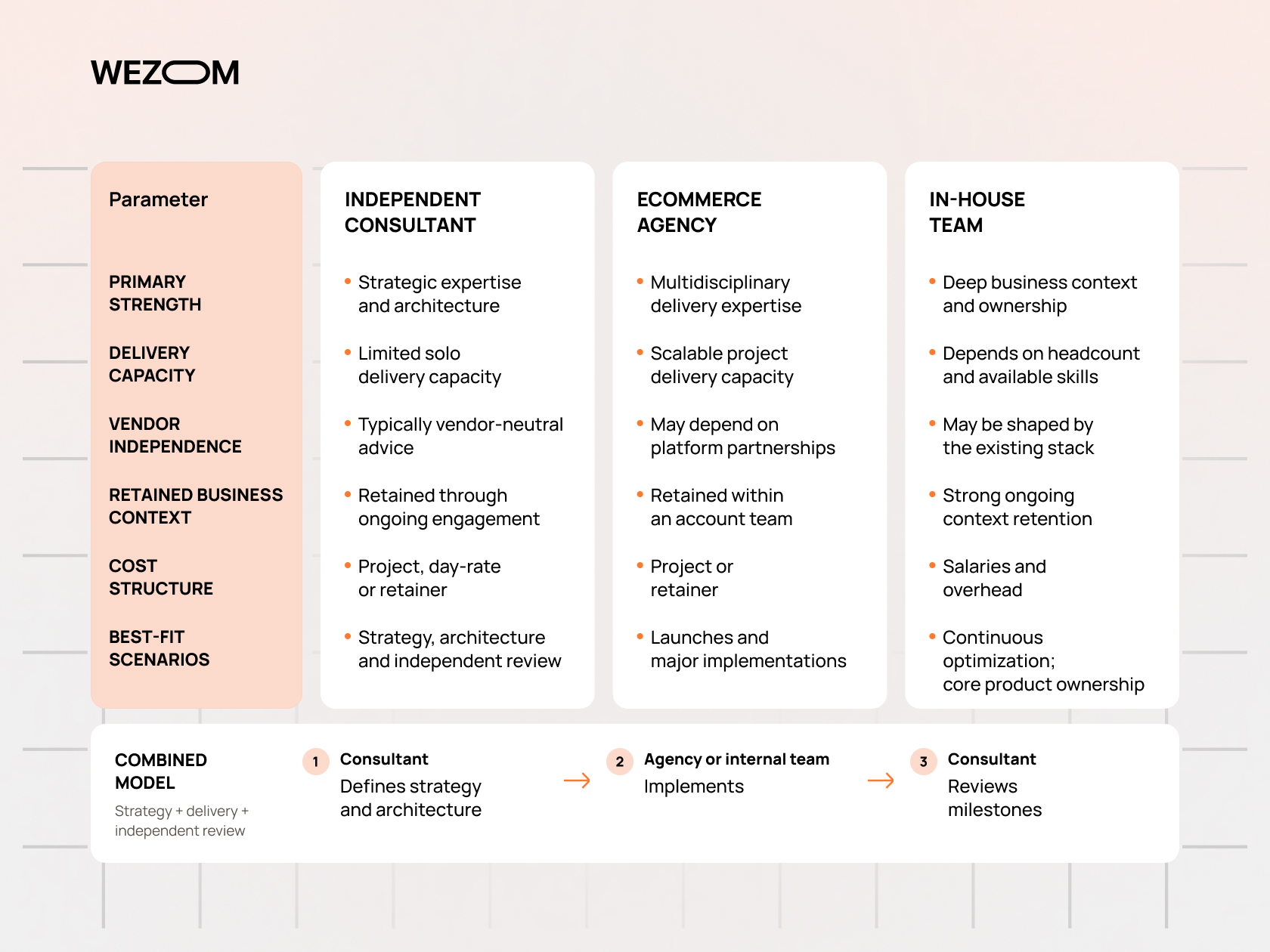
The options solve different problems, and many businesses combine them.
When an independent consultant makes sense
Consultants fit second opinions, platform selection, and decisions requiring vendor neutrality. Capacity is the limit, since one senior person cannot run delivery too.
When an ecommerce agency is the better option
Agencies suit execution-heavy work such as design, development, and campaigns, offering multidisciplinary delivery capacity.
When to build expertise in-house
In-house teams make sense when ecommerce is central to revenue and the work is continuous, as with merchandising and CRO. They retain context advisers must rebuild each time.
Combining consulting with an internal development team or agency
Often an ecommerce strategy consultant defines the roadmap and architecture, an agency or internal team builds, and the consultant reviews milestones under agreed decision rights.
How to Prepare Before Hiring an Ecommerce Consultant
Preparation shortens discovery and keeps paid time focused on analysis.
Gather analytics and ecommerce performance data
Provide analytics access and sales by channel, with a year of history to separate seasonality from trends.
Document your current technology stack
List platform version, extensions, integrations, hosting, and vendor contract renewal dates.
Identify major operational bottlenecks
Note where staff work around systems and which manual tasks take the most time.
Define business objectives and decision-makers
Agree the primary objective and name who approves recommendations.
Prepare a realistic budget and implementation capacity
Budget for implementation, not only consulting. Recommendations nobody can deliver will stall.

FAQ
How much does an ecommerce consultant typically cost?
Cost depends on scope, seniority, location, and engagement model. Advisory work is usually billed hourly or daily, audits as fixed fees, and ongoing support as retainers. The main drivers are the number of systems in scope, the depth of technical analysis, and whether the consultant supervises implementation.
Can ecommerce consulting help an existing store without rebuilding it?
Yes. Many engagements find the platform adequate and the problems in configuration, data quality, integrations, or UX. Online store optimization is often cheaper and less risky than replatforming.
Can a consultant work with our current ecommerce agency or development team?
Yes, this is common. The consultant sets priorities and reviews architecture while the existing team implements, with clear responsibilities to avoid conflicting instructions.
Does ecommerce consultancy include marketing strategy?
It depends on the provider. Some cover acquisition, SEO, and retention; others focus on platform, operations, and conversion. Marketing in scope should connect to site performance and customer data.
Should startups hire an ecommerce consultant?
Rarely for a full engagement. A short consultation can still pay off before hard-to-reverse decisions, such as choosing a platform for a complex catalog.
What information should we provide during the first ecommerce consultation?
Bring goals, key metrics, a description of the technology stack, operational pain points, budget range, deadlines, and decision-makers. Analytics access speeds up the assessment.
How can you tell whether ecommerce consulting recommendations are working?
Compare scoped KPIs against baselines after each change goes live, use controlled experiments where possible, and review progress at agreed intervals. Recommendations that do not move their metrics should be revisited.
