
A trading platform is judged in the fraction of a second between a user pressing "Buy" and seeing a confirmed fill. An investment platform is judged months later, when a client compares a performance report with a custodian statement. Both depend on accurate market data, correct order and position state, regulated money movement, and an audit trail that holds up when a regulator asks for it. Trading platform development therefore covers far more than the app: order routing, broker and exchange connectivity, a reliable ledger, security controls, and compliance processes that work under peak load. Investment platform development adds portfolio accounting, rebalancing, performance measurement, and integration with custodians. This guide covers platform types, features, architecture, the build process, compliance, costs, and partner selection.
What Is a Trading or Investment Platform and How Does It Work?
Trading platforms vs. investment portfolio management software
A trading platform is built around the order. It lets users see prices, submit buy or sell instructions, and follow executions and open positions with intraday or real-time precision. Investment portfolio management software is built around the portfolio: it records holdings across accounts, compares them with a target allocation, calculates performance and risk, and supports rebalancing and client reporting. The data models differ. Trading systems are optimized for event throughput and execution state, while portfolio systems are optimized for accurate positions, tax lots, cash, and historical returns.
How trading platforms process orders, transactions, and market data
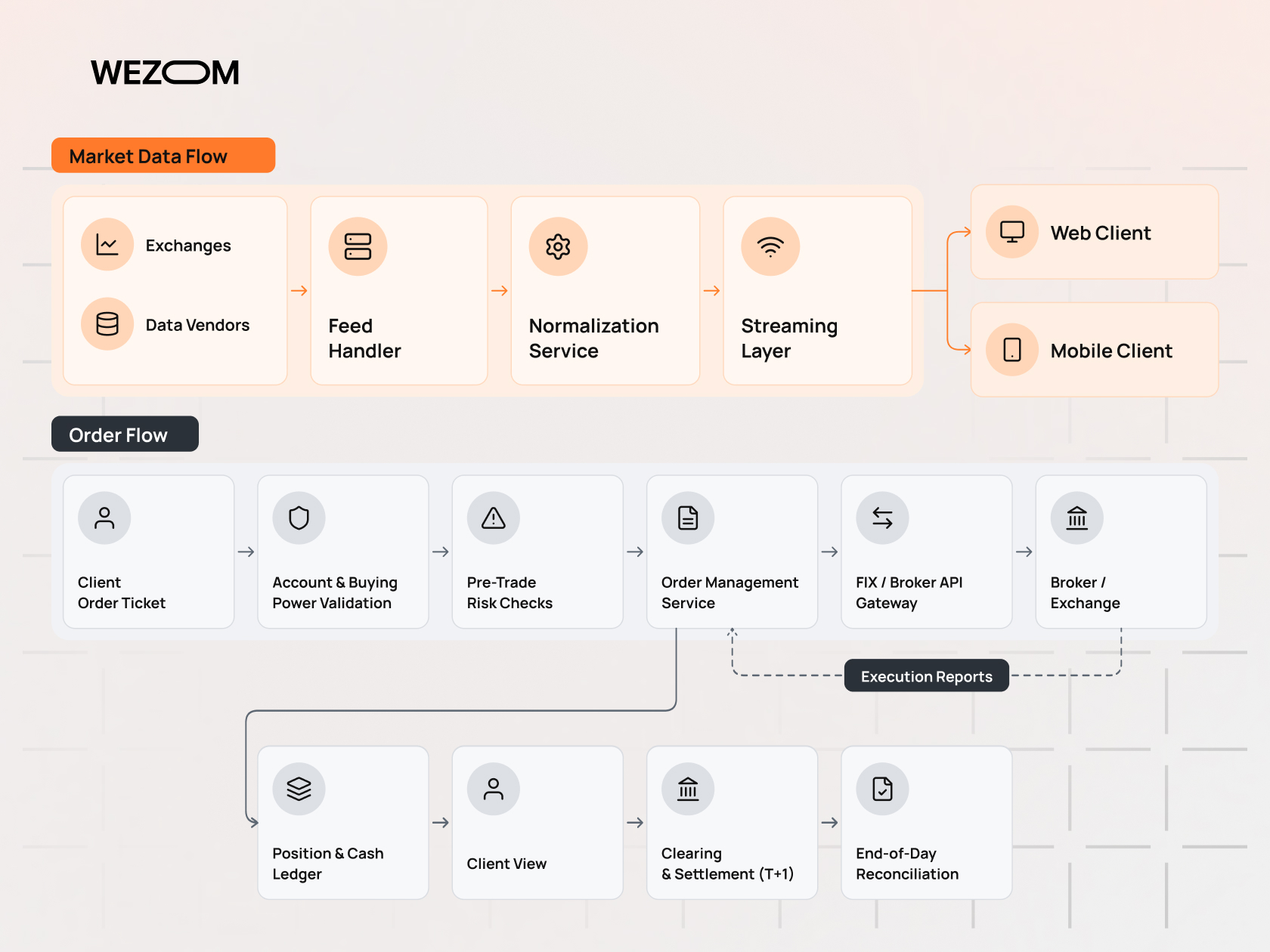
Market data arrives from an exchange, a consolidated feed, or a vendor, is normalized into a common instrument model, and is streamed to client apps and internal services. When a user submits an order, the platform validates the account, buying power, instrument permissions, and pre-trade risk limits, then routes the order to a broker, a venue, or an internal matching engine, usually over FIX or a broker API. Execution reports come back as acknowledgments, partial fills, fills, or rejections, and each one updates positions, cash, and order status. After execution, the trade moves through clearing and settlement. US equities have settled on a T+1 cycle since May 2024, which leaves less time for funding checks and reconciliation.
Who uses trading and investment platforms: retail investors, brokers, and institutions
Retail investors use self-directed apps, mostly on mobile, and expect simple order tickets, fractional shares, transparent fees, and fast funding. Brokers and broker-dealers operate the online brokerage technology behind those apps: account opening, custody, order routing, supervision, and back-office reporting. Institutions such as asset managers, hedge funds, banks, and pension funds need multi-account allocation, pre-trade compliance, algorithmic execution, and connections to custodians and accounting systems. Wealth managers and registered investment advisers rely on rebalancing and proposal tools and send block orders through a custodian.
Trading software development vs. ready-made financial solutions
Ready-made options include white-label brokerage front ends, broker-as-a-service APIs, and licensed OMS or portfolio packages. Trading software development from scratch makes sense when the product's value lies in its own workflow, analytics, or asset coverage, or when the business needs control over data, latency, and the roadmap. Many teams take a middle path: a licensed core, such as a clearing broker's API or an accounting engine, with custom client-facing and analytics layers built around it.
Types of Trading and Investment Platforms
Stock and equity trading software
Equity trading software covers order entry for stocks and ETFs, real-time quotes and Level 2 depth, corporate action processing, and margin where it is offered. Stock trading platform development for US markets has to account for the national best bid and offer, Regulation NMS, FINRA pattern day trader rules, extended-hours sessions, and order-routing disclosures under SEC Rule 606. Options add chains, Greeks, multi-leg orders, and customer approval levels.
Forex and cryptocurrency trading platforms
Forex is traded over the counter against liquidity providers or a dealer, so price aggregation, spread management, leverage limits, and rollover calculations replace exchange routing. Crypto platforms operate around the clock, connect to several exchanges or run their own matching engine, and manage wallets, on-chain deposits, private-key custody, and confirmation times. In the EU, crypto-asset service providers are licensed under MiCA, and national regulators cap leverage on retail forex and CFD products.
Algorithmic and automated trading platforms
Automated trading software development centers on a strategy engine that consumes market data, generates signals, and submits orders without manual input. The supporting algorithmic trading infrastructure includes historical tick data for backtesting, a paper-trading mode, position and loss limits enforced outside the strategy code, and a kill switch. Latency needs vary widely: a rule-based retail bot can tolerate delays of seconds, while market-making and high-frequency strategies depend on co-location and native exchange protocols.
Investment portfolio management systems
These systems serve advisers, wealth managers, and self-directed investors who think in allocations rather than single trades. Typical functions include household and account aggregation, model portfolios, drift monitoring, tax-aware rebalancing, performance calculation, and client reporting.
Institutional portfolio management software
Institutional portfolio management software supports asset managers, pension funds, insurers, and endowments that run large multi-asset mandates. Beyond position keeping, it covers investment guideline compliance, cash forecasting, order generation across hundreds of accounts, performance attribution, and data exchange with custodians, fund administrators, and an investment book of record (IBOR).
Multi-asset trading and investment platforms
Multi-asset platforms bring equities, ETFs, fixed income, options, futures, FX, and sometimes crypto into one account view. The difficulty sits in the data model. Each asset class has its own identifiers, price conventions, settlement cycles, margin rules, and corporate events, so a unified instrument master and a position engine that understands these differences become the platform's core components.
Essential Features of Trading and Investment Platform Software
Investment platform software is defined less by its feature list than by how consistently features share account, position, and market data state.
User registration, identity verification, and account management
Onboarding collects personal and tax details, verifies identity with document and biometric checks, screens applicants against sanctions and politically exposed person lists, and records suitability data such as investment experience and risk tolerance. Account management then handles account types, beneficiaries, trading permissions for options or margin, and delivery of statements and tax documents.
Real-time market data, price charts, and financial analytics
Real-time market data integration supplies quotes, trades, order book depth, and reference data, which the platform turns into quote panels, interactive charts, and technical indicators. Exchanges distinguish real-time from delayed data and professional from non-professional subscribers, so entitlements must be enforced per user. Fundamentals, screeners, and news come from financial market data providers.
Order placement, execution, and trade management
The order ticket supports market, limit, stop, stop-limit, and trailing stop orders, time-in-force settings such as day and good-till-cancelled, and bracket or one-cancels-other logic for active traders. Behind the ticket, a trade execution engine or broker connection manages the order state machine: pending, acknowledged, partially filled, filled, cancelled, or rejected.
Portfolio tracking, performance analytics, and reporting
Portfolio tracking and analytics show holdings, market value, realized and unrealized gains, cost basis by tax lot, dividend and interest income, and allocation by asset class or sector. Performance should rely on recognized methods: time-weighted returns for evaluating a strategy and money-weighted returns for the investor's own experience. Reported figures must reconcile with broker or custodian statements.
Risk management tools, alerts, and exposure monitoring
Pre-trade controls check buying power, maximum order size, price collars, and restricted instruments before an order leaves the platform, which blocks fat-finger errors. Post-trade investment risk management covers margin calls, concentration, sector and currency exposure, plus value at risk and stress scenarios for institutions. Price, news, and margin alerts reach users through push notifications, email, or in-app messages.
Watchlists, investment research, and personalized dashboards
Watchlists, screeners, research notes, and earnings calendars help users find and follow instruments. An investment analytics dashboard lets them arrange widgets for positions, charts, and alerts. Personalization has a regulatory boundary: content that recommends specific securities to a specific customer can be treated as investment advice and trigger suitability or best-interest obligations.
Payment processing, deposits, withdrawals, and transaction history
Funding runs through ACH, wire, SEPA, cards where permitted, or on-chain transfers. Deposits carry return risk, since an ACH transfer can be reversed after the user has already traded, so many brokers grant provisional buying power with limits. Withdrawals pass through AML checks and bank account ownership verification, and the transaction history must tie every cash movement to a ledger entry.
Advanced features for institutional investors and portfolio managers
Institutional users expect block orders allocated across many accounts, execution algorithms such as VWAP, TWAP, and implementation shortfall, transaction cost analysis, pre-trade compliance against mandate rules, FIX connectivity to multiple brokers, and approval workflows by role. They also require APIs and data exports so the platform fits existing institutional investment workflows.
How to Build a Trading or Investment Platform Step by Step
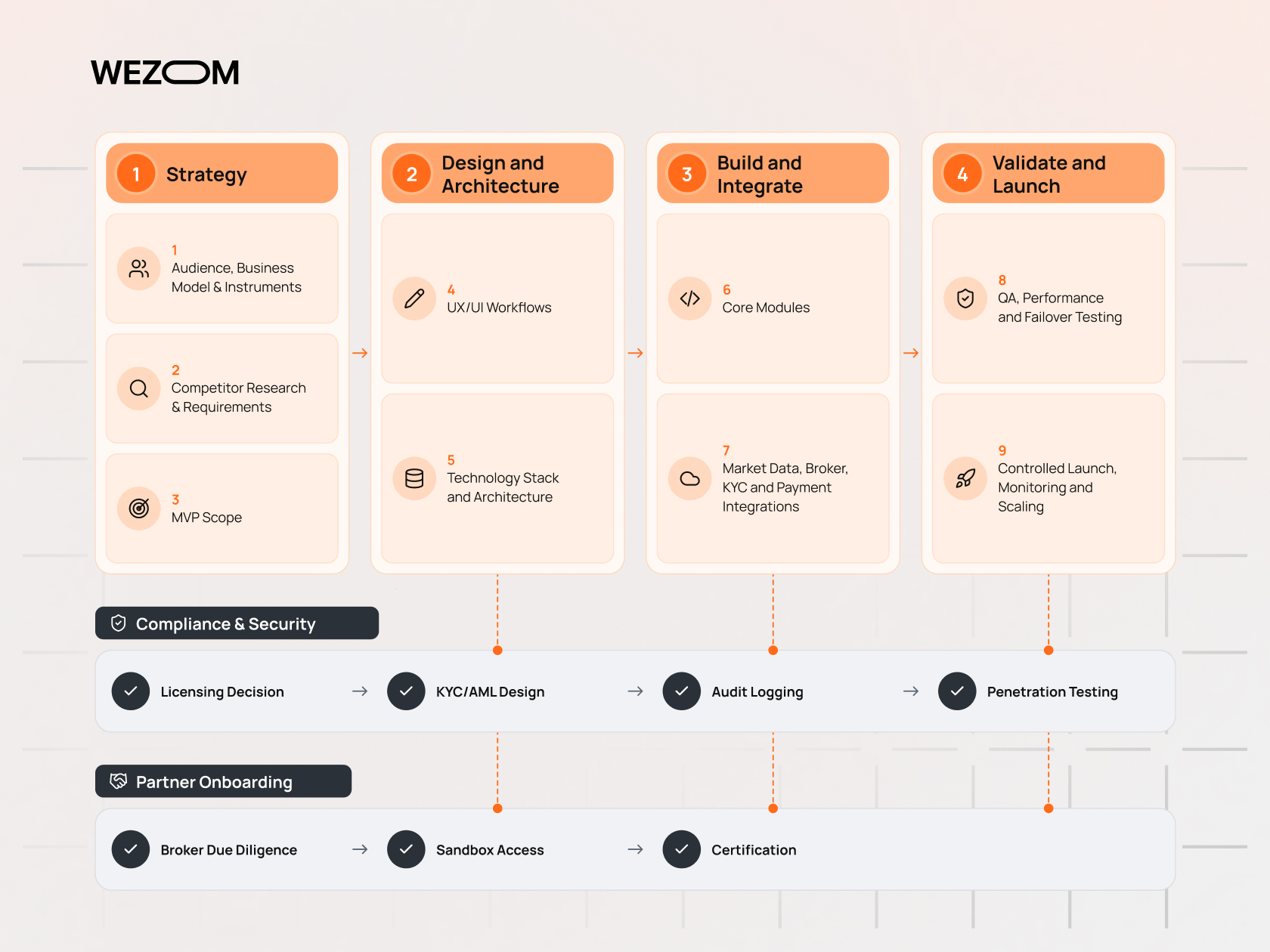
The sequence below describes how to build a trading platform or an investment product so that regulatory, integration, and architecture decisions are made before the code that depends on them.
Step 1. Define your target audience, business model, and trading instruments
Start with who will invest, which instruments they will trade, in which jurisdictions, and how the platform earns revenue. A US equities app and an EU crypto venue need different licenses, partners, and data budgets. Decide early whether the company will hold its own license or operate on a partner's license, because that choice determines account ownership, onboarding flows, and custody.
Step 2. Research competitors and establish platform requirements
Competitor research shows the baseline users already expect and the gaps a new product can fill, such as asset coverage, pricing, analytics, or usability. Requirements should then be split into functional ones (order types, account types, reports) and non-functional ones (latency targets, availability, data retention, peak concurrency, regulatory controls).
Step 3. Select the platform type and prioritize MVP features
An MVP should complete one workflow end to end: onboarding, funding, trading or portfolio construction, and statements for a limited instrument set. Features that look small, such as options, margin, or multiple currencies, often bring new compliance obligations and testing scope, so they belong in later releases unless the business model depends on them.
Step 4. Design the trading platform UX/UI and user workflows
Trading application UX/UI must make state and risk visible: order status, available buying power, estimated costs, and confirmation steps before irreversible actions. Order entry, funding, and error recovery flows should be prototyped and tested with target users before development begins.
Step 5. Choose the technology stack and system architecture
Architecture choices in trading platform software development follow from the non-functional requirements: an event-driven core for orders and market data, a durable ledger for positions and cash, separate services for onboarding and reporting, and clear boundaries between latency-sensitive and batch workloads.
Step 6. Develop trading, portfolio management, and account management modules
Development usually starts with the domain core: instrument master, accounts, ledger, order management, and position keeping. A double-entry ledger with immutable events, introduced from the first release, prevents reconciliation problems that become very hard to correct once real money has moved.
Step 7. Integrate market data providers, brokers, and third-party APIs
Typical integrations include a market data feed, brokerage account integration with a clearing broker or broker-as-a-service provider, KYC screening, payment rails, and tax reporting. Broker API integration has to handle rate limits, session recovery, idempotent order submission, and differences between a vendor's sandbox and its production behavior.
Step 8. Implement security controls and regulatory compliance
Security and compliance work runs through the whole project, but before launch the platform needs verified access controls, encryption, audit logging, KYC and AML workflows, record retention, and documented supervisory procedures.
Step 9. Test trading workflows, performance, and system reliability
Trading software quality assurance covers order state transitions, partial fills, cancel requests that race with executions, corporate actions, and end-of-day reconciliation, along with load tests that replay peak market volumes. Certification with brokers or venues is often a formal step, and failover tests must prove that the platform recovers without losing or duplicating orders.
Step 10. Launch, monitor, and scale the investment platform
A controlled launch with limited users, instruments, and funding amounts exposes operational issues before volume grows. Monitoring should track business signals, such as order rejection rates and reconciliation breaks, next to technical metrics.
Technology Stack and Architecture for Trading Platform Development
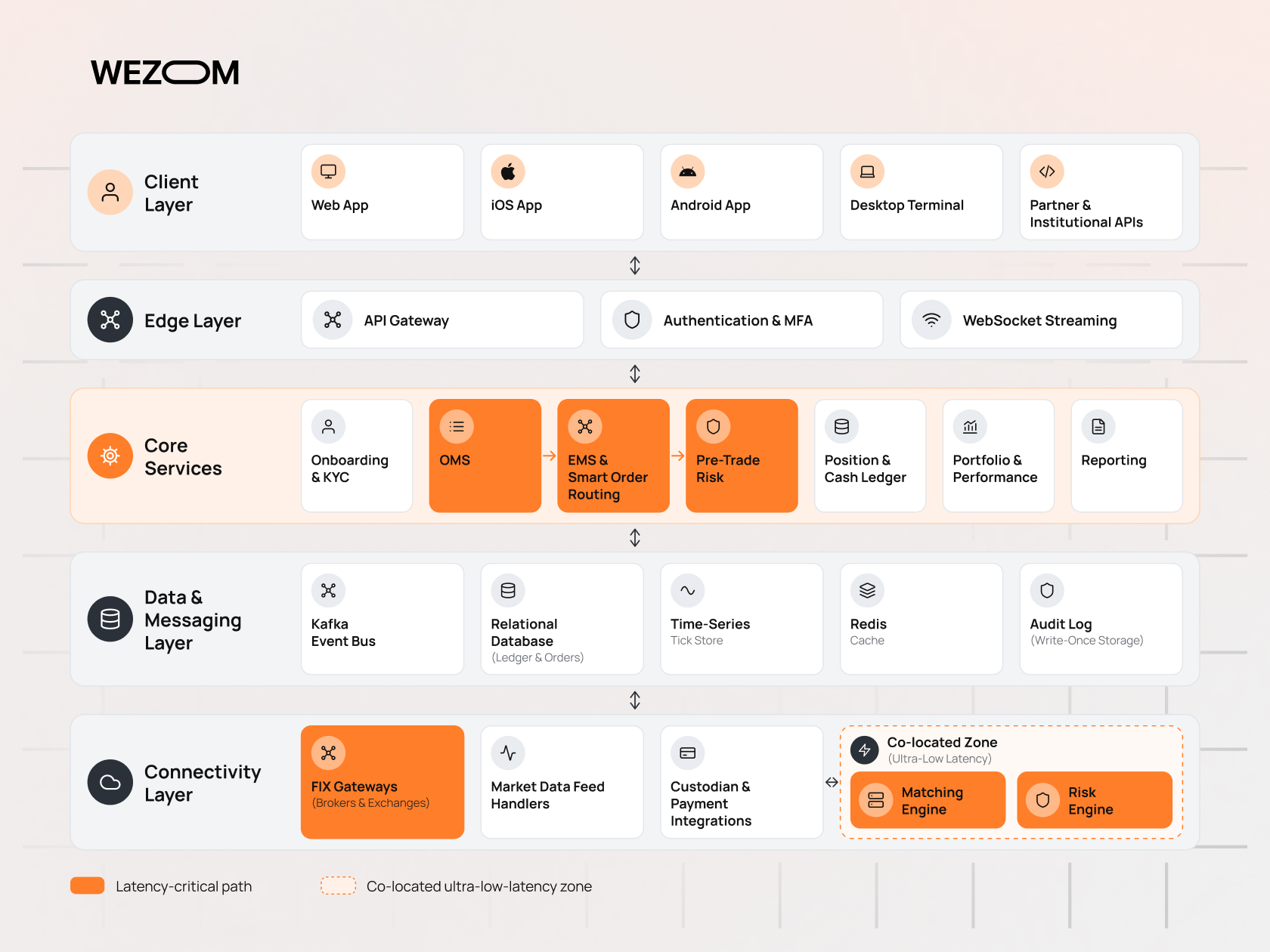
The financial technology stack behind a trading product is usually polyglot. Teams choose tools per layer rather than standardizing on one language.
Frontend technologies for web and mobile trading applications
Trading application development for the web commonly uses React, Angular, or Vue with TypeScript, WebSocket connections for streaming quotes, and specialized financial charting libraries. Mobile apps are built natively in Swift and Kotlin or cross-platform with React Native or Flutter.
Backend frameworks and programming languages for trading software
Java and C# dominate order management and ledger services because of mature ecosystems, strong typing, and predictable performance once garbage collection is tuned. C++ and, increasingly, Rust appear where microseconds matter, such as matching engines and feed handlers. Go and Node.js suit API gateways and integration services, while Python remains the standard for quantitative research, backtesting, and analytics.
Databases, caching, and real-time data streaming technologies
Accounts, orders, and the ledger usually live in a relational database such as PostgreSQL or Oracle with strict transactional consistency. Time-series stores like kdb+, TimescaleDB, or ClickHouse hold tick data and analytics. Redis caches quotes and sessions, and market data streaming between services runs over Kafka, or over specialized low-latency messaging such as Aeron where every microsecond counts.
Cloud infrastructure, microservices, and scalable architecture
Cloud-native financial applications run on AWS, Azure, or Google Cloud with containers, Kubernetes, managed databases, and infrastructure as code. Microservices separate onboarding, orders, market data, portfolio, and reporting so each can scale and deploy independently. Trading platform scalability depends less on the number of services than on clear ownership of state: one service owns orders, one owns the ledger, and the rest consume their events.
APIs and FIX protocol for market data and order execution
FIX protocol integration is the standard for order flow between asset managers, brokers, and venues. Engines such as QuickFIX manage sessions, sequence numbers, and recovery. Exchanges also offer native binary protocols, such as Nasdaq ITCH and OUCH, for lower latency. Retail platforms more often consume REST and WebSocket APIs from brokers and data vendors, while financial API development on the platform side exposes its own functions to mobile apps, partners, and institutional clients.
Order management systems (OMS) and execution management systems (EMS)
An order management system (OMS) is the order book of record: it validates orders, applies compliance and risk checks, allocates fills across accounts, and handles trade lifecycle management through settlement. An execution management system (EMS) focuses on how orders reach the market, with smart order routing, execution algorithms, real-time market views, and transaction cost analysis. Institutions often run both, linked over FIX, whereas retail platforms embed simplified versions of each in their backend.
Building low-latency, high-availability trading infrastructure
Low-latency order processing depends on fewer network hops, no blocking calls on the order path, in-memory hot data, and latency measurement at each stage with synchronized clocks. High availability requires deployment across availability zones, replicated order and ledger state, and deterministic recovery from event journals. High-frequency trading infrastructure goes further with co-location, kernel-bypass networking, and FPGA-based processing, which most retail and wealth platforms do not need.
Developing Investment Portfolio Management Software
Portfolio management software development shifts the emphasis from execution speed to correct holdings, valuations, and reporting. The software automates the cycle of setting objectives, choosing an allocation, monitoring, and rebalancing across thousands of accounts.
Core components of modern portfolio management systems
Modern portfolio management systems are built around an investment book of record that stores positions, transactions, tax lots, and cash for every account. Around it sit a security master, a pricing and valuation service, model and strategy management, an order generation module, a performance engine, and a reporting layer.
Portfolio allocation, diversification, and rebalancing tools
Portfolio allocation and rebalancing tools compare each account with its target model and generate trades when drift exceeds a threshold or on a schedule. Real-world constraints complicate the math: minimum trade sizes, cash reserves, restricted securities, wash-sale rules, and tax-lot selection. Portfolio optimization algorithms, from mean-variance optimization to risk parity, can propose allocations.
Performance measurement, benchmark tracking, and investment reporting
Investment performance reporting calculates time-weighted and money-weighted returns, compares results with benchmarks, and attributes outperformance to allocation or security selection. Asset managers presenting composite performance often follow the GIPS standards. Reports must account for fees, external cash flows, and corrections to historical data.
Institutional portfolio management software requirements
Institutional mandates bring requirements beyond retail and wealth tools: multi-currency accounting, derivatives and overlay strategies, look-through exposure for fund holdings, pre- and post-trade guideline compliance, shadow accounting against the fund administrator, and fine-grained entitlements for portfolio managers, traders, and compliance officers. Multi-asset investment management also needs consistent valuation of illiquid and private-market assets, which often rely on manual or third-party marks.
Integration with custodians, accounting systems, and financial data providers
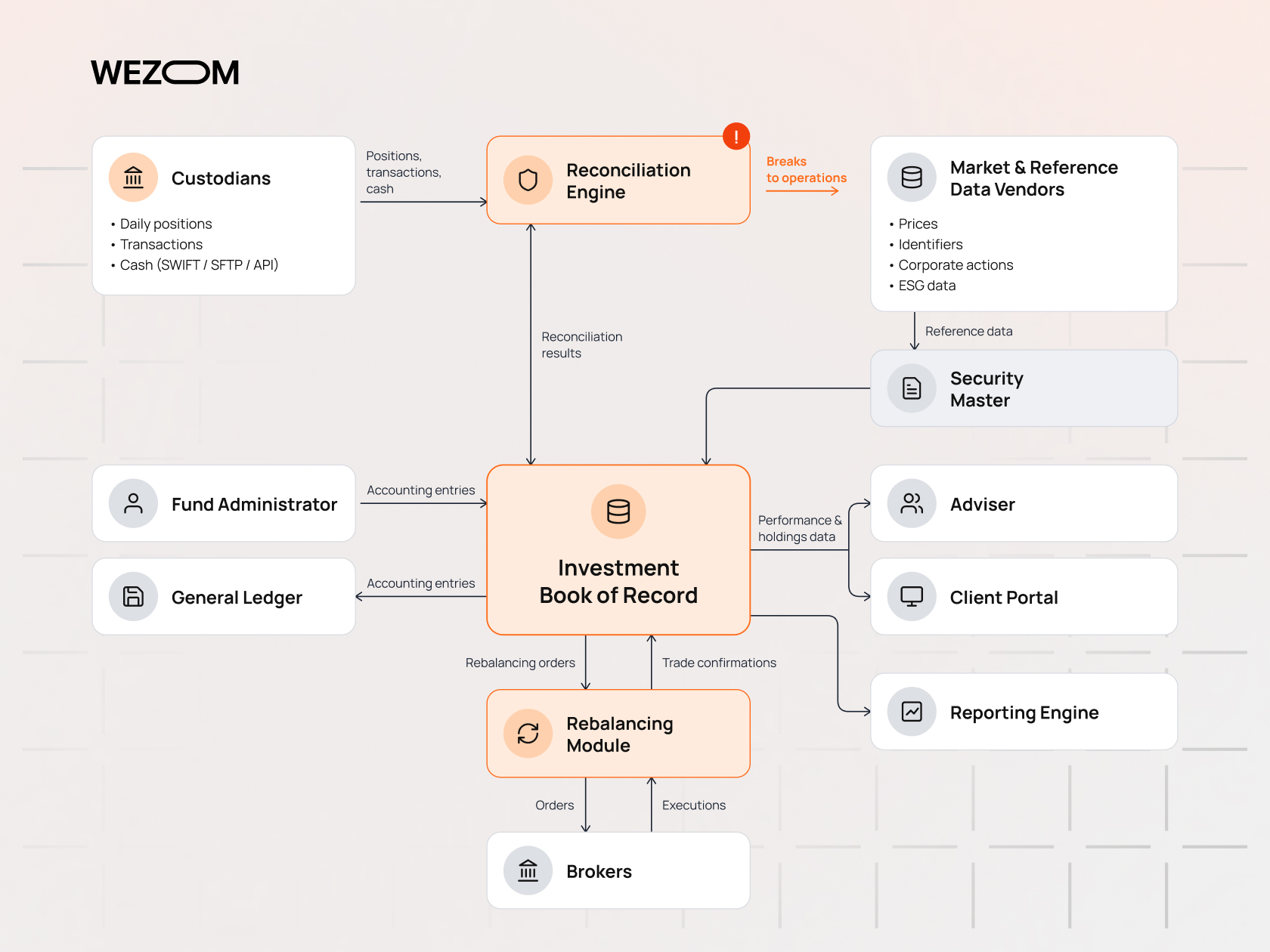
Custodial services integration imports daily positions, transactions, and cash balances through SWIFT messages, SFTP files, or APIs, followed by automated reconciliation that flags breaks for operations staff. Investment accounting integration feeds the general ledger and fund accounting systems. Prices, reference data, and ESG data come from vendors such as Bloomberg, LSEG, or ICE.
AI-powered portfolio analytics and investment decision support
Machine learning helps classify transactions, detect anomalies in custodian data, forecast cash flows, and identify clients whose portfolios have drifted away from their stated risk profile. These tools support decisions rather than make them: recommendations must remain explainable, and suitability obligations still rest with the firm and its advisers.
Security and Regulatory Compliance in Trading Software Development
Data encryption, multi-factor authentication, and access controls
Financial data security starts with TLS for data in transit, encryption at rest with keys held in an HSM or cloud key management service, and secrets kept out of source code. Multi-factor authentication protects logins and sensitive actions such as withdrawals or changes to linked bank accounts. Role-based and attribute-based access control, combined with least-privilege service accounts, limits what internal staff and services can reach.
KYC, AML, and investor identity verification
KYC and AML compliance requires identity verification at onboarding, sanctions and PEP screening, customer risk scoring, enhanced due diligence for higher-risk customers, and ongoing monitoring. US broker-dealers must operate a Customer Identification Program and file suspicious activity reports, while EU firms follow the AML directives and the incoming EU AML regulation. The platform must store evidence of every check.
SEC, FINRA, MiFID II, and GDPR requirements by market and business model
Financial regulatory requirements depend on what the business actually does. In the US, a firm that holds customer accounts or executes trades generally registers with the SEC as a broker-dealer and becomes a FINRA member, whereas a firm giving personalized investment advice registers as an investment adviser. In the EU, MiFID II and MiFIR govern investment firms, covering best execution, product governance, transaction reporting, and record keeping. GDPR applies to personal data of people in the EU regardless of where the platform is hosted, and DORA adds ICT risk management and incident reporting obligations for EU financial entities.
Investor protection, asset custody, and transaction monitoring
US brokers holding customer assets must comply with the SEC Customer Protection Rule (Rule 15c3-3), which requires segregation of customer securities and cash, and member firms carry SIPC coverage. The platform reflects this through omnibus or segregated account structures and daily reconciliation. Transaction and trade surveillance watches for money laundering patterns and market abuse such as spoofing, layering, and wash trading.
Audit trails, recordkeeping, and regulatory reporting
Every order, modification, execution, and relevant communication must be recorded with accurate timestamps and kept for prescribed periods, for example under SEC Rule 17a-4 or MiFID II record-keeping rules. US broker-dealers report order events to the Consolidated Audit Trail, and EU investment firms submit transaction reports under MiFIR.
Penetration testing, disaster recovery, and business continuity
Independent penetration testing before launch and after major changes is standard practice. Disaster recovery plans define recovery time and point objectives per service, with tested restores and cross-region failover. FINRA Rule 4370 requires broker-dealers to maintain business continuity plans, and DORA requires digital operational resilience testing from EU firms.
How Much Does Trading Platform Development Cost?
There is no universal figure, because trading platform development cost depends on regulatory scope, asset classes, and integration depth far more than on the number of screens.
Key factors influencing trading software development costs
The main drivers are the number of asset classes and markets, whether the platform executes trades itself or routes through a partner, the number and maturity of integrations, latency and availability targets, compliance features, the number of client apps, and historical data volumes.
MVP vs. full-featured trading platform development costs
An MVP limits instruments, markets, order types, and account types, relies on partners for brokerage, custody, and KYC, and ships one client application. A full-featured product adds options and margin, multiple currencies, advanced analytics, institutional functions, and redundant infrastructure. The MVP architecture should still allow this growth, otherwise early savings are consumed by a rebuild.
Cost differences between retail trading and institutional investment platforms
Retail platforms spend more on UX, mobile apps, onboarding at scale, and support tooling. Institutional platforms spend more on complex domain logic, multi-broker FIX connectivity, compliance rule engines, data integration with custodians and accounting systems, and configuration for each client's workflows.
Third-party integrations, market data licensing, and infrastructure expenses
Recurring costs often exceed initial expectations. Exchange and vendor data fees vary with display versus non-display use, user counts, and professional status; KYC vendors charge per check; broker-as-a-service providers charge per account or transaction; and cloud bills grow with data retention and streaming volume.
Ongoing maintenance, security, compliance, and support costs
After launch, the budget covers infrastructure, monitoring, on-call support, security testing, updates for dependencies and vendor APIs, regulatory changes, and new features.
How to optimize the development budget without compromising reliability
Budgets go further when the team buys commodity capabilities such as KYC, payments, and charting, builds only differentiating logic, launches with a narrow instrument set, and automates testing and deployment from the start. Cutting reconciliation, audit logging, or failover work is a false saving, because failures in those areas create direct financial losses and regulatory exposure.
How Long Does It Take to Develop a Trading Platform?
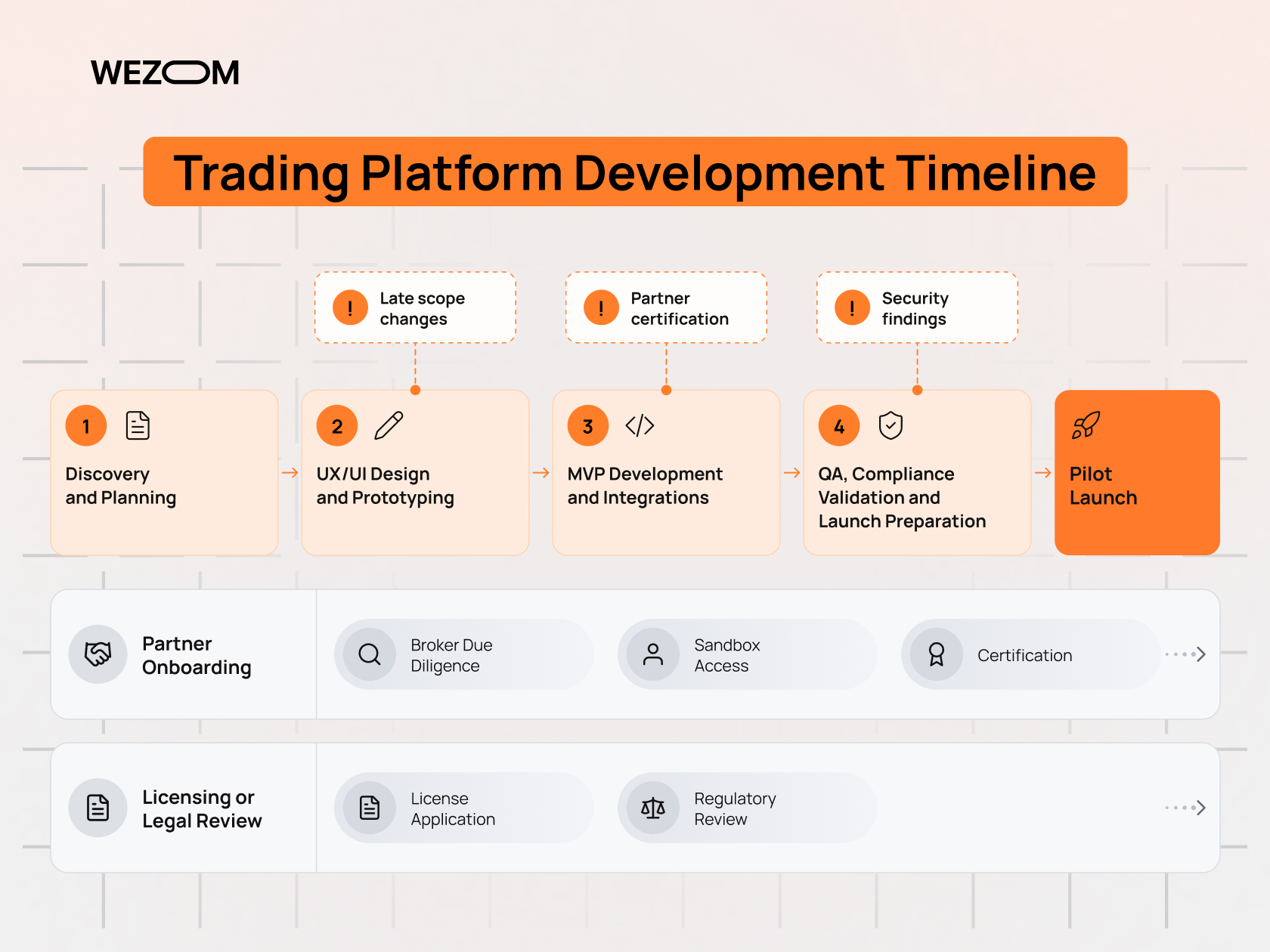
Discovery, business analysis, and technical planning
Discovery defines the business model, regulatory scope, partners, requirements, and architecture, and produces an estimated backlog. Its length depends on how many stakeholders and partners must agree and whether the legal analysis of licensing is already settled.
UX/UI design and interactive prototyping
Design covers user flows, a design system, and clickable prototypes tested with target users. Prototypes validate order confirmations, error states, and the placement of required disclosures before backend work depends on them.
MVP development and third-party integrations
This is the longest phase: the domain core, client apps, and integrations are built here. Partner onboarding often sets the pace, because broker due diligence, sandbox access, and certification follow the vendor's schedule rather than the project's.
Quality assurance, compliance validation, and launch preparation
Functional, performance, security, and certification testing is followed by compliance review, operational readiness checks, and a pilot launch. If the company is applying for its own license, regulatory approval runs on a separate track that can take longer than development itself.
Factors that can extend the trading software development timeline
Delays usually come from a change in licensing strategy midway through the project, slow partner certification, unclear handling of edge cases such as corporate actions, poor data quality during migration, and security findings discovered late. Freezing MVP scope and starting partner and legal work during discovery reduces this risk.
Custom Trading Software Development vs. Off-the-Shelf Solutions
Advantages of custom trading software development
Custom trading software development gives the business full control over workflows, data models, user experience, and the release roadmap. It can support unusual asset classes or strategies, integrate deeply with internal systems, and avoid per-user license fees as the client base grows.
Limitations of white-label and ready-made trading platforms
White-label platforms launch quickly but share their feature set with every other client of the vendor, restrict customization to configuration and branding, and tie the operator to the vendor's pricing, roadmap, and hosting. A vendor outage or regulatory problem directly affects the operator's customers.
Comparing flexibility, time to market, scalability, and total cost of ownership
The trade-offs are easier to judge side by side, since each option is cheaper on one axis and more expensive on another.
| Factor | White-label or off-the-shelf | Custom development |
|---|---|---|
| Time to market | Short: configuration and branding | Longer: design, build, and certification |
| Flexibility | Limited to vendor configuration | Workflows and data model built to requirements |
| Scalability | Bounded by vendor architecture and pricing tiers | Designed for the expected load profile |
| Total cost of ownership | Lower upfront, recurring license and per-user fees | Higher upfront, lower marginal cost at scale |
| Differentiation | Similar to other vendor clients | Unique features and user experience |
When custom development delivers greater long-term business value
Custom development pays off when a proprietary workflow is the competitive advantage, when license fees would scale steeply with users or assets, when integration needs exceed what vendors expose, or when data residency and control are mandatory. Custom investment management software is also justified for firms whose investment process cannot be expressed through a vendor's model portfolio structure.
Common Challenges in Trading Platform Development
Managing real-time data accuracy and execution latency
Market data feeds deliver out-of-order messages, gaps, stale quotes, and bad ticks. Platforms need sequence checking, gap recovery, stale-price detection, and price sanity checks before data drives orders or margin calculations. Latency has to be measured end to end, because the bottleneck is often a database write or a synchronous service call rather than the network.
Ensuring platform stability during high-volume trading periods
Market opens and volatility spikes can multiply traffic within seconds. Load tests with replayed peak data, autoscaling for stateless services, backpressure on market data fan-out, and graceful degradation, such as lowering chart update frequency before order flow is affected, keep core functions available.
Connecting multiple exchanges, brokers, and liquidity providers
Each venue has its own symbology, order types, FIX dialect, trading hours, and failure modes. An adapter layer that normalizes them into an internal model, combined with smart order routing and per-venue circuit breakers, keeps exchange connectivity manageable as new venues are added to the securities trading infrastructure.
Maintaining security and compliance across different jurisdictions
Rules on onboarding, leverage, crypto, data residency, and reporting differ from country to country. A configurable rules layer that applies jurisdiction-specific limits, disclosures, and workflows avoids maintaining a separate codebase for each market.
Designing an intuitive interface for complex investment workflows
Professional users want dense information, while beginners need guidance and guardrails. Progressive disclosure, sensible defaults, explicit confirmations, and separate modes for novice and advanced users let one platform serve both groups without hiding risk.
Balancing advanced functionality with development costs
Each new asset class or order type multiplies testing and support effort. Ranking features by user value and regulatory impact, and measuring actual usage after release, prevents a costly long tail of rarely used functions.
How to Choose Trading Software Developers for Your Project
Technical expertise required for financial software development
Financial software development calls for event-driven and distributed systems design, secure coding, exact numeric handling with decimal types rather than floating point for money, ledger and reconciliation logic, FIX and broker APIs, and cloud infrastructure with strong observability. Trading software developers should be able to explain how their designs behave during partial failures.
Evaluating experience with trading platforms and portfolio management systems
Ask for relevant projects, architecture samples, and client references, and check whether the team has worked with brokers, custodians, market data vendors, and compliance processes rather than only consumer fintech apps. Prior work in capital markets technology shortens discovery.
Questions to ask a trading software development company
A trading platform development company should give concrete answers to questions such as these:
- How do you design the ledger, and how are reconciliation breaks detected and resolved?
- Which brokers, data providers, and FIX engines has your team integrated?
- How do you test order state transitions, failover, and peak load?
- How are compliance controls and audit trails documented for examiners?
- Who owns the source code, and how is knowledge transferred at the end of the engagement?
Dedicated development team vs. outsourced development partner
A dedicated team works exclusively on the product under the client's direction, which suits long-lived platforms with evolving roadmaps. An outsourced partner delivering a fixed scope suits an MVP or a well-defined module.
What to include in a trading platform development proposal
A solid proposal states scope and assumptions, target architecture, technology stack, integrations, team composition, phases and milestones, testing and security approach, division of compliance responsibilities, estimates with identified risks, post-launch support terms, and provisions for IP ownership and knowledge transfer.
Future Trends in Trading and Investment Platform Development
AI-powered trading analytics and predictive market insights
Machine learning increasingly supports signal research, news sentiment analysis, surveillance, and personalized insights. Regulators apply existing conduct, conflict-of-interest, and suitability rules to AI-driven recommendations, so explainability and model governance are design requirements rather than optional extras.
Robo-advisors and automated portfolio optimization
Automated investment strategies are expanding from basic ETF allocation into direct indexing, automated tax-loss harvesting, and hybrid services that combine algorithms with human advisers. Platforms need rebalancing engines that scale across many personalized portfolios.
Fractional investing and personalized investment experiences
Fractional shares and dollar-based orders lower the entry point for retail investors and make recurring investment plans and highly personalized portfolios practical. The broker must aggregate fractional orders and track fractional positions, dividends, and corporate actions.
Tokenization and blockchain-based investment infrastructure
Tokenized money market funds, government bonds, and other real-world assets are being issued on public and permissioned blockchains, and frameworks such as MiCA and the EU DLT Pilot Regime are clarifying the rules. For platform builders, this means supporting digital asset custody, on-chain settlement, and reconciliation between blockchain records and traditional books.
Open finance APIs and cross-platform investment ecosystems
Open finance initiatives extend data sharing from bank accounts to investment and pension accounts, with the EU's proposed Financial Data Access (FIDA) regulation as one example. Platforms that expose and consume standardized APIs can aggregate holdings across providers and offer embedded investing inside non-financial apps.
FAQ
Can you build a trading platform without becoming a licensed broker?
Yes. Many platforms partner with a licensed broker-dealer or broker-as-a-service provider that opens accounts, holds assets, and executes and clears trades, while the platform provides the interface and features. Activities such as handling customer funds, giving personalized advice, or receiving transaction-based compensation can still trigger registration, so legal review is needed in each target jurisdiction.
What is the difference between a trading platform and a brokerage platform?
A trading platform is the software through which users analyze markets and submit orders. A brokerage platform is the regulated business and infrastructure that maintains accounts, custody, clearing, and compliance. A trading platform can also be independent software connected to one or several brokers.
Can a trading platform support stocks, ETFs, options, and cryptocurrencies simultaneously?
Technically yes, provided it has a multi-asset instrument model and a position engine that handles each asset class correctly. The regulatory and operational structure is the harder part: securities and crypto are often held by different legal entities or partners, with separate custody arrangements, disclosures, and investor protections, and the interface must make those differences clear.
How do trading platforms generate revenue?
Common models include commissions, spreads, subscription tiers, margin interest, interest on uninvested cash, securities lending, and fees for premium data or research. Payment for order flow is another source where permitted, but it faces growing restrictions, and the EU has moved to prohibit it.
Do you need direct stock exchange connectivity to launch a trading application?
No. Most retail applications route orders through a broker or clearing partner and obtain market data from a licensed vendor. Direct exchange membership requires licensing, capital, and certification, and suits mainly broker-dealers, market makers, and latency-sensitive institutions.
Can an existing investment management system be modernized without rebuilding it?
Often it can. Investment management software development for modernization typically wraps the legacy core in APIs, moves client portals and reporting to new services, replaces batch file exchanges with event streams, and then migrates modules such as performance or rebalancing one at a time. A full rebuild is justified when the core data model or ledger cannot support required asset classes or the necessary accuracy.
Who owns the source code and intellectual property in custom trading software development?
Ownership is determined by the contract. Typically the client receives full rights to the custom code after payment, while the vendor keeps rights to pre-existing libraries and grants a license to use them. Contracts should also cover open-source components, repository access, and knowledge transfer.
How can you validate a trading platform idea before investing in full-scale development?
Useful methods include customer interviews, clickable prototypes, a demo or paper-trading version on delayed data, and early conversations with broker and data partners about feasibility and costs. A narrow pilot with real accounts on a partner's infrastructure gives the strongest evidence.
