
Logistics processes in the oil and gas industry are complex. Consequently, standard systems often suffer from cascading failures – not least because they cannot proactively respond to changes within a distributed infrastructure. If you find yourself frequently halting operations worth millions of dollars, it’s time to rethink your approach to selecting gas route optimization software.
Why Oilfield Supply Chains Need Purpose-Built Logistics Software

Attempting to adapt standard logistics systems provokes blind spots in the business operations of companies in the oilfield and gas sector.
Coordinating Remote Oilfield Operations, Suppliers, Carriers, and Field Crews
The remote location of drilling sites creates a significant barrier to data synchronization. Specialized oilfield logistics software, however, can connect autonomous drilling rigs, transport contractors, field crews, and the operator in real time. This bridges the communication gap and allows for the coordination of loading windows based on site capacity limits.
Managing Drilling Materials, Equipment, Fuel, Water, Chemicals, and Spare Parts
The specific nature of transporting hazardous materials demands strict control over numerous aspects of the process. In this context, the system manages oilfield chemical specifications, monitors water and fuel levels at sites, and tracks the lifecycle of every unit of equipment, thereby preventing shortages of critical spare parts at the drilling rig.
Reducing Supply Chain Disruptions, Delays, and Logistics Costs
Downtime caused by logistical disruptions strains project budgets. From this regard, predictive oil and gas logistics analytics instantly identifies bottlenecks by modeling scenarios such as switching carriers or rerouting shipments, thereby minimizing the excessive costs associated with emergency freight.
Building Real-Time Visibility Across Upstream, Midstream, and Downstream Operations
The gas marketing and logistics software must collect and update data in real time, spanning the entire range from the wellhead to the trunk pipeline. To achieve this, developers must integrate disparate information streams at the software level, enabling operators to track the movement of assets from end to end. Thus, natural gas management software eliminates the risk of losing control over expensive equipment during relocation.
Main Capabilities of Oilfield Logistics Software
The architecture of gas allocation software must be designed in accordance with industry standards.
Oilfield Transportation Planning and Dispatch Management
The dispatch module must optimize the allocation of tanker trucks and specialized equipment. This process has to account for driver specialization, their current workloads, site-specific safety clearances (including for high-hazard facilities), and vehicle technical status.
Real-Time Fleet, Cargo, and Equipment Tracking
Combining satellite and cellular communication protocols in oil and gas logistics software enables continuous cargo location monitoring, even in remote extraction regions. This gives businesses comprehensive control over geofences.
Digital Field Ticketing, Proof of Delivery, and Load Management
Replacing paper-based paperwork, the digital system can handle the entire workflow – including digital field ticketing right at the rig site and the automated generation of Proof of Delivery records featuring secure timestamps and geolocation data.
Inventory, Warehouse, and Yard Management for Oil & Gas Operations
Specialized oil and gas transportation software manages the movement of technical assets – both at intermediate supply bases and drilling sites – ensuring accurate tracking of consumables and chemical reagents.
Route Optimization and Dynamic Scheduling
The algorithms take into account complex terrain, seasonal road capacity, bridge and vehicle weight limits, and regulations for oversized cargo transport. This enables the system to establish logistics corridors in real time.
Carrier, Contractor, and Vendor Management
If the system includes a contractor portal, it unlocks great capabilities for gas contract management, KPI tracking, as well as the automated verification of licenses and insurance coverage.
Logistics Cost Tracking, Billing, and Settlement Automation
The oil and gas industry is characterized by multi-level pricing structures (as they must account for hourly shifts, rates per tonne-kilometer, premiums for work in extreme climatic conditions, location-specific factors, etc.). Therefore, it’s crucial for gas marketing and logistics software to be capable of automatically generating invoices. This eliminates the human factor that leads to errors during the reconciliation of statements.
Gas Marketing and Logistics Software for Commercial Operations
Success in this niche requires end-to-end synchronization of trading operations. This is achieved through the implementation of oilfield logistics software which completely eliminates administrative delays.
Managing Gas Purchases, Sales, Contracts, and Transactions
The platform must perform oil and gas logistics automation of the commercial contract lifecycle, accommodating multi-level pricing formulas, hub index linkages, legal nuances, and more. This provides the legal department with a fully transparent contract portfolio.
Gas Nomination, Scheduling, and Allocation Workflows
Gas nomination management requires precision to avoid penalties for imbalances. In this context, a well-designed pipeline transportation software solution automates the submission of daily and intraday nominations to gas transmission system operators. It can also handle end-to-end gas delivery scheduling and volume allocation across locations.
Storage Capacity and Inventory Management
Effective oilfield inventory management is essential for seasonal arbitrage. Software solutions, in turn, can assist here by tracking available buffer/active capacity and managing injection and withdrawal schedules. The most advanced ones can also calculate the real-time value of stored gas inventories.
Physical Gas Trading, Pricing, and Exposure Management
In gas distribution software, the trading module consolidates market quotes and a company's specific logistics capabilities. It also provides traders with advanced tools for assessing price risks, managing open positions, as well as analyzing trade margins while accounting for all transportation costs.
Automating Reconciliation, Invoicing, and Settlements
Reconciling supply volumes using data from third-party sources often takes weeks. The system, in turn, must be designed to independently compare discrepancies and generate invoices based on accurate data (regardless of the complexity of tariff calculation formulas).
Connecting Gas Marketing Data With Physical Logistics Operations
Integrating commercial contracts with physical logistics aims to optimize the interaction between the sales department and the dispatching service. Specifically, gas transportation software must be capable of matching gas flows at facilities against contractual obligations in real time, thereby preventing over-delivery or unauthorized offtake.
Gas Transportation Software for Pipeline and Midstream Logistics
The management of midstream infrastructure and trunk-line transportation is always based on adherence to throughput capacity limits.
Pipeline Scheduling and Transportation Capacity Management
Planning the operation of trunk pipelines requires precise reservation of capacity for shippers. Gas transportation software must also be capable of automatically generating flow schedules for various segments of the gas transmission network.
Gas Nominations, Confirmations, and Balancing
The real-time logistics tracking system must automate the process of reconciling nominations with operators. Advanced solutions can also verify confirmed volumes and monitor the physical gas balance in the pipeline in real-time to prevent emergency situations.
Transportation Contracts, Tariffs, and Capacity Tracking
Accounting for transportation contract terms typically relies on sophisticated tariff structures and requires complex calculations involving fixed capacity and variable volume components. Additionally, companies can benefit from the ability to monitor the utilization rates of reserved capacity limits.
Gas Measurement, Allocation, and Operational Data Management
SCADA integration enables operators to instantly analyze data on pressure, temperature, gas composition, and flow rates. Some systems also perform mathematical volume allocation among consumers.
Pipeline Monitoring and Transportation Exception Management
Real-time pipeline condition monitoring helps operators detect parameter deviations and any abnormal situations at compressor stations, thereby minimizing the risk of transport disruptions.
Improving Visibility Across Gathering, Processing, Storage, and Transmission
End-to-end analytics integrated into the gas storage management software must consolidate data from field sites, processing plants, storage facilities, and trunk pipelines into a unified environment.
Gas Distribution Software for Last-Mile Delivery Operations
Last-mile logistics for compressed/liquefied/petroleum gases, as well as industrial gases in cylinders, require specialized algorithms in gas balancing software; the specific tasks these address are outlined below.
Gas Delivery Scheduling and Dynamic Route Optimization
Routing algorithms factor in cargo specifics, customer delivery windows, specialized vehicle capacities, road restrictions, and other variables to generate the most cost-effective and fastest delivery routes.
Bulk, Cylinder, LNG, LPG, and Industrial Gas Distribution
These algorithms in gas distribution software account for the variability of delivery conditions: bulk gas delivery to storage tanks via tanker trucks, the circulation of heavy high-pressure cylinders, cryogenic liquefied natural gas transport (including boil-off gas management), and more.
Real-Time Driver, Vehicle, and Delivery Tracking
GPS fleet tracking algorithms handle satellite oilfield fleet management and the tracking of safety parameters for tanker trucks. These algorithms also integrate deeply with fuel level sensors and vehicle-based sensors to track trip status in real-time and oversee delivery to end customers.
Demand Forecasting and Customer Replenishment Planning
These supply chain optimization algorithms handle predictive analytics for customer inventory levels by autonomously analyzing tank telemetry and historical consumption data. This enables oil and gas supply chain software to automatically schedule routine refills without dispatcher intervention.
Proof of Delivery and Mobile Driver Applications
Mobile applications for drivers within comprehensive gas logistics software automate the gas acceptance process at the client's site. They enable electronic signatures, meter reading capture, photo documentation, the generation of deal-closing documents, and a range of other related tasks.
Managing Seasonal Demand and Emergency Gas Deliveries
Peak winter loads or urgent requests for unscheduled deliveries are handled by algorithms capable of automatically reallocating fleet resources and adjusting schedules based on client prioritization.
Managing Complex Oil & Gas Supply Chains From a Single Platform
Managing energy supply chains requires shifting from fragmented databases to a unified, centralized environment updated in real time.
Procurement and Supplier Coordination
The gas delivery management software must centralize the procurement of equipment and chemical reagents, streamlining vendor interactions and overseeing the fulfillment of contractual obligations.
Material Requirements Planning for Drilling and Production Sites
Material requirements planning must account for drilling schedules, well depths, geological rock characteristics, extraction rates, and numerous other parameters to effectively prevent both component shortages and the tying up of capital in inventory.
Multi-Site Inventory and Stock Replenishment
The oil and gas warehouse management system must manage distributed inventory across intermediate supply bases and well-cluster sites. It also automatically generates stock replenishment requests when inventory levels hit predefined thresholds.
Transportation Management Across Road, Pipeline, Marine, and Rail
This oilfield equipment tracking software component manages multimodal logistics, integrating road transport for remote routes, pipeline transport, and other modes (maritime, rail, etc.).
Offshore and Onshore Oilfield Logistics Management
Onshore and offshore operations entail distinct logistical requirements; therefore, the transportation management system for oil and gas must be capable of optimizing schedules for offshore support vessels, helicopter links to platforms, and land-based transport fleets.
Control Tower Visibility for Energy Supply Chain Operations
The logistics control tower must ensure visibility of all logistics flows and the real-time location of physical assets across the entire company.
Oilfield Logistics Automation and Real-Time Data

Automation and integration of sensor data in energy trading and risk management software minimize the risk of delays.
Automated Dispatching and Load Assignment
Dispatching involves allocating transport requests based on vehicle availability, load capacity, driver qualifications and schedules, as well as clearances for hazardous sites.
GPS, Telematics, IoT, and Geofencing Integration
Integrating GPS trackers with onboard telematics and IoT sensors on tanker trucks enables dispatchers to monitor vehicle movement parameters and verify cargo integrity.
Predictive Analytics for Demand, Capacity, and Delivery Planning
Predictive models analyze historical data and drilling schedules. This is essential for forecasting peak loads and preventing logistical bottlenecks.
Automated Alerts for Delays, Shortages, and Logistics Exceptions
Dispatchers must be able to receive real-time notifications regarding schedule deviations, supply shortages at sites, and other force majeure events.
AI-Powered Route Planning and Supply Chain Optimization
AI algorithms must be capable of planning routes that account for the complex terrain of deposit sites and the weight limits of bridges.
KPI Dashboards and Oil & Gas Logistics Analytics
Analytical dashboards must be capable of visualizing KPIs for the entire vehicle fleet and logistics costs for each project.
Integrating Oil & Gas Logistics Software With Enterprise Systems
The highest efficiency can be achieved through the seamless integration of logistics processes with the company's IT architecture.
ERP Integration With SAP, Oracle, Microsoft Dynamics, and Other Platforms
For your company’s oil and gas inventory management platform, developers must implement the oil and gas ERP integration to synchronize transactions and ensure the traceability of inventory and materials.
Connecting Transportation Management Systems and Warehouse Management Systems
Developers must integrate the oilfield route optimization platform with transportation and warehouse management systems. This automates the entire cycle of warehouse processing and subsequent cargo delivery.
SCADA, ELD, GPS, Telematics, and IoT Integration
Integration with industrial SCADA systems, electronic logbooks, and oil and gas IoT solutions is also crucial to ensure that production and logistics data do not exist in silos.
Accounting, Billing, and Financial System Integration
The automated transfer of electronic waybills and certificates of completion to financial modules accelerates estimations and eliminates manual data entry errors.
API and EDI Connectivity Across the Oil & Gas Supply Chain
APIs and electronic data interchange standards ensure secure information exchange with counterparties.
Creating a Unified Data Environment for Logistics and Operations
The creation of a unified digital environment eliminates time costs associated with the transfer of information between departments and contractors.
Compliance, Safety, and Risk Management in Oil & Gas Logistics
Adhering to environmental and industrial safety standards without disrupting business continuity is a priority for oil and gas supply chain visibility.
HSE Compliance and Digital Documentation
The oilfield load management system must automatically monitor compliance with occupational health, industrial safety, and environmental protection standards.
Driver Safety and Fleet Compliance Management
Monitoring compliance with driver work and rest schedules, medical examinations, and the technical condition of the vehicle fleet is mandatory.
Chain of Custody and Audit-Ready Logistics Records
Strict chain-of-custody control for hazardous materials is essential for ensuring the company is prepared for any audit.
Hazardous Materials Transportation Management
Automated compliance with ADR regulations during the transport of petroleum products prevents the majority of operational incidents.
Regulatory Reporting and Data Traceability
The oilfield dispatch software platform must automatically generate reports for government supervisory bodies, enabling the traceability of every kilogram of transported resource.
Supply Chain Risk and Business Continuity Management
Risk management tools must also be provided in your oilfield trucking software, as they are responsible for modeling supply chain disruption scenarios and ensuring business continuity.
Business Benefits of Oilfield Logistics Software
Optimizing logistics processes with the gas pipeline management software yields commercial benefits at every stage of the supply chain.
Lower Transportation and Field Logistics Costs
Real-time route optimization, consumption monitoring, as well as the reduction of empty runs and operational downtime significantly lower the costs of transporting equipment and chemical reagents to remote locations.
Faster Dispatch-to-Invoice Cycles
Moving from paper waybills to mobile electronic tickets within the pipeline scheduling software accelerates the delivery confirmation process, thereby reducing accounts receivable and speeding up capital turnover.
Higher Fleet and Asset Utilization
Automated dispatch and predictive maintenance algorithms implemented in the oil and gas fleet management software maximize the utilization rates of vehicle fleets and oilfield equipment.
Reduced Manual Data Entry and Administrative Work
Integrating field data with corporate systems enables end-to-end automation of routine tasks, eliminating the human factor.
Better Inventory Availability and Fewer Operational Delays
End-to-end monitoring of inventory levels at intermediate depots prevents material shortages, ensuring uninterrupted operations.
Greater Supply Chain Visibility and Decision-Making Accuracy
Real-time dashboards in gas nomination software enable dispatchers to make informed operational decisions based on verified data.
How to Choose Oil & Gas Logistics Management Software
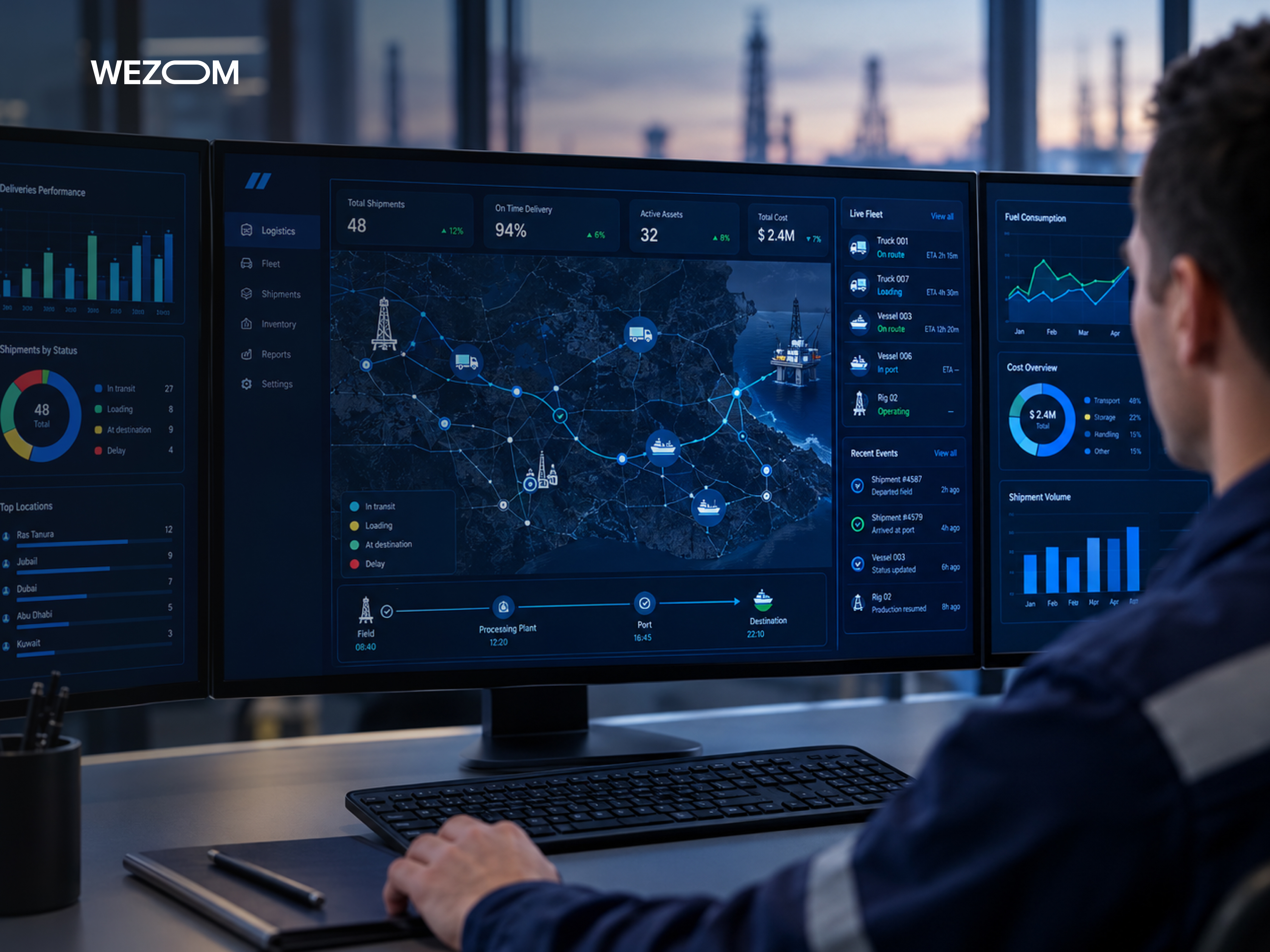
Selecting a software solution for oil and gas transportation management requires adherence to industry standards, as well as accounting the following aspects.
Essential Features for Oilfield and Gas Logistics Operations
The gas capacity management platform must include modules for dynamic routing that accounts for field terrain, electronic document management, hazardous cargo tracking, and integration with field sensors.
Cloud-Based vs. On-Premise Energy Logistics Software
While cloud-based SaaS natural gas logistics solutions offer rapid deployment and easy access for remote locations, on-premise gas supply management software remains relevant when strict corporate data isolation is required.
Scalability for Multi-Site and Multi-Region Operations
The oilfield supply chain software architecture must support scalability (including the addition of new oil and gas fields and the onboarding of hundreds of new third-party contractors) without compromising performance.
Integration and API Requirements
It is essential to ensure the natural gas transportation management system includes open APIs and connectors for integration with ERP systems, as well as SCADA, financial, and other modules; all of this is necessary to create a unified digital ecosystem.
Mobile and Offline Functionality for Remote Field Operations
Since gas production facilities are often located outside cellular network coverage areas, mobile applications must be capable of operating offline and independently handling subsequent data synchronization.
Custom Oil & Gas Logistics Software vs. Off-the-Shelf Platforms
While off-the-shelf energy supply chain management solutions are generally suitable for standard tasks, custom gas scheduling software development remains the optimal choice for vertically integrated holdings with unique business processes.

FAQ
How much does custom oilfield logistics software cost?
This depends on the scale of the specific company's infrastructure, the number of systems to be integrated, the complexity of business processes, information security requirements, and specific industry standards; therefore, such complex projects are assessed individually following an infrastructure audit by the development team.
How long does it take to implement an oil and gas logistics management system?
Implementing an MVP for gas trading and logistics typically takes 3-5 months, depending on data readiness, the need for integration with legacy systems, the scale of deployment, and other factors. Developing a full-scale energy logistics software solution, however, can take nine months or longer.
Can oilfield logistics software work offline at remote drilling sites?
Yes, because as part of the oil and gas logistics digital transformation process, developers can create mobile clients for field personnel for these tasks. They support offline operation, storing data on the device and then transmitting it to the server when a connection is available.
What cybersecurity requirements should gas logistics software meet?
The oilfield supply chain management software must comply with regional standards for critical information infrastructure protection, utilize end-to-end data encryption, and have a role-based access model. We also maintain secure audit logs in such projects.
Can one platform manage both oilfield logistics and natural gas operations?
Yes, such oil and gas logistics management platforms exist, but they are typically custom projects. They integrate upstream oilfield logistics, natural gas trading, and trunk pipeline transportation.
How can legacy oil and gas systems be migrated to a modern logistics platform?
Migration from the legacy oilfield transportation software should be implemented in stages to ensure security and minimize downtime. First, the team builds intermediate API gateways, then migrates historical data (while also testing new modules), and only then does the isolation of legacy tools occur.
What data should be tracked to measure oil and gas logistics performance?
The most indicative metrics for a gas distribution management system are the percentage of on-time deliveries, the fleet utilization rate, the cost per tonne-kilometre, the frequency of logistics failures, and the speed of dispatch cycle closure.
